
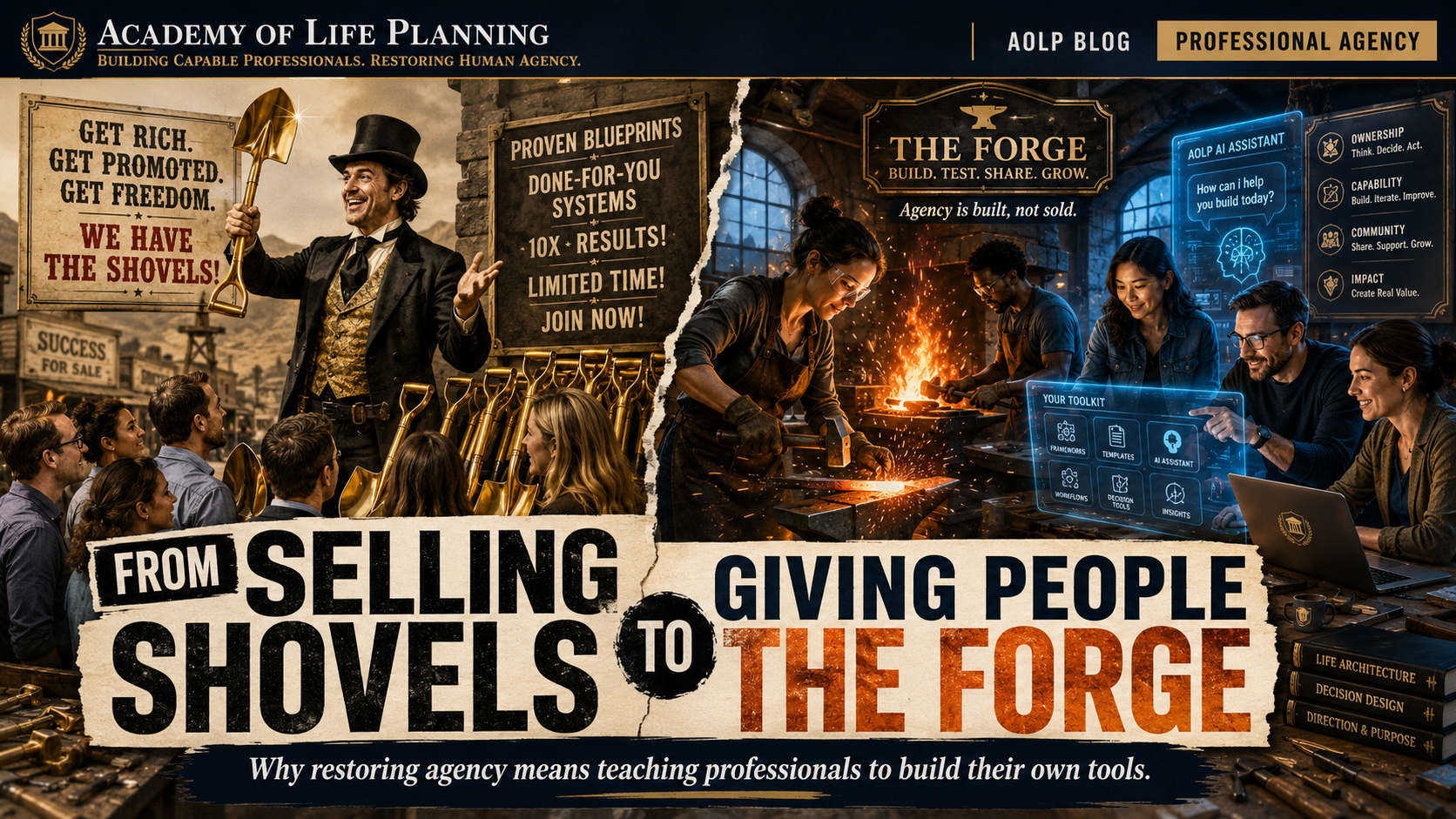
Most professional academies make the same promise.
They identify the professional’s dream of freedom, success and independence, then sell them the tools they supposedly need to reach it.
A business model.
A marketing system.
A coaching framework.
A qualification.
A secret formula.
The message is familiar:
You can build the practice you want—but only if you follow our method.
The academy becomes the gatekeeper to the professional’s ambition.
It sells the shovel, teaches the approved digging technique and, in many cases, charges rent for the right to keep using the title, framework or methodology.
The professional may become more successful.
But they may also become more dependent.
At the Academy of Life Planning, we are trying to build something fundamentally different.
We do not want professionals to remain dependent on the Academy.
We want them to become capable of designing a better tool, choosing a different mine—or starting an academy of their own.
The familiar gold-rush model
During a gold rush, the people who reliably make money are often not the miners.
They are the people selling the shovels.
The same pattern appears across professional education, coaching and business development.
The professional has a dream: to build a successful practice, earn a sustainable livelihood and do meaningful work.
The academy packages the route.
It may sell training, intellectual property, certifications, templates, coaching, software, lead-generation systems or ongoing membership.
Some of those resources may be genuinely useful.
The problem is not that money changes hands.
The problem arises when the business model depends on the professional continuing to believe:
I cannot succeed without this organisation.
That is not agency.
It is dependency wearing the clothes of professional development.
Giving away the shovel is not enough
There is a more generous model.
Instead of withholding knowledge, the academy gives the professional the tools.
It shares the frameworks, apps, intellectual property and working methods needed to build a successful practice.
That is better.
But it still leaves an important question unanswered.
Who designed the shovel?
Who decided that digging was the right activity?
Who defined the gold?
Giving someone a tool is valuable, but it may still direct them towards somebody else’s model of success.
Agency goes further.
Agency means understanding how the tool works.
It means being able to adapt it, challenge it and replace it.
It means being able to decide that digging is not the answer at all.
Perhaps the better approach is panning.
Perhaps the mine is in the wrong place.
Perhaps the thing everyone is calling gold is not what you value.
The destination is therefore not merely access to tools.
It is tool-making capability.
The five stages of professional agency
The progression looks like this:
- The Academy digs for you.The professional depends on the Academy to provide the method, answers and direction.
- The Academy teaches you how to dig.The professional learns the process but still works largely within the Academy’s prescribed model.
- The Academy gives you the shovel.The professional receives the frameworks, apps, intellectual property and practical resources required to act independently.
- The Academy helps you decide whether digging is even the right activity.The professional develops the judgement to question the method, redefine the problem and choose a different approach.
- Full capability allows you to design a better tool, choose a different mine—or start your own Academy.
This final stage is the real purpose of professional development.
Not continued loyalty.
Not permanent dependency.
Not lifelong rent paid to the creator of the framework.
Capability.
The Academy gives the planner agency
The Academy of Life Planning follows the same principle in its relationship with professionals that it promotes in the relationship between planners and clients.
We believe individuals should become more capable through planning.
We believe professionals should become more capable through professional development.
The principle is consistent:
The success of the relationship should be measured by the capability left behind.
That is why the Academy does not simply build apps for planners.
We show planners how to build their own.
We do not simply hand over frameworks.
We help professionals develop frameworks from their own experience, purpose and unique contribution.
We do not simply offer a ready-made business model.
We help planners build businesses around open intellectual property, personal values and the needs of the communities they serve.
The purpose is not to turn every professional into a smaller copy of the Academy.
It is to help them become more fully themselves.
What the Academy gives away
The Academy provides members with the resources required to build an agency-centred professional practice.
That includes:
- planning frameworks;
- practical tools and apps;
- working methods;
- open intellectual property;
- business-model thinking;
- marketing concepts;
- professional education;
- examples from other practices;
- access to an evolving body of knowledge.
These resources are not withheld to create artificial scarcity.
They are shared because capability grows when knowledge circulates.
The Academy charges for something different.
It charges for human support where human support adds real value.
What professionals pay for
Professionals do not primarily pay the Academy for access to secret knowledge.
They pay for support through periods of complexity, stress and change.
That might include:
- navigating regulatory uncertainty;
- responding to rapid developments in AI;
- managing financial pressure;
- launching a new practice;
- changing an existing business model;
- clarifying positioning;
- developing a proposition;
- solving a difficult client or operational problem;
- regaining confidence during a demanding transition.
Support can be accessed at different levels:
- remote, on-demand guidance;
- peer-support groups;
- one-to-one mentoring;
- personalised business-development support.
The level of support can increase or decrease according to need.
A professional may move from one-to-one support to peer support.
From peer support to remote support.
From remote support to complete independence.
And, when circumstances change, they may return.
There is no failure in returning.
Agency does not mean never needing help.
It means retaining the authority to decide when help is useful.
The inner circle is for transition, not forever
Many professional communities build prestige around the inner circle.
The closer you are to the founder, the more you pay.
The longer you remain, the more committed you appear.
The Academy takes a different view.
The inner circle of personalised support exists for transition.
It is not intended to become a permanent professional home from which nobody graduates.
Professionals need intensive support when circumstances are complex, stressful or changing.
Once the transition is complete, the support should reduce.
The Academy’s job is not to make membership indispensable.
It is to make the professional increasingly capable of operating without it.
That is why membership should last for as long as it is helpful.
Not for as long as the Academy can persuade someone to continue paying.
Fair pricing without manufactured dependency
The Agency Network model is built around fair and proportionate support.
One-to-one support is delivered at a level of cost that many other academies charge merely for peer-group access.
The purpose is not to maximise the lifetime value extracted from each member.
It is to make meaningful support available when it is needed, while keeping the pathway to independence open.
This creates a very different commercial logic.
The Academy succeeds not when members remain dependent forever, but when they:
- establish their practices;
- become confident in their methods;
- develop their own intellectual property;
- create their own tools;
- build sustainable businesses;
- leave when they no longer need support;
- return when new complexity or change makes support valuable again.
This is not a funnel.
It is a network.
Accreditation without rent
The same principle applies to accreditation.
GAME Plan practitioner accreditation is not dependent on continuing to pay the Academy for compulsory ongoing CPD.
Once the accreditation has been earned, it belongs to the practitioner for life.
There is no recurring rent required to retain the title.
That matters.
A qualification should represent capability achieved.
It should not become a licence leased indefinitely from the organisation that awarded it.
The Academy may continue to offer new learning, new tools and new methods.
But participation should be based on relevance and value—not fear of losing status.
Learning together in an age of change
None of this means professional learning ever ends.
We are living through a period of rapid change in AI, apps, agents and new forms of professional practice.
As the Academy learns and develops, its members learn and develop with it.
During periods of significant change, membership makes sense.
Professionals benefit from:
- shared experimentation;
- pooled learning;
- peer challenge;
- collective problem-solving;
- new tools;
- new methods;
- practical interpretation of emerging technology.
But once something has been learned, it belongs to the professional.
The Academy does not own the capability it has helped create.
The planner does.
Alumni are evidence of success
A large number of successful firms now operate independently of active Academy membership.
Accredited GAME Plan practitioners have gone on to build and develop their own practices, including Suitable Life, Pecunia FP, Gerrards Wealth, AAB Wealth, TT Wealth, Pyrmont Wealth, Goal Chi Capital, HVFP, Money Matters, Wealth & Tax, and others.
Academy alumni—GAME Plan practitioners who are no longer active members—account for around a third of all graduates.
A conventional membership business might see this as lost revenue.
We see it differently.
It is evidence that the model worked.
People came for support.
They developed capability.
They built businesses.
They became independent.
Some later return when market conditions, personal circumstances or business transitions create a new need for focused support.
That is how an agency network should work.
Support is available.
Dependency is not required.
As with clients, so with planners
The Academy’s philosophy cannot stop at the client.
It would be inconsistent to argue that planners should restore agency to individuals while the Academy creates dependency among planners.
The method must reflect the message.
If we believe clients should understand, choose and act independently, then professionals should be supported to do the same.
If we believe financial planning should leave capability behind, professional education should leave capability behind too.
If we believe experts should become progressively less necessary to clients, the Academy should become progressively less necessary to its members.
That is the signature.
As with clients, so with planners.
From selling shovels to giving people the forge
The traditional academy sells the shovel.
A better academy gives the shovel away.
An agency-centred academy gives professionals access to the forge.
It helps them understand how tools are made.
It encourages them to adapt the tools, challenge the assumptions behind them and create better ones.
It gives them permission to reject the mine entirely.
That is why the Academy does not merely build apps.
We show planners how to build apps.
We do not merely give professionals intellectual property.
We help them create their own.
We do not ask them to remain followers.
We help them become founders.
The final stage of professional capability is not becoming the Academy’s best student.
It is no longer needing the Academy at all.
The adviser digs for the client.
The coach teaches the client how to dig.
The Academy gives them the shovel.
Agency helps them decide whether digging is the right activity.
Full capability allows them to design a better tool—or choose a different mine.
The same must be true for the professional.
The Academy gives the planner agency.
And, when the model has done its job, the planner is free to leave the forge and build one of their own.
Enter the Forge
The final stage of professional capability is not becoming the Academy’s best student.
It is no longer needing the Academy at all.
That is why we created The Agency Forge.
The Agency Forge is an eight-week live online programme for professionals who want to build AI-powered tools that leave people more capable.
You do not need to be a developer.
You do not need to know how to code.
You need a problem worth solving, a willingness to experiment and a desire to create something that restores agency for the people you serve.
Over eight weeks, you will identify the dependency, define the capability, design the user journey, build the app, test it with real people and prepare it for launch.
Do not wait for somebody else to build the tool your clients need.
Build it yourself.
The founding cohort is limited to 10 places at the special price of £495.
The programme begins on Tuesday 8 September 2026.
Bookings close at 5:00 pm on Friday 14 August 2026, or earlier when all places are taken.
Eight weeks. Ten builders. Ten working tools that replace dependency with agency.
Join The Agency Forge and build the tool your community needs.

