
Many financial planners can now see the bridge.
Behind them is the familiar professional model.
Products. Platforms. Assets under management. Ongoing servicing. Regulatory process. Advice built around the assumption that the professional remains permanently in the middle.
Ahead is something less certain—but potentially far more valuable.
An independent, future-ready practice built around human agency.
A practice that does not simply tell people what to do.
A practice that helps them understand, choose and act for themselves.
A practice that uses AI not to replace the planner, but to extend the planner’s ability to educate, activate and support more people.
Many professionals are now approaching that bridge of transition.
They know the old model no longer fully fits.
They can see that AI is changing how people find information, understand choices and make decisions.
They may want greater independence.
A clearer sense of purpose.
A business model built around genuine value rather than continuing intermediation.
But seeing the bridge is not the same as crossing it.
The question is:
What does a future-ready planning practice actually do?
From advice delivery to financial activation
Traditional financial advice often begins once the client has enough money, enough complexity or enough willingness to delegate.
That leaves too many people outside the system.
They may have pensions, savings, careers, businesses, families and important decisions to make.
But they are not yet “advice ready”.
They may be uncertain.
Disorganised.
Lacking confidence.
Unable to see the connection between their life, their money and the choices in front of them.
They do not necessarily need someone to take control.
They need to become financially activated.
By financial activation, I mean helping someone move from passive awareness to informed action.
They begin to understand their position.
They clarify what matters.
They organise the information.
They recognise the decision.
They identify the next step.
They act.
That is a different professional outcome from merely delivering a recommendation.
It is the creation of decision capability.
The future-ready planner builds capability
The future of planning will not be won by the professional who hoards the most knowledge.
AI is making knowledge easier to access.
It will not be won by the professional who performs the most calculations.
Technology will increasingly perform those calculations instantly.
And it will not be won by the professional who remains indispensable by keeping the client dependent.
That model will become harder to justify.
The future-ready planner will create the conditions in which people can make better decisions.
They will combine:
- human judgement;
- structured planning;
- accessible education;
- practical tools;
- AI support;
- proportionate professional intervention.
Their value will not rest on remaining permanently between the person and the decision.
Their value will rest on helping the person become capable of moving forward.
That is the shift from advice delivery to agency restoration.
But where do the tools come from?
This is where many planners become stuck.
They can see the opportunity.
They may have a distinctive process, area of expertise or client problem they understand deeply.
They may repeatedly think:
There ought to be an app for this.
An app that helps clients prepare properly before a meeting.
An app that helps someone understand their retirement choices.
An app that turns scattered life and financial information into a clear structure.
An app that helps business owners understand their human capital.
An app that helps families organise estate information.
An app that helps people see the financial consequences of a life decision.
An app that helps a particular community move from confusion to action.
In the past, building such tools required developers, substantial budgets and long implementation projects.
That barrier is falling.
AI now allows professionals with no previous development experience to design and build practical applications from their own knowledge.
The planner no longer has to wait for a software company, platform provider or professional institution to decide that the problem is worth solving.
They can build it themselves.
Do not wait for somebody else to build your future
Most professionals use tools created by somebody else.
The software reflects somebody else’s assumptions.
The workflow follows somebody else’s process.
The business model serves somebody else’s commercial interests.
That may be necessary at the beginning.
But full professional capability goes further.
It allows you to ask:
- What do my clients actually need?
- Where do they become stuck?
- What dependency could I remove?
- What part of my expertise could become accessible before a meeting?
- What could a client understand or do without waiting for me?
- Where would human support still add genuine value?
- What tool would reflect my own philosophy of planning?
This is not simply about becoming more efficient.
It is about turning your professional insight into agency infrastructure.
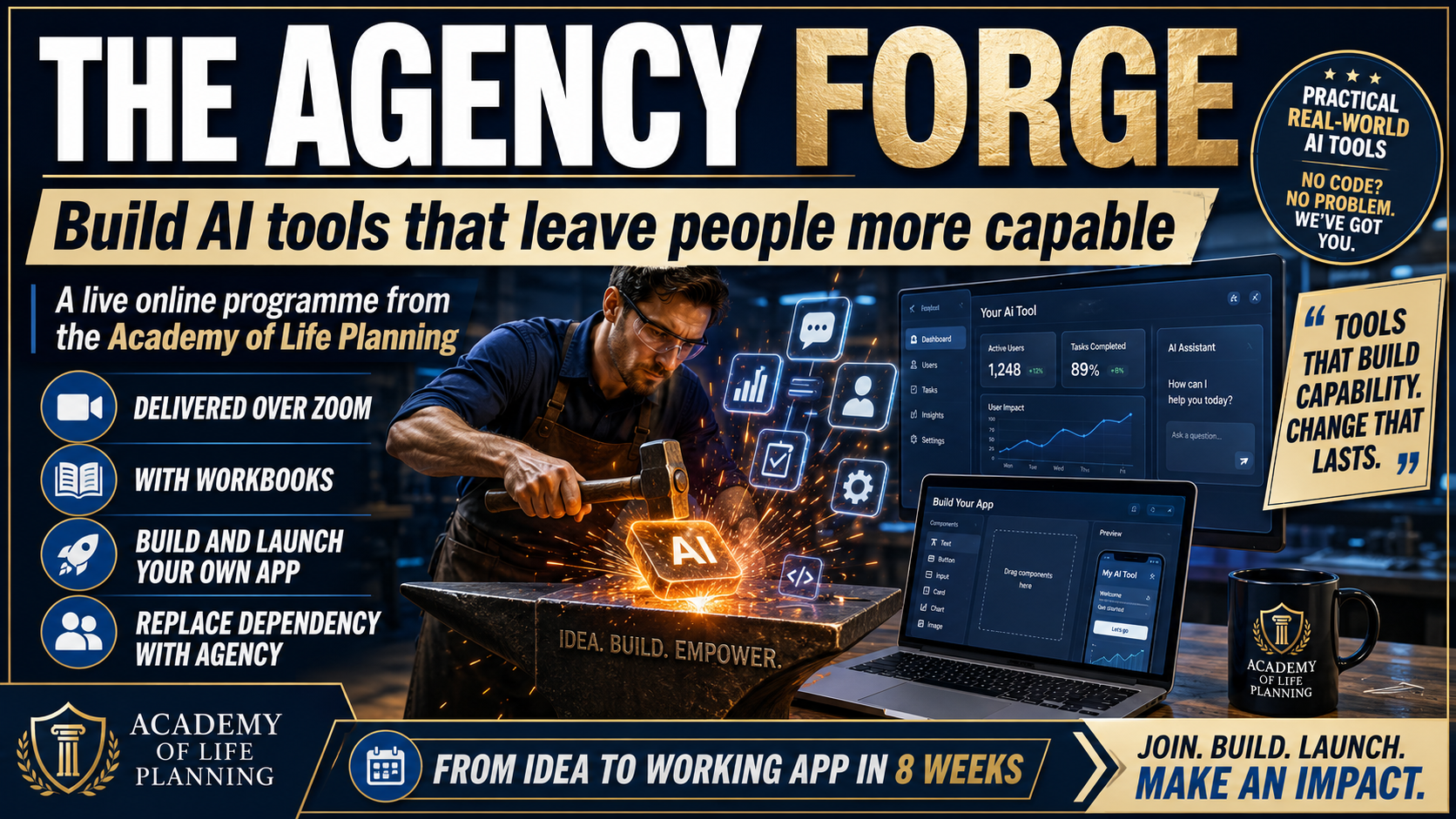
Introducing The Agency Forge
The Agency Forge is an eight-week live online programme for planners and other professionals who want to build and launch AI-powered apps that leave people more capable.
It is designed for those approaching the bridge of transition.
Those who want to build an independent practice.
Those who can see that the future of planning will involve a different relationship between professionals, clients and technology.
Those who do not merely want to use the next generation of tools.
They want to help create it.
No previous app-development experience is required.
You do not need to know how to code.
You do not need a finished app idea.
You need a real problem worth solving and a desire to create something that restores agency for the people you serve.
What might your app do?
Let your imagination run beyond the conventional financial-planning process.
Your app might help a person:
- understand where their money currently goes;
- organise their life and financial information;
- clarify their goals before seeking advice;
- assess their readiness for retirement;
- explore the effect of different life choices;
- understand a pension statement;
- prepare questions for a professional meeting;
- identify gaps in their financial resilience;
- record gifts and estate-planning information;
- recognise signs of financial exploitation;
- measure their human, social or financial capital;
- create an action plan from a complex decision;
- understand when professional support is genuinely needed.
The app does not need to replace the planner.
It may activate the person before they meet the planner.
It may improve the quality of the conversation.
It may help the client arrive better prepared, more confident and more engaged.
It may allow the planner to support people who would otherwise never access traditional advice.
It may become the beginning of a completely different business model.
Build around your own professional identity
A future-ready independent practice should not be a copy of another adviser’s firm.
It should grow from the practitioner’s own combination of:
- experience;
- values;
- specialist knowledge;
- personal purpose;
- client understanding;
- preferred way of working.
Your most valuable app idea may already be hidden inside the conversations you have every week.
The explanation you repeat.
The worksheet you keep recreating.
The question clients always struggle to answer.
The process you wish people had completed before they came to see you.
The decision that produces unnecessary anxiety because nobody has made it understandable.
These are not minor operational frustrations.
They may be the raw material for your future proposition.
The eight-week journey
During The Agency Forge, participants will move through the complete development process.
Week 1: Find the dependency
Identify the recurring problem and the reason people remain stuck or dependent.
Week 2: Define the capability
Specify what the user should be able to understand, choose or do after using the app.
Week 3: Design the experience
Map the questions, explanations, decision paths and outputs.
Week 4: Build the prototype
Use AI-assisted development tools to create a working browser-based app.
Week 5: Build for agency
Test whether the app transfers capability, preserves user control and communicates its limitations.
Week 6: Test with real people
Observe how prospective users interact with the app and where it needs to improve.
Week 7: Create a sustainable model
Decide how the tool will support your practice without monetising continued user dependency.
Week 8: Launch
Present the app, the problem it addresses and the capability it creates.
The aim is not to complete another course.
The aim is to leave with something real.
Agency-by-Design
Not every AI app restores agency.
Some merely create a new intermediary.
Some automate decisions without making the reasoning visible.
Some gather information while giving little useful capability back.
Some are designed to keep the user inside a commercial funnel.
The Agency Forge begins with a different standard.
An Agency-by-Design app should:
- help the user understand the issue;
- make assumptions and limitations visible;
- preserve the person’s authority over the decision;
- build confidence rather than dependence;
- allow the user to retain their information;
- clarify when human support would add value;
- leave the person more capable after using it.
The most important design question is not:
What can the app do?
It is:
What can the person do because the app exists?
A new route to independence
For planners approaching the bridge of transition, building an app can become more than a technology project.
It can help clarify your future business.
It can reveal the problem you are best placed to solve.
It can create a practical entry point for prospective clients.
It can demonstrate your professional philosophy before anyone pays for your time.
It can allow people to experience value without surrendering control.
It can separate your business from firms still competing through products, investment propositions or generic promises of lifestyle freedom.
Most importantly, it can help you build an independent practice around something you own.
Your knowledge.
Your process.
Your intellectual property.
Your client experience.
Your app.
Your relationship with the people you serve.
That is a very different form of independence from simply leaving one institution and recreating the same model elsewhere.
Cross the bridge by building
There is a temptation to wait until the future becomes clearer.
To wait for regulation to settle.
For AI platforms to mature.
For clients to ask directly.
For somebody else to prove the model.
But transitions rarely become clear from the side of the bridge you are trying to leave.
Clarity often arrives through building.
You create a prototype.
You place it in front of people.
You see what helps.
You discover what they misunderstand.
You refine the idea.
Your future practice begins to reveal itself.
The Agency Forge is intended to support that process.
Not by handing you another secret formula.
Not by making you dependent on the Academy.
But by helping you develop the capability to build your own tools, your own proposition and your own future.
Join the founding cohort
The first Agency Forge cohort is limited to 10 participants.
The founding price is £495.
The programme begins on Tuesday 8 September 2026 and runs for eight weeks, finishing on Tuesday 27 October 2026.
Bookings close at 5:00 pm on Friday 14 August 2026, or earlier when all ten places are taken.
You do not need previous app-development experience.
All apps will be built using AI.
The only real criterion is that you want to create an Agency-by-Design tool for your business—one that helps financially activate clients and leaves them better able to understand, choose and act.
Do not wait for us to build the tool your future practice needs.
Build it yourself.
Eight weeks. Ten builders. Ten working tools that replace dependency with agency.
Join The Agency Forge and begin building your independent, future-ready practice.

