
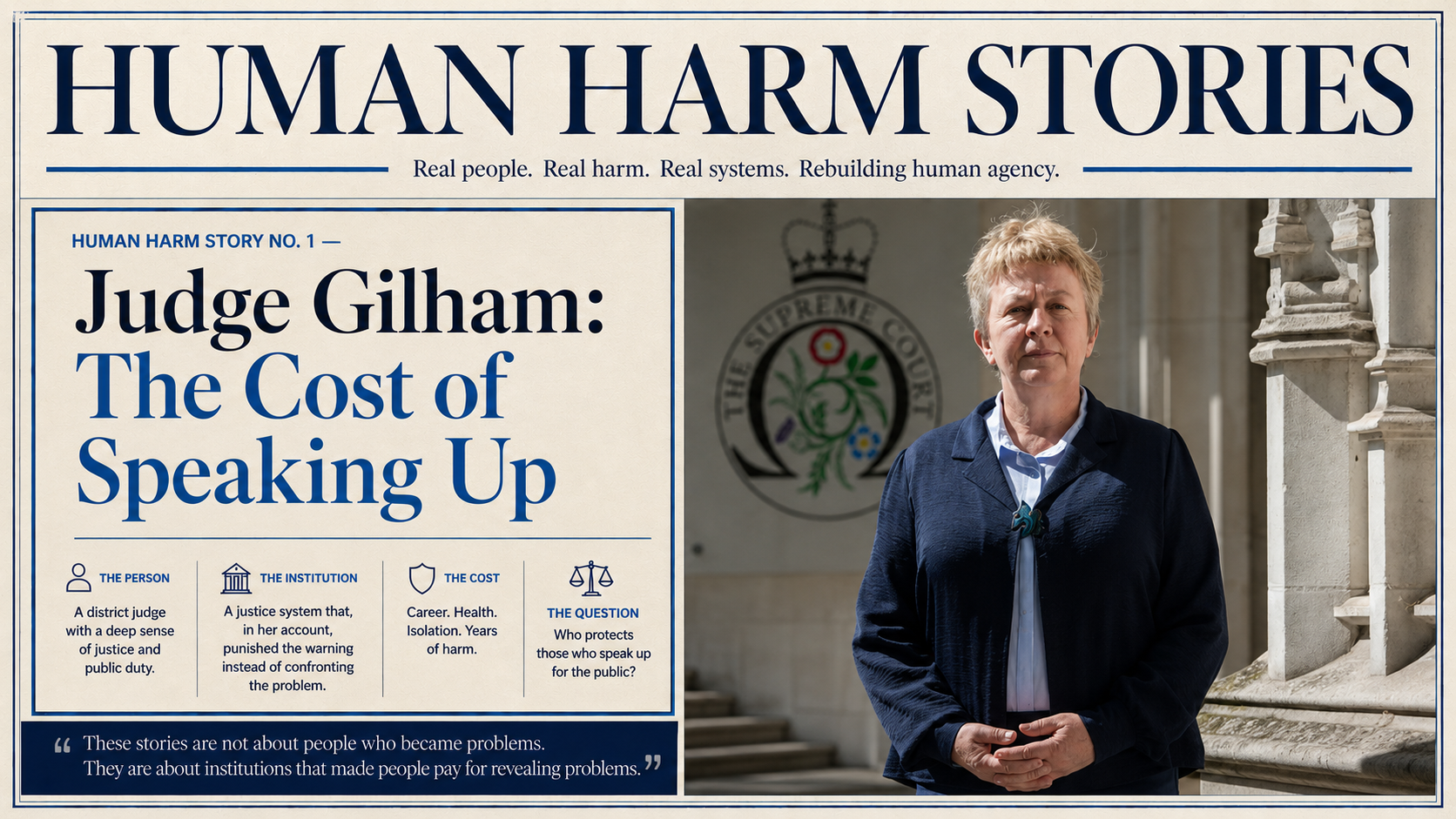
Before the harm
Claire Gilham was a district judge.
In her own words, she was what many people would regard as a “bog-standard district judge”: a general practitioner of the civil courts dealing with family disputes, road traffic accidents, mortgage and rent arrears, and the everyday conflicts through which ordinary people encounter the justice system.
Before becoming a judge, she had held senior roles in the public sector, including executive and board-level responsibilities. She brought with her a strong belief in public service, transparency and the importance of properly governed institutions.
She did not describe herself as a campaigner entering the judiciary to challenge it.
She was an insider. An experienced public servant. A judge trying to do the job properly.
Her professional identity rested upon fairness, independence and the protection of people whose lives could be changed by decisions made in court.
That was the life before the harm: a respected judicial career, a clear public-service ethic and an expectation that serious concerns about justice would be taken seriously.
What she saw
From around 2010, during a period of recession and public-sector cost-cutting, Judge Gilham began to see decisions being made within the court system that she believed were damaging the administration of justice.
The concerns were not abstract.
She described safeguarding systems being stripped away, unsafe court buildings, inadequate risk management and severe pressure on judges and court staff.
Her examples included:
- care orders involving children being issued in circumstances she believed were improper;
- children who needed protection not receiving it;
- people facing repossession despite not having been served with a claim;
- offices being used as courtrooms because too many courts had closed;
- children being taken inside court buildings;
- attacks and threats against court users and judges;
- a violent offender bringing a ceramic knife into a building with the intention of killing her;
- orders involving children being presented as consent orders where no proper hearing had taken place;
- staff being given performance targets that encouraged them to “manage” judges;
- cases being moved between judges in search of someone willing to make an order another judge had refused.
To Judge Gilham, these were not merely administrative shortcomings.
They were public harms.
They affected children, families, homes, personal safety and the integrity of judicial decision-making.
The values collision
The clash was between two competing systems of value.
Judge Gilham’s governing values were judicial independence, public safety, fairness and fidelity to the law.
The institution, as she experienced it, appeared to be governed by different operational priorities: budget reduction, administrative control, implementation of policy and protection of the system from criticism.
This was the central values collision:
She believed the institution existed to protect justice.
The institution appeared to treat protection of the organisation as the higher priority.
Judge Gilham acted according to the judiciary’s declared values.
The response she described suggested that the institution’s operative values were different.
That distinction matters.
Whistleblowers are often accused of disloyalty when, in reality, they may be the people most loyal to the institution’s stated purpose.
Speaking up
Judge Gilham did not begin by going to the press or the courts.
She described holding meetings, writing emails and resisting changes she believed were unsafe or unlawful.
She tried to raise concerns from inside the system.
Her aim was not simply to object. It was to prevent harm and preserve the integrity of the courts.
But her concerns were not resolved.
She described being ignored, receiving no meaningful answers and seeing nothing properly investigated.
In her own summary, she encountered:
“Punishment, years of no time, near suicide, isolated, not answered, nothing investigated, closed doors, silence, blame, deliberate undermining, records destroyed.”
This was the first major turning point.
The institution did not merely fail to solve the problem.
According to her account, it began to reposition the person raising the problem as the problem itself.
The institutional response
Judge Gilham described a pattern familiar to many whistleblowers.
First, the substance of the warning was not adequately addressed.
Then attention shifted to her conduct, personality and suitability.
During a grievance hearing, she said she was challenged about her views on judges belonging to the Garrick Club, apparently to test her views on feminism.
She said it was then concluded that her public-sector background and her expectations of zero tolerance towards racism and sexism made her an “unsuitable personality” to be a judge.
That was not a neutral disagreement.
Her professional standards and ethical expectations were reframed as personal defects.
The language reportedly used—“difficult,” “divisive,” “unsuitable personality”—did more than criticise her behaviour.
It undermined her credibility.
It suggested that the real problem was not what she had observed, but who she was.
This is a recurring form of institutional retaliation:
The warning is depersonalised.
The whistleblower is pathologised.
The institution no longer has to answer the concern if it can persuade others that the person raising it is unstable, unreasonable or unfit.
The human experience of retaliation
Judge Gilham’s account makes clear that the retaliation was not experienced as an ordinary professional dispute.
She described isolation, blame, silence and deliberate undermining over a period of years.
She said records were destroyed.
She said concerns were not answered.
She said nothing was properly investigated.
She described being made ill.
Most starkly, she described becoming close to suicide.
These words reveal the lived reality behind institutional language such as “grievance,” “conduct,” “process” and “employment dispute.”
For the institution, the matter could be divided between departments, hearings, policies and legal submissions.
For the individual, it was one continuous experience.
Her work, identity, reputation, health and future were all affected at once.
This is how institutional harm becomes severe.
It is rarely one event.
It is the accumulation of unanswered letters, closed meetings, altered narratives, professional exclusion and the gradual realisation that the system to which a person has devoted their working life may no longer protect them.
How she responded
Judge Gilham continued trying to use internal channels.
She raised concerns.
She pursued grievance procedures.
She attempted to obtain redress.
But, according to her account, those routes did not protect her.
Eventually, she spoke externally to The Guardian.
That decision marked a significant escalation, but it was not her first action.
It came after internal processes had, in her view, failed.
She later said:
“After going through internal routes, without any redress I whistleblew externally now to the Guardian newspaper. I was given notice and sent my P-45.”
The sequence is important.
She did not bypass the institution.
She escalated because the institution had not responded.
The retaliation escalator
Judge Gilham’s story follows a pattern seen across many institutional harm cases:
- She identified serious risks.
- She raised concerns internally.
- The concerns were not effectively resolved.
- She persisted.
- Her persistence was reframed as a problem of personality and suitability.
- She sought external accountability.
- The institutional response intensified.
- The conflict became legal, prolonged and personally destructive.
Each attempt to restore accountability created further exposure for the individual.
This is the Retaliation Escalator:
The more the individual tries to make the institution confront the problem, the more the institution treats the individual as the problem to be contained.
The legal barrier
When Judge Gilham sought whistleblowing protection under the Employment Rights Act 1996, she encountered another institutional barrier.
The lower courts held that, because she was a judicial office-holder and did not have an ordinary employment contract, she was not legally a “worker” entitled to the Act’s whistleblowing protections.
The Ministry of Justice argued that judges did not require those protections because they already enjoyed security of tenure and protection from arbitrary dismissal.
But that argument failed to address the retaliation Judge Gilham said she had actually suffered.
Formal protection from dismissal did not protect her from bullying, victimisation, professional undermining, isolation or the refusal to investigate her concerns.
Lady Hale later recognised that distinction.
She observed that it was not enough to say judges were protected against dismissal if they remained exposed to bullying, victimisation and the failure to take their complaints seriously. Judge Gilham quoted that observation in her later account.
How bad did the harm become?
By Judge Gilham’s own account, the harm became profound.
Professionally, she was isolated, blamed and undermined.
Reputationally, she was portrayed as difficult, divisive and unsuitable.
Procedurally, she said concerns went unanswered, investigations did not happen and records were destroyed.
Physically and psychologically, she became seriously ill and came close to suicide.
Ultimately, after speaking externally, she said she was given notice and sent a P45.
The severity of the case cannot be understood by examining any one event in isolation.
The harm lay in the combination:
- professional exclusion;
- reputational attack;
- institutional silence;
- procedural powerlessness;
- deteriorating health;
- fear for the future;
- and eventual loss of office.
The institution possessed time, resources, legal representation and control over procedure.
The individual carried the human consequences.
The Supreme Court outcome
In October 2019, the UK Supreme Court unanimously ruled in Judge Gilham’s favour on the central legal question.
The Court held that excluding judicial office-holders from whistleblowing protection was incompatible with her rights under Articles 10 and 14 of the European Convention on Human Rights: freedom of expression combined with protection from unjustified discrimination.
The law had to be interpreted so that judicial office-holders could bring whistleblowing claims.
The judgment was significant.
It recognised that judicial independence was not only about protecting judges from dismissal or reductions in salary.
It was also about protecting their ability to speak when they believed the administration of justice was being compromised.
The Supreme Court ruling did not itself determine every factual allegation Judge Gilham had made.
It established that she was entitled to have her whistleblowing case heard.
That distinction is important.
She won the right to seek justice.
That was not the same as being restored to the life she had before the harm.
The human outcome
The legal decision was historic.
The human outcome was more complicated.
By the time the Supreme Court ruled, Judge Gilham had already experienced years of conflict, isolation, ill health and professional damage.
This is the Vindication Gap:
The distance between being proved right in principle and being made whole in practice.
A court can correct the legal interpretation.
It cannot return lost years.
It cannot fully restore health.
It cannot erase the experience of being disbelieved, isolated or recast as a problem by the institution one served.
Judge Gilham later continued speaking about whistleblowing and institutional culture.
She did not present the judgment as the end of the problem.
She remained concerned that judicial whistleblowing arrangements were closed, lacked external oversight and might operate as mechanisms of control rather than genuine protection.
What changed within the institution?
A whistleblowing policy was eventually introduced for judges.
But Judge Gilham questioned whether the policy represented meaningful cultural change.
She said the policy had been developed largely behind closed doors, with limited involvement from ordinary judges.
She was particularly concerned that an early draft could have exposed judges to disciplinary consequences for speaking to the media, politicians or external organisations.
Only after the policy was leaked and criticised publicly was that explicit threat removed.
Even then, she argued that the process remained closed, lacked appeal rights, did not provide adequate data collection and had no independent external regulator to which serious matters could be referred.
The institution therefore produced a policy.
But the deeper question remained unanswered:
Had the culture that punished the whistleblower actually changed?
What happened to those responsible?
Judge Gilham’s account does not identify clear disciplinary consequences for the institutional actors she believed were responsible for the retaliation.
There is no equivalent narrative of individuals being investigated, removed or held personally accountable.
This reveals the Accountability Asymmetry.
Judge Gilham’s conduct, personality, disclosures and legal status were subjected to years of scrutiny.
The actions of institutional decision-makers remained comparatively obscured behind collective processes, confidentiality and organisational structures.
The individual became visible.
The institution remained abstract.
That asymmetry is common in institutional harm.
Responsibility is acknowledged at the level of “the organisation,” while the people who made decisions continue without equivalent scrutiny.
Life after the harm
The source material shows Judge Gilham continuing to speak publicly about whistleblowing, judicial independence and the need for stronger protection.
She appears to have sought meaning from what happened by helping others understand the weaknesses within the system.
But her later account was not one of easy recovery or complete resolution.
She described the experience in terms of punishment, isolation, ill health and near suicide.
She remained sceptical that policy reform alone would protect future whistleblowers.
Her question was not whether the judiciary now possessed a whistleblowing document.
It was whether a judge who raised serious concerns would genuinely be safer than she had been.
Her answer was cautious:
Time would tell.
The system revealed
Judge Gilham’s story exposes a deep institutional paradox.
A justice system depends upon judicial independence.
But when a judge used her independence to raise concerns about the functioning of that system, she says she was isolated, undermined and eventually removed.
The institution appeared willing to defend the principle of judicial independence in the abstract while resisting its exercise in practice.
The case also reveals that whistleblowing failure is rarely caused by the absence of a reporting channel.
The deeper failure occurs when the institution controls:
- the investigation;
- the evidence;
- the timetable;
- the definition of acceptable conduct;
- and the narrative about the person raising the concern.
In that environment, procedure may exist without protection.
The human agency lesson
Whistleblowers are often described as unusually courageous people.
But courage should not be the primary safeguard against institutional harm.
An institution that requires individuals to risk their health, livelihood and identity before it will examine evidence is not learning.
It is defending itself.
Judge Gilham’s case shows why human agency requires more than a formal right to speak.
It requires:
- a credible route to be heard;
- investigation independent of the implicated institution;
- protection against reputational and professional retaliation;
- accountability for those who misuse institutional power;
- and meaningful restoration when harm occurs.
Without those protections, the right to speak may exist only on paper.
The unanswered question
Judge Gilham ultimately secured a landmark legal ruling.
But the central human question remains:
What would her life have looked like if the institution had investigated the warning instead of managing the person who delivered it?
And the wider question for every institution is harder still:
When someone speaks in defence of the institution’s declared values, will the institution protect the truth—or protect itself?

