
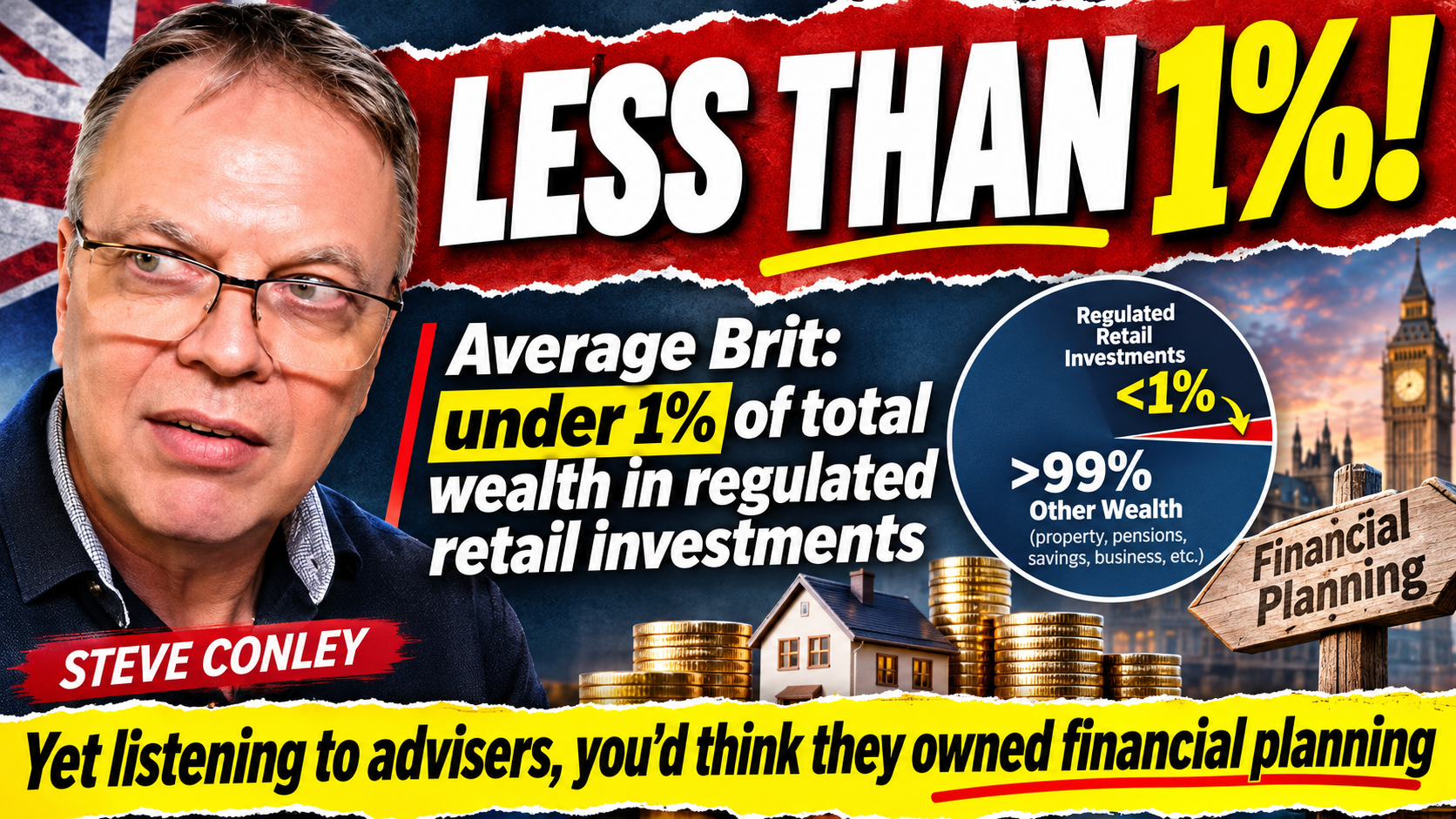
What ONS data reveals about financial wealth, human capital and why financial planning needs a bigger picture.
By Steve Conley, Founder, Academy of Life Planning
Imagine asking someone how wealthy they are.
They might tell you about their house, savings, pensions and investments.
They probably wouldn’t mention their ability to earn a living. Their knowledge. Their professional experience. Their health. Or the relationships that help them find opportunities and navigate difficult times.
Yet these resources may be worth considerably more than their investment portfolio.
This raises an uncomfortable question.
Why has an industry concerned primarily with financial products become so influential in defining what financial planning means?
At the Academy of Life Planning, we believe financial planning should begin with the whole person.
And the statistics help explain why.
What the ONS measures as wealth
The Office for National Statistics (ONS) conducts the Wealth and Assets Survey (WAS), examining the assets and liabilities of households across Great Britain.
Its April 2020 to March 2022 survey, published in January 2025, divided household wealth into four main components.
| Wealth category | Share |
|---|---|
| Net property wealth | 40% |
| Private pension wealth | 35% |
| Net financial wealth (savings & investments) | 14% |
| Physical wealth | 10% |
Source: ONS, Household total wealth in Great Britain, April 2020 to March 2022. Figures are rounded.
Property and pensions account for approximately three-quarters of conventionally measured household wealth.
Net financial wealth represents just 14%. And that category includes bank accounts, cash savings, investment accounts and other financial assets, less financial liabilities.
The proportion represented by non-pension retail investments — the shares, funds and other investments most closely associated with conventional investment management — is smaller still.
Our analysis uses an upper-bound estimate of less than 5% of conventionally measured wealth for this narrower investment category.
That figure is an Academy classification of the underlying wealth categories, rather than the ONS headline for financial wealth. The precise asset selection matters, particularly because pension wealth is reported separately.
But there is something even more important missing from these conventional wealth calculations.
The value of the person.
The missing asset: human capital
Suppose you’re 40 years old.
You have skills, qualifications, experience and perhaps another 25 or 30 years of working life ahead of you.
Your future earnings have economic value.
Economists call this human capital.
The ONS measures human capital by estimating the present value of people’s projected lifetime labour earnings.
In its April 2026 publication, the ONS estimated the UK’s human capital stock at £28.59 trillion in 2024.
That is not the value of people’s investments, homes or pension pots.
It represents the estimated present value of future labour income associated with the skills and knowledge of the working-age population.
Human capital is not a bank balance. It cannot simply be withdrawn or sold. But it represents an economically significant resource that people can develop, protect and deploy.
Consider two people with identical investment portfolios.
One has excellent health, valuable skills, strong relationships and promising opportunities.
The other faces declining health, unemployment and limited opportunities to earn.
Their financial statements may look similar.
Their overall financial circumstances are very different.
Yet a planning process that concentrates on investment portfolios can miss much of that difference.
How do we value human capital?
The principle is straightforward.
We estimate future earnings and discount them to their present value.
For example, consider someone expecting to earn £40,000 annually over the next 25 years.
Using a simplified illustration, assuming constant annual earnings paid at year-end and a 3% annual discount rate, those future earnings have a present value of approximately £697,000.
That estimate would change with assumptions about earnings growth, employment, inflation, retirement and the discount rate.
The ONS uses a more sophisticated methodology incorporating age, sex, qualifications, earnings and projected working lives.
Neither approach claims that human beings are worth only what they can earn.
Quite the opposite.
The calculation demonstrates that even a narrow economic valuation of human capability can reveal a substantial resource missing from conventional personal balance sheets.
And human capital, understood more broadly, includes much that future earnings alone cannot capture.
Putting the two measures together
At the Academy of Life Planning, we use an expanded model of total wealth that brings human capital together with conventionally measured financial and physical assets.
For an illustrative person aged 40, our model assumes that human capital represents approximately 80% of expanded total wealth.
That leaves 20% represented by conventionally measured wealth.
The exact proportions vary with age, earnings, assets and personal circumstances. The 80% figure is a modelling assumption for our representative case, not a single combined ONS statistic.
Now consider the investment share.
Our narrower retail-investment estimate is less than 5% of conventional wealth.
The calculation is:
Retail investments as a share of expanded total wealth = retail investment share of conventional wealth × conventional wealth share of expanded total wealth.
Therefore:
Less than 5% × 20% = less than 1%.
There is no complicated mathematics here.
What matters is that we are using two different denominators.
The first percentage refers to conventionally measured wealth.
The second refers to expanded total wealth, including human capital.
Once human capital is included, the relative significance of a conventional investment portfolio can become much smaller.
What does less than 1% actually mean?
It does not mean investments are unimportant.
Nor does it mean every person’s investments represent less than 1% of their total wealth.
Someone approaching retirement may have substantial accumulated retail pension and investment assets but relatively little future earned income.
A business owner may hold considerable wealth in a private company.
A younger professional may have limited financial assets but substantial future earning potential.
The proportions change throughout life.
Our illustration is intended to expose a conceptual imbalance, not create a universal statistic.
ONS also exclude private business ownership from the WAS survey. Business ownership may represent a substantial source of wealth in its own right.
Equally, the calculation should not be interpreted as saying that all retail personal pensions or every financial product together represent less than 1% of wealth. That is a different, much broader asset category.
The narrower proposition is about retail investment holdings (FCA regulated investments and pensions) – the particular investments FCA-registered financial intermediaries advise on – relative to an expanded measure that includes human capital.
And that brings us to the real question.
Why does financial planning traditionally concentrate on such a small part of life?
The answer is partly historical and partly commercial.
Financial services developed business models around financial transactions, investment portfolios, insurance contracts, personal pension arrangements and the administration of financial assets.
Those activities generate identifiable revenue.
Financial products can be sold. Assets can be managed. Transactions and services can be charged for.
But how does an industry traditionally organised around financial products earn money from helping someone become more employable?
Or helping a family understand its care responsibilities?
Or helping someone weigh the advantages and disadvantages of changing career?
Or helping a person recover their confidence and independence after financial exploitation?
These activities can create enormous value for the individual.
But they don’t necessarily result in a financial product being purchased.
That creates a structural incentive to concentrate on the parts of wealth from which revenue can most readily be generated.
What gets monetised gets attention. What matters to the person may be something entirely different.
That distinction is central to the Academy of Life Planning.
What if we planned the person before the money?
Consider someone aged 40 who wants to improve their financial security.
A conventional wealth-management conversation might begin by reviewing their savings, pension and investment portfolio.
Those are legitimate subjects.
But a broader conversation might reveal something more consequential.
Perhaps the person is unhappy in their career.
Perhaps their skills are becoming outdated.
Perhaps they are considering a business opportunity.
Perhaps a family responsibility is limiting their ability to work.
Perhaps improving their health or gaining a qualification could change their future earning potential.
The most valuable financial decision might not involve buying or selling any investment.
It might involve investing in themselves, or a property, or a business.
The same principle applies when life becomes complicated.
Bereavement, divorce, serious illness, redundancy, retirement, business succession and caring responsibilities all create financial consequences.
But the starting point is the human situation.
The plan should serve the person’s life. The person’s life should not be organised around the financial plan.
A different role for the financial planner
At the Academy of Life Planning, we call our approach Total Wealth Planning.
It begins with a simple proposition.
Your total wealth includes the financial and human resources available to support your life, taking account of your liabilities and responsibilities.
We help people understand those resources, examine their options, consider the advantages and disadvantages of different approaches and make informed decisions.
We provide neutral, generic information, education, practical tools and experienced support.
We don’t make decisions for clients.
We help clients become more capable of making decisions themselves.
And when specialist expertise is required, we help them recognise the need and work alongside the appropriate professionals.
There are more than 70 potential specialist disciplines relevant to the wider planning of a person’s financial life, from law and taxation to healthcare, property, business, pensions and family matters.
No single planner needs to become all those experts.
Their contribution is helping the individual see the whole picture and remain in control.
The regulated retail investment adviser is just one of more than 70 financial professionals we may call upon in an independent financial plan.
Financial planning when life gets complicated
This approach also changes when people need access to a planner.
Most people don’t need permanent professional supervision of their financial lives.
They need occasional, focused support during periods of stress, change or complexity.
We call this episodic financial planning.
You bring a problem, decision or life event.
We help you understand the circumstances, explore possible courses of action and establish your next steps.
When the work is complete, you continue independently.
If another issue arises, you can return.
There is no need to build a permanent dependency.
Self-directed by default. Supported when it matters.
The bigger question
The wealth-management industry has developed considerable expertise in looking after financial assets.
But financial assets are only part of the resources people rely upon to live fulfilling, secure and purposeful lives.
The ONS data on household wealth and human capital makes that distinction visible.
The Academy’s expanded model then asks what happens when we consider them together.
For our illustrative 40-year-old, the narrow retail investment category represents less than 1% of expanded total wealth.
The significance is not the exact decimal point.
It is the much larger territory that conventional investment-centred planning can overlook.
If we want to improve people’s financial wellbeing, should we begin with the products they own?
Or should we begin with the capabilities, opportunities and resources that shape their lives?
Traditional wealth management concentrates on a fraction of what people have.
Total Wealth Planning starts with the whole of what people are and what they can become.
And that’s why our purpose is not to manage people’s dependence.
It’s to restore their agency.
Explore Total Wealth Planner
If you’re facing an important decision or a period of stress, change or complexity, discover how independent, episodic financial planning can help.
You bring me the problem, not the portfolio.
Discover Financial Planning When Life Gets Complicated.
Data sources and methodology
1. ONS Wealth and Assets Survey
Household total wealth in Great Britain: April 2020 to March 2022, released 24 January 2025.
2. ONS Financial Wealth dataset
Financial wealth: wealth in Great Britain, released 24 January 2025. The detailed financial-asset categories appear in the accompanying workbook.
3. ONS Human Capital estimates
Human capital stocks estimates in the UK: 2004 to 2024, released 24 April 2026.
4. Academy of Life Planning model
The less-than-1% estimate is a derived, illustrative calculation, not a statistic published directly by the ONS.
It assumes human capital represents 80% of expanded total wealth for a representative person aged 40, leaving conventional wealth at 20%. The Academy’s narrower non-pension retail-investment category is assumed to represent less than 5% of conventional wealth.
The resulting estimate is less than 1% of expanded total wealth. The final numerical claim depends on validating the investment-category selection and the age-specific human-capital assumption on a consistent basis.
The WAS household estimates cover Great Britain, while the ONS human-capital series covers the UK working-age population. These published series use different populations, periods and units of analysis. They are used here to motivate an illustrative model, not combined as though they were a single survey.
The ONS has also suspended the accredited official statistics status of the WAS core outputs from its 2020–22 round while quality improvements are undertaken. The figures remain published as official statistics.

