
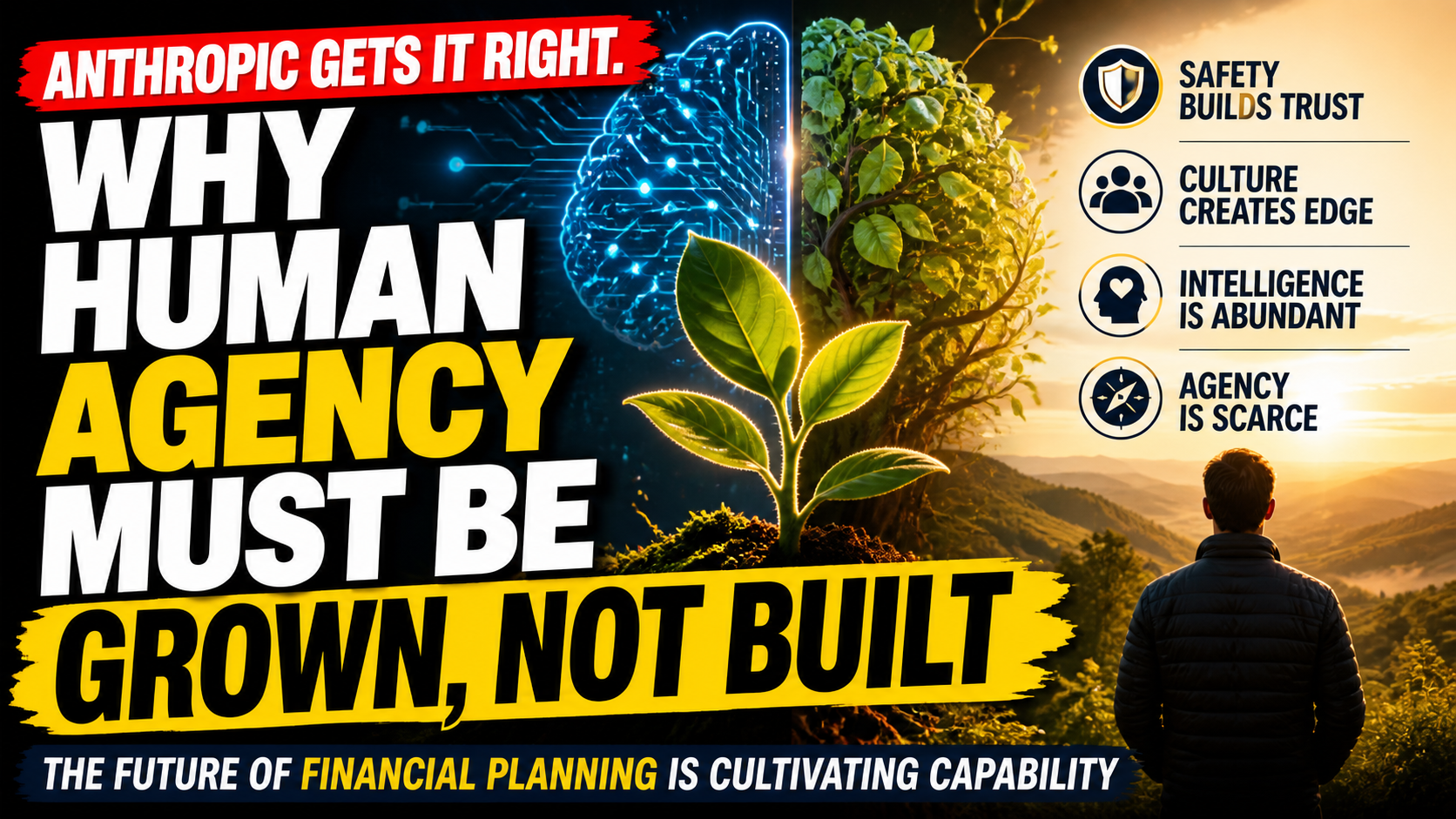
What Anthropic’s culture reveals about the future of financial planning
In a recent investment note, Anthropic describes its own technology in unusual terms. Its models, we are told, are “grown more than built”.
It is a striking phrase. Not because it is poetic, but because it is precise.
It signals a shift away from the industrial mindset that has shaped both technology and financial services for decades. A mindset built on control, predictability, and engineered outcomes. One that assumes, with enough data and expertise, the future can be modelled, managed, and ultimately delivered.
But what if that assumption is breaking down?
From engineered certainty to cultivated capability
Large language models behave in ways their creators do not fully anticipate. They develop emergent capabilities. They surprise their engineers. They resist neat explanation.
This is not a flaw in the system. It is a property of it.
And it introduces a different way of thinking:
You do not build intelligence in a linear way.
You create the conditions for it to emerge.
That means:
- Environment matters more than instruction
- Feedback matters more than control
- Boundaries matter more than prediction
Anthropic’s internal analogy is gardening. You can choose the seed, prepare the soil, and provide structure. But you cannot dictate the exact shape of the outcome.
That same principle applies far beyond AI.
Financial planning has been built on the wrong assumption
For decades, financial planning has operated as if lives can be engineered.
Inputs are gathered. Models are run. Recommendations are produced. Outcomes are implied.
The implicit promise is one of certainty:
Follow this plan, and your future becomes predictable.
But the reality is closer to Anthropic’s model than to traditional advice:
- People change
- Priorities shift
- External conditions evolve
- Decisions compound in unexpected ways
Two individuals with identical financial profiles can have entirely different life trajectories. Not because the model failed, but because the premise was flawed.
The future is not something to be calculated.
It is something to be navigated.
The real constraint is not capital. It is agency
The investment case for Anthropic rests on a simple idea: the world is constrained by access to intelligence.
Doctors, teachers, executives and developers all operate with incomplete information, limited time, and cognitive overload. AI, at scale, can relieve that constraint.
But this introduces a second-order effect that is less discussed.
If intelligence becomes abundant, the bottleneck shifts.
From information → to judgement
From access → to application
From advice → to agency
This is where the current financial system begins to look structurally outdated.
It is still designed for a world where:
- Information is scarce
- Expertise is centralised
- Clients are dependent
But we are moving rapidly into a world where:
- Information is abundant
- Expertise is distributed
- Tools are accessible
In that world, the limiting factor is no longer what people know.
It is what they can do with what they know.
Why culture becomes the real differentiator
One of the more subtle insights in the Anthropic piece is not about technology at all. It is about culture.
A safety-first approach.
A non-mercenary workforce.
High retention despite aggressive external offers.
These are not soft attributes. They are structural advantages.
They shape how decisions are made under uncertainty.
In financial planning, the same principle applies.
A system built on product distribution will behave differently from one built on client agency.
A system optimised for extraction will produce different outcomes to one designed for empowerment.
Culture, in this sense, becomes infrastructure.
It determines:
- What is prioritised
- What is measured
- What is tolerated
- What is avoided
And ultimately, who benefits.
From advice to agency
The traditional advice model made sense in a paper-based world.
Data was fragmented.
Analysis was slow.
Expertise was scarce.
Intermediation was necessary.
Today, that context has changed.
We now have tools that can:
- Model lifetime cashflows in real time
- Analyse complex documents instantly
- Simulate multiple future scenarios
- Translate technical knowledge into accessible insight
The question is no longer whether people can access expertise.
It is whether they are supported to use it.
This is the transition from advice to agency.
Not removing expertise, but repositioning it.
From decision-maker → to decision-support
From authority → to enabler
From gatekeeper → to guide
Growing a Total Wealth Planner
If Anthropic grows intelligence through environment, feedback and constraint, the same logic applies to the development of a Total Wealth Planner.
You do not “train” one in the traditional sense.
You cultivate one.
Through:
- Frameworks that structure thinking
- Tools that support exploration
- Conversations that build clarity
- Environments that encourage independent judgement
Over time, capability emerges.
Confidence follows.
And with it, a different kind of value.
Not the ability to recommend products.
But the ability to navigate life.
A different kind of system
The deeper implication is this:
If AI is going to supply intelligence at scale, then the role of financial planning is not to compete with it.
It is to complement it.
To provide the human layer that AI cannot:
- Meaning
- Context
- Values
- Direction
This requires a different system architecture.
One that starts not with products, or even with money, but with what is already present:
- Skills
- Relationships
- Time
- Energy
- Intent
From there, financial capital becomes one component of a broader picture.
Not the driver of decisions, but the servant of them.
Closing reflection
Anthropic’s insight that intelligence is “grown more than built” may turn out to be one of the defining ideas of this technological era.
Not because it explains AI.
But because it reframes how we think about capability itself.
For financial planning, the implication is direct.
You cannot build certainty into people’s lives.
But you can help them grow the capability to navigate uncertainty.
And in a world that is becoming more complex, more dynamic, and less predictable, that may be the most valuable service of all.
Curious how others see this shift — are we still building plans, or starting to grow capability?

