
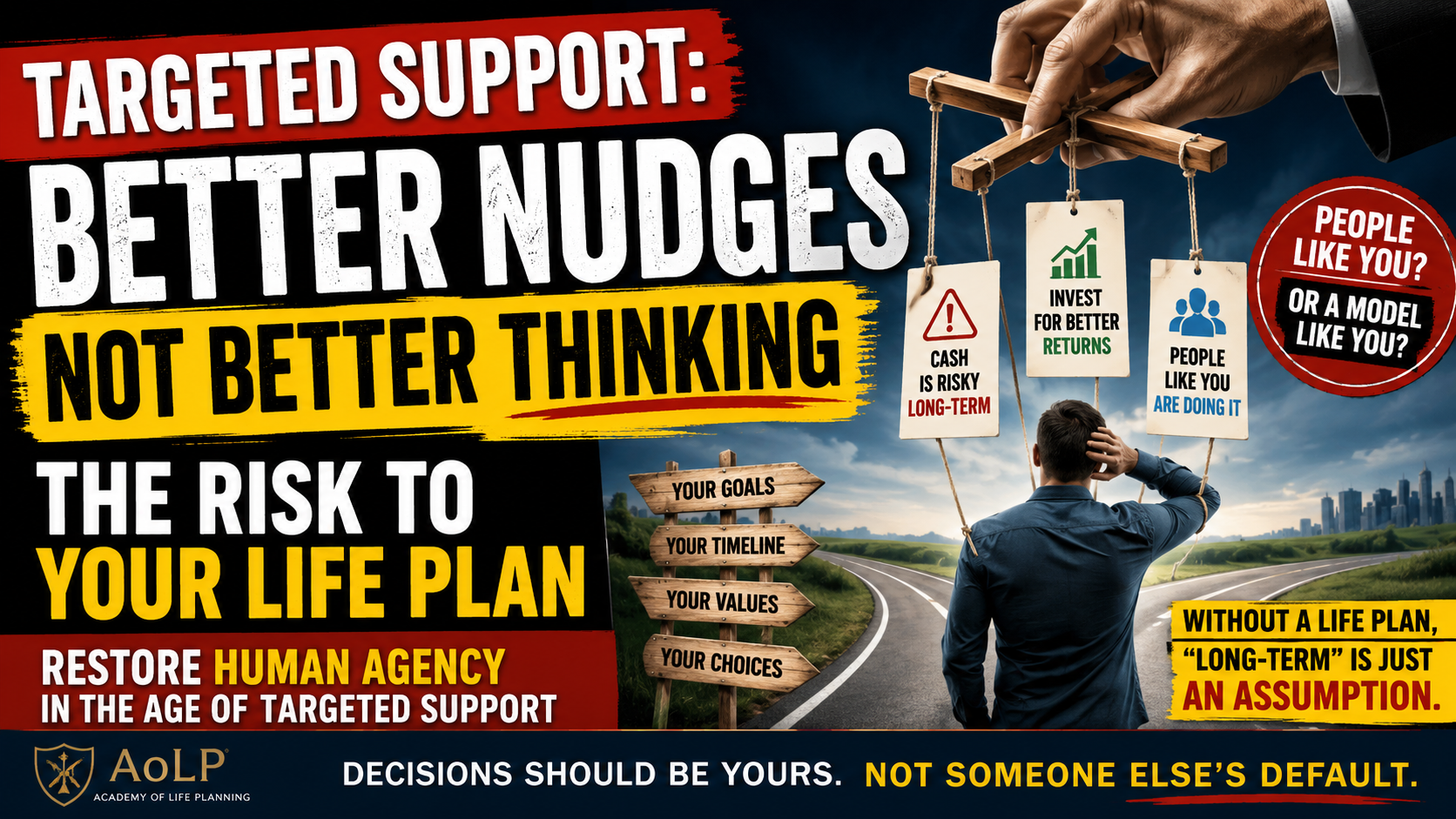
Why better nudges don’t replace better thinking—and why human agency matters more than ever
There is a quiet shift underway in financial services.
Providers are moving from passive information delivery to something more active—what the regulator now calls “Targeted Support.” The intention is clear: use data, behavioural insight, and simplified communication to help people make better decisions.
On the surface, it’s hard to argue with.
If someone has held their pension in cash for years, highlighting the impact of inflation and suggesting alternatives feels not only helpful, but responsible.
But beneath that logic sits a deeper question—one that goes largely unasked:
How do we know what “better” actually means for that individual?
The hidden assumption: “long-term”
Much of Targeted Support rests on a simple premise:
Holding cash over the long term is harmful to retirement outcomes.
In many cases, that will be true.
But the phrase “long term” is doing a lot of work here.
Because “long term” is not a number.
It is not an age.
It is not a demographic category.
It is a function of intention.
And intention cannot be inferred from a dataset.
When two identical clients are nothing alike
Consider two individuals:
- Same age
- Same pension value
- Same contribution history
From a provider’s perspective, they are identical.
But:
- One plans to step back from work within three years, prioritising stability and income certainty
- The other intends to remain economically active for 15–20 years, embracing flexibility and growth
To a model, they are “people like you.”
In reality, they are on completely different trajectories.
So when a system nudges both toward the same “optimal” behaviour, it is not personalised.
It is standardised.
The category error at the centre of the system
This reveals a deeper structural issue.
Targeted Support is attempting to solve a planning problem using segmentation logic.
Segmentation works by grouping people based on observable traits—age, balance size, behaviour patterns.
Planning, by contrast, begins somewhere else entirely:
- What does a good life look like?
- When will money be needed—and for what?
- What role does work, purpose, and flexibility still play?
These are not data points.
They are decisions.
And decisions require a different kind of infrastructure.
From advice to nudging—and the risk in between
Historically, financial services operated on an “advice” model—experts interpreting information on behalf of clients.
Today, that is evolving into something more subtle:
guided decision-making within pre-defined systems.
This can feel empowering.
But there is a risk.
Because when the system defines:
- the problem
- the options
- and the “most relevant path”
…then the individual is no longer deciding freely.
They are selecting from a curated frame.
And that frame is not neutral.
Providers operate within commercial models:
- asset retention matters
- product pathways matter
- margins vary across solutions
None of this implies bad intent.
But it does mean that optimisation can drift—quietly—toward the system’s interests.
When better decisions aren’t better for you
This is the uncomfortable possibility:
We may be helping people make better financial decisions—
for the system they are in, rather than the life they are trying to live.
A nudge away from cash may improve expected returns.
But if the individual needed:
- liquidity
- psychological safety
- short-term certainty
…then the “better” decision may actually reduce alignment.
And misalignment, over time, is where harm accumulates.
Restoring the missing layer: decision capital
What’s missing is not more data.
It is decision capital.
Decision capital is the ability to:
- define your own goals
- understand your time horizons
- evaluate trade-offs in context
- and act with intention
It sits upstream of every product decision.
Without it, even the best guidance becomes:
easier decisions… inside someone else’s model
With it, the individual can:
- question the assumptions
- reshape the frame
- and decide whether the suggested path is appropriate at all
Reordering the process
At the Academy of Life Planning, we approach this differently.
The sequence matters.
- Goals – What does your life actually require?
- Actions – What are you doing, and what could you do?
- Means – What resources exist across financial and human capital?
- Execution – How do specific financial decisions support the plan?
Targeted Support operates at Step 4.
But without Steps 1–3, Step 4 becomes guesswork—however sophisticated the data.
A constructive role for Targeted Support
None of this means Targeted Support has no value.
Used well, it can be a powerful execution layer:
- highlighting risks
- simplifying choices
- prompting timely action
But it should sit beneath an agency-led planning process—not replace it.
Because only the individual can define:
- what “long term” means
- what risk is acceptable
- what trade-offs are worth making
The question that matters now
As Targeted Support expands across pensions, ISAs, and retirement income solutions, we face a choice:
- Do we build more sophisticated systems to guide decisions for people?
- Or do we build the capability for people to guide decisions for themselves?
The first improves efficiency.
The second restores agency.
A simple test
Before acting on any “targeted” recommendation, ask:
Does this reflect my life plan—
or someone else’s model of what my life should look like?
That question alone begins to rebuild decision capital.
Targeted Support may shape the future of financial services.
But the future of financial planning—if it is to be worthy of the name—must begin somewhere else:
with the individual, not the system.

