
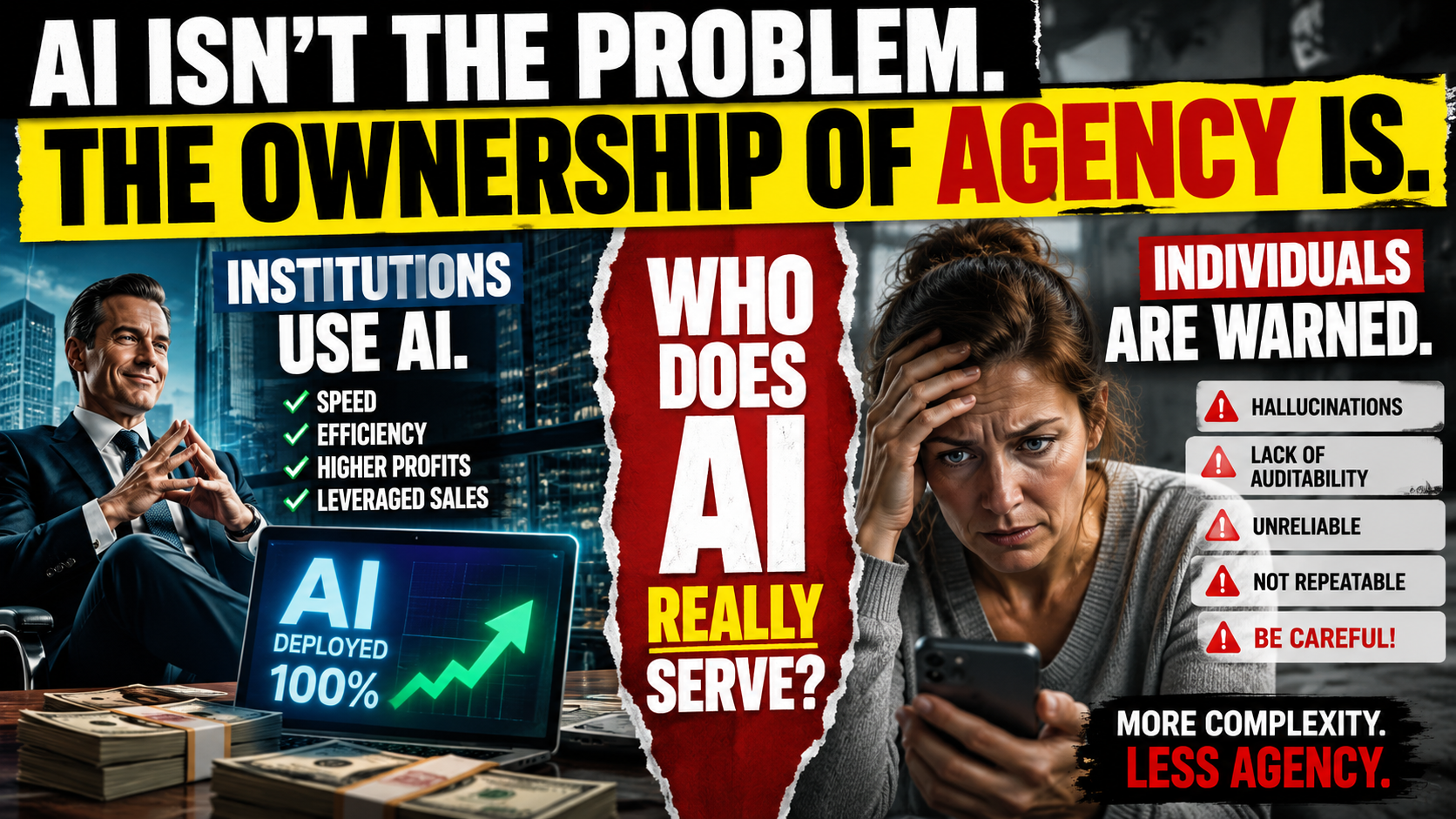
AI Is Not the Problem. The Ownership of Agency Is.
There is a strange tension emerging around artificial intelligence.
When individuals use AI, suspicion follows.
A long dash in a sentence becomes a clue.
A polished image becomes “obviously AI.”
A well-structured article becomes “too smooth.”
A useful answer becomes “probably hallucinated.”
The individual is warned to be careful. To be sceptical. To remember that AI is unreliable, unrepeatable, unauditable, biased, synthetic, and dangerous.
Some of those warnings are valid.
AI can make things up. It can flatten nuance. It can reproduce bias. It can produce confident nonsense. It can create false images, fake evidence, manipulative advertising, and emotional shortcuts that bypass human judgement.
But there is another side to the story.
The same institutions warning individuals about the dangers of AI are often deploying it aggressively inside their own organisations.
They are using it for speed.
For efficiency.
For cost reduction.
For sales conversion.
For marketing personalisation.
For fraud detection.
For risk scoring.
For customer segmentation.
For operational leverage.
For higher margins.
So the public message becomes oddly asymmetric.
Individuals are told: “Be careful. AI may mislead you.”
Institutions tell themselves: “Move faster. AI may transform us.”
That is the real issue.
Not AI itself.
Agency.
The new divide is not human versus machine
The question is not whether AI is good or bad.
The question is: who becomes more capable because of it?
If AI helps a person think more clearly, challenge poor advice, understand a contract, organise evidence, build a plan, ask better questions, or reclaim confidence, it can increase human agency.
If AI helps an institution profile, persuade, automate, obscure, segment, deny, delay, or overwhelm, it can diminish human agency.
The technology is not neutral in practice because it lands inside unequal systems.
Large institutions already have data, capital, legal teams, compliance departments, behavioural scientists, technology vendors, and distribution channels. AI gives those systems more reach, more speed, and more precision.
Individuals often have none of that.
They have stress.
Complex forms.
Unclear terms.
Limited time.
Low confidence.
Fragmented information.
And sometimes, no one they can safely trust.
So when AI enters the picture, it does not automatically level the playing field.
It can widen the gap.
Why people are reacting negatively
The public reaction to AI is not irrational.
It comes from lived experience.
People have seen fake images. Fake reviews. Synthetic voices. Automated customer service loops. Chatbots that apologise but do not solve. Content that looks human but feels empty. Institutions using technology to make themselves harder to reach, not easier to understand.
So when someone sees AI-generated text or imagery, the reaction is often not really about punctuation, pixels, or polish.
It is about trust.
People are asking:
“Is this real?”
“Who made this?”
“What is being hidden?”
“Am I being manipulated?”
“Is this replacing human care?”
“Is someone cutting costs while pretending to improve service?”
That scepticism is understandable.
The trouble is that the suspicion is often directed horizontally, at other individuals, while the deeper structural question is missed.
A person using AI to express themselves more clearly is not the same as an institution using AI to optimise extraction.
A citizen using AI to understand a pension is not the same as a firm using AI to increase product sales.
A victim using AI to organise evidence is not the same as a corporation using AI to automate complaint handling.
A planner using AI to support human judgement is not the same as a platform using AI to steer consumer behaviour.
The ethical question is not simply “Was AI used?”
The better question is:
“Did the use of AI increase or reduce human agency?”
The institutional double standard
There is a growing double standard in the AI debate.
Individuals are warned about hallucinations.
Institutions are encouraged to innovate.
Individuals are told AI lacks auditability.
Institutions build AI into workflows most customers will never see.
Individuals are told AI may mislead them.
Institutions use AI to personalise influence at scale.
Individuals are told not to rely on AI.
Institutions rely on it to reduce cost, increase productivity, and accelerate decision-making.
This does not mean all institutional AI use is harmful. Some uses are genuinely beneficial. AI can detect fraud, improve accessibility, reduce administrative waste, identify risk, and support better service.
But the direction of travel matters.
If AI strengthens the already powerful while making life more complex for everyone else, society does not become more intelligent. It becomes more asymmetrical.
The powerful become faster.
The individual becomes more exposed.
From artificial intelligence to artificial asymmetry
The real danger is not that AI will replace humans.
The real danger is that AI will be used to replace accountability.
A human adviser can be questioned.
A firm can be challenged.
A contract can be read.
A decision can, in theory, be appealed.
But when decisions are shaped by models, workflows, third-party systems, automated nudges, and opaque data profiles, responsibility becomes harder to locate.
The customer may still be told they made a “choice.”
But the environment around that choice may have been engineered.
That is where AI becomes a human agency issue.
Not because the machine thinks.
But because the person may be left with less room to think.
What this means for financial planning
Financial planning now faces a defining choice.
AI can be used to scale the old model: more leads, more segmentation, more nudges, more product distribution, more efficient extraction from consumer uncertainty.
Or it can be used to build a different model: one that helps people understand their own lives, assets, choices, risks, rights, and possibilities before they are sold anything.
That is the line the Academy of Life Planning is drawing.
We do not reject AI.
We reject agency theft.
We do not believe the answer is to frighten individuals away from AI while institutions quietly embed it everywhere.
We believe individuals need access to structurally trustworthy AI tools that help them think, plan, question, and act with confidence.
That means AI should be:
Transparent enough to understand.
Private enough to be safe.
Supportive without becoming controlling.
Useful without pretending to be infallible.
Human-centred rather than sales-centred.
Designed to restore judgement, not replace it.
The better question
The public is right to be cautious.
But caution should not become learned helplessness.
If individuals are taught that AI is too dangerous for them, while institutions use it to become more powerful, the result will not be safety.
It will be dependency.
The future should not belong only to organisations with the capital to automate complexity.
It should belong to people with the tools to understand their lives, protect their interests, and make informed decisions.
So perhaps the question is not:
“Was this written with AI?”
Perhaps the question is:
“Whose agency did this serve?”
That is where the real AI debate begins.

