
For months I’ve watched the public conversation about artificial intelligence with growing curiosity.
Every week there seems to be another warning.
AI will take jobs.
AI hallucinates.
AI creates misinformation.
AI cannot be trusted.
AI will replace professionals.
AI will concentrate power.
Some of these concerns are legitimate.
Every transformative technology creates risks.
But I cannot help feeling that something important is missing from the discussion.
Most commentary about AI focuses on what institutions can do with it.
Much less attention is given to what individuals can become because of it.
And that may be the most important story of all.
A Different Question
Instead of asking:
“How will AI change business?”
Perhaps we should ask:
“How will AI change human potential?”
For most of history, capability was scarce.
If you wanted expertise, you needed access to experts.
If you wanted research, you needed access to researchers.
If you wanted planning, you needed access to planners.
If you wanted education, you needed access to teachers.
Knowledge was concentrated.
Capability was expensive.
Institutions held most of the cards.
Today, something extraordinary is happening.
For the first time in history, individuals can access capabilities that previously belonged almost exclusively to organisations.
That changes everything.
Start With Your Human Capital
At the Academy of Life Planning, we often talk about human capital.
Human capital is not your money.
It is you.
Your knowledge.
Your skills.
Your experience.
Your relationships.
Your interests.
Your health.
Your creativity.
Your ability to solve problems.
Your capacity to learn.
Most people spend years focusing on financial capital while overlooking the most important asset they possess.
Themselves.
Before planning money, it makes sense to understand the productive assets already available within your life.
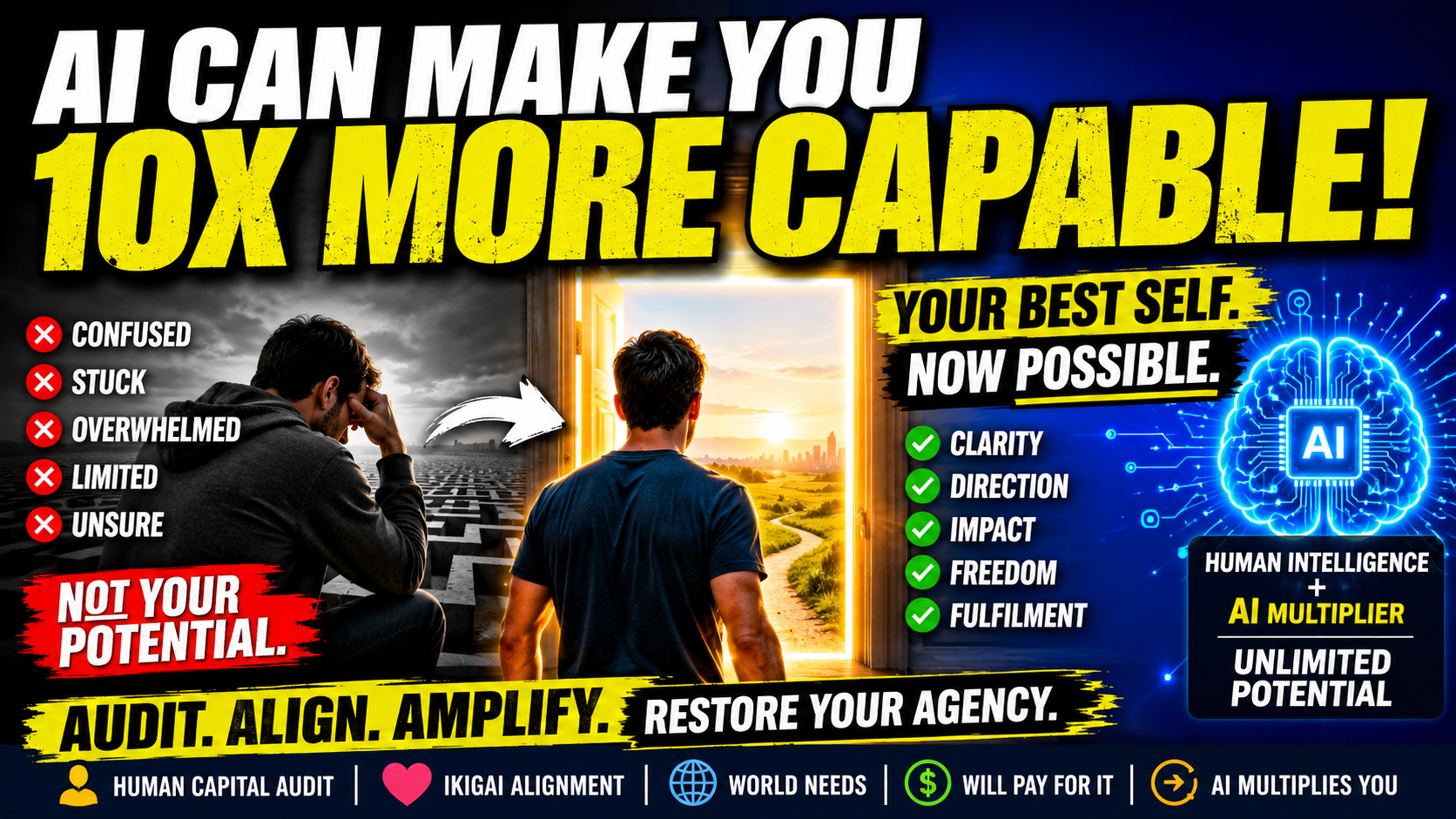
That is why a Human Capital Audit can be so powerful.
It asks questions such as:
- What am I good at?
- What do I know?
- What have I experienced?
- What problems can I solve?
- What do people ask me for help with?
- What am I capable of becoming?
These questions matter because the future increasingly belongs to people who can combine human capability with artificial intelligence.
Then Add Ikigai
The Japanese concept of Ikigai offers another useful lens.
It sits at the intersection of four questions:
- What do you love?
- What are you good at?
- What does the world need?
- What will people pay for?
Many people spend years searching for answers.
AI can accelerate the process dramatically.
It can help identify patterns.
Reveal strengths.
Generate possibilities.
Explore business models.
Test ideas.
Challenge assumptions.
Create plans.
Model outcomes.
The dream that once felt impossible can suddenly feel practical.
Not because AI does the work for you.
But because it expands what you are capable of doing.
The Capability Multiplier
Most people think about AI as a replacement technology.
I see it differently.
I see it as a capability multiplier.
A good financial planner becomes a better planner.
A teacher becomes a better teacher.
A writer becomes a better writer.
A researcher becomes a better researcher.
An entrepreneur becomes a better entrepreneur.
A citizen investigator becomes a better investigator.
A parent becomes a better learner and coach.
A community leader becomes a better organiser.
The question is not whether AI replaces people.
The question is which people learn to work alongside it.
Those who do may become ten times more capable than they were before.
The New Possibilities
Think about what was previously out of reach.
Twenty years ago you might have needed:
- A graphic designer
- A web developer
- A copywriter
- A researcher
- A market analyst
- A business consultant
- A mentor
- A personal tutor
Today one motivated individual can access support across all of these areas.
Not perfectly.
Not instantly.
But sufficiently to make meaningful progress.
An unemployed person can build a business.
A retiree can become a creator.
A victim can become an advocate.
A planner can become an educator.
A citizen can become an investigator.
A dream can become a project.
A project can become a livelihood.
The barriers have fallen dramatically.
Most people have not yet realised how much.
Why The Resistance?
Perhaps some of the resistance comes from fear.
Every technological shift creates uncertainty.
Perhaps some comes from institutions that benefit from maintaining information asymmetries.
Perhaps some comes from individuals who still believe opportunity is scarce.
If capability becomes abundant, many old assumptions begin to crumble.
The belief that expertise must always be purchased.
The belief that knowledge belongs to gatekeepers.
The belief that ordinary people cannot solve complex problems.
The belief that you need permission before you begin.
AI challenges all of these assumptions.
That can be unsettling.
But it can also be liberating.
The Agency Question
At the Academy of Life Planning, our mission is restoring human agency.
Agency is the ability to think clearly, make informed decisions, and act intentionally.
AI does not automatically create agency.
Used badly, it can create dependence.
Used wisely, it can amplify autonomy.
The difference lies in how we use it.
Do we hand over our thinking?
Or do we strengthen our thinking?
Do we become passive consumers?
Or active creators?
Do we use AI to replace our judgment?
Or to expand our capability?
Those questions will shape the future.
The Opportunity Of Our Time
The most important AI story may not be about machines.
It may be about people.
People discovering capabilities they never knew they possessed.
People turning knowledge into action.
People transforming potential into reality.
People becoming more fully themselves.
The challenge is not simply to adopt AI.
The challenge is to use it in service of human flourishing.
To become the best possible version of ourselves that is accessible and achievable in this new age.
That is not a technology story.
It is a human story.
And it may be the greatest opportunity of our generation.
Curious how others see this.
Is AI primarily making institutions more powerful?
Or is it giving individuals the tools to become more capable than ever before?

