
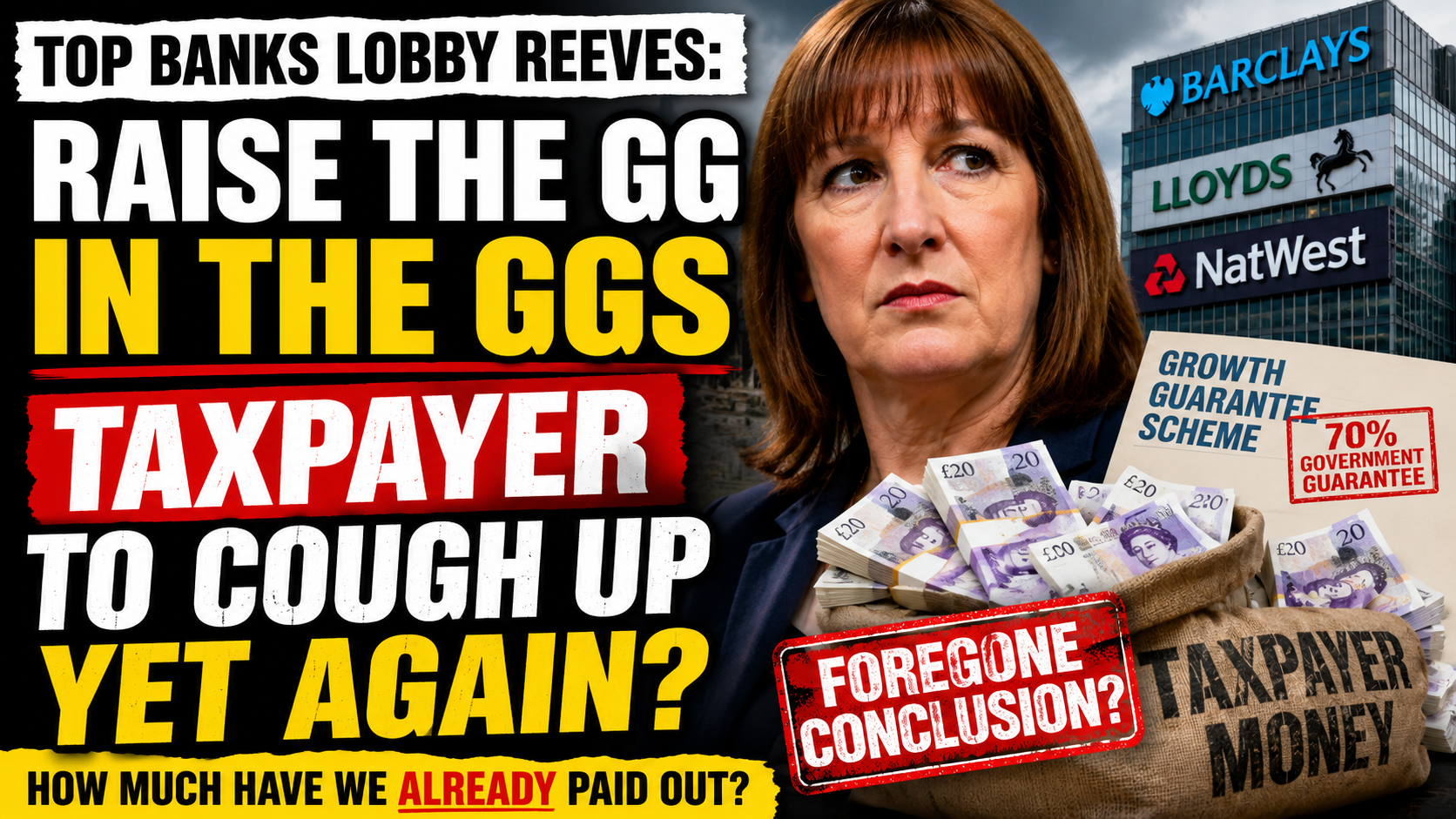
The latest call from Britain’s largest banks may sound like a straightforward proposal for economic growth.
According to reports, major lenders are urging Chancellor Rachel Reeves to significantly expand the Growth Guarantee Scheme (GGS), a government-backed lending programme designed to support small and medium-sized businesses.
Under the current arrangement, loans can be protected by a government guarantee covering up to 70% of lender losses if borrowers default.
The banking industry’s argument is simple.
More guarantees could unlock more lending.
More lending could stimulate business investment.
More investment could support economic growth.
On the surface, that sounds entirely reasonable.
But for many people who have experienced financial harm, particularly those supported through Get SAFE, the announcement raises deeper questions.
Not because they oppose small businesses.
Not because they oppose economic growth.
But because they have learned to ask an important question whenever risk is involved:
Who carries the downside?
A Different Perspective
When a private lender makes a loan, there is always risk.
Normally that risk sits primarily with the lender.
Government guarantee schemes change the equation.
A portion of the risk is transferred from private institutions to the public purse.
Supporters argue this encourages banks to lend where they otherwise might not.
Critics ask whether taxpayers are being asked to underwrite private-sector activity while private institutions continue to retain the profits.
Both perspectives deserve consideration.
The Questions Missing From The Debate
The current discussion appears heavily focused on the potential benefits of expanding the scheme.
Less attention has been given to some important questions:
- How many loans issued under previous guarantee schemes have ultimately required government support?
- What has been the total cost to taxpayers?
- How much economic value has been generated in return?
- What proportion of guaranteed lending would have happened anyway?
- Are there alternative ways to support small business growth without increasing taxpayer exposure?
These are not arguments against the scheme.
They are simply questions that should accompany any proposal involving public money.
Trust Requires Transparency
One of the recurring themes within the Academy of Life Planning is that trust grows when information is complete.
When only the benefits are discussed, scepticism grows.
When both benefits and risks are openly examined, confidence increases.
Most people would likely support policies that genuinely help productive businesses grow.
But they also expect transparency about costs, risks, and outcomes.
That is especially true at a time when public finances are already under pressure.
The Bigger Issue
This story may ultimately be about more than business lending.
It highlights a broader challenge within modern society.
Many institutional decisions are framed as technical or economic questions.
Yet they often contain deeper questions about fairness, accountability, and who ultimately bears the consequences when things go wrong.
The role of citizens is not simply to accept or reject proposals.
It is to ask better questions.
Questions create accountability.
Accountability creates trust.
And trust remains one of the most valuable assets any economy possesses.
Questions Worth Asking
If the Growth Guarantee Scheme is expanded:
- What are the projected taxpayer liabilities?
- What is the historical performance of similar schemes?
- How will success be measured?
- Who benefits most?
- Who carries the risk?
These are not anti-business questions.
They are pro-transparency questions.
And in a healthy democracy, they should be welcomed.
At the Academy of Life Planning, we believe human agency begins with informed participation.
That starts by understanding not only the opportunities being presented, but also the assumptions hidden beneath them.

