
Money Marketing, Momodou Musa Touray 29 May 2026
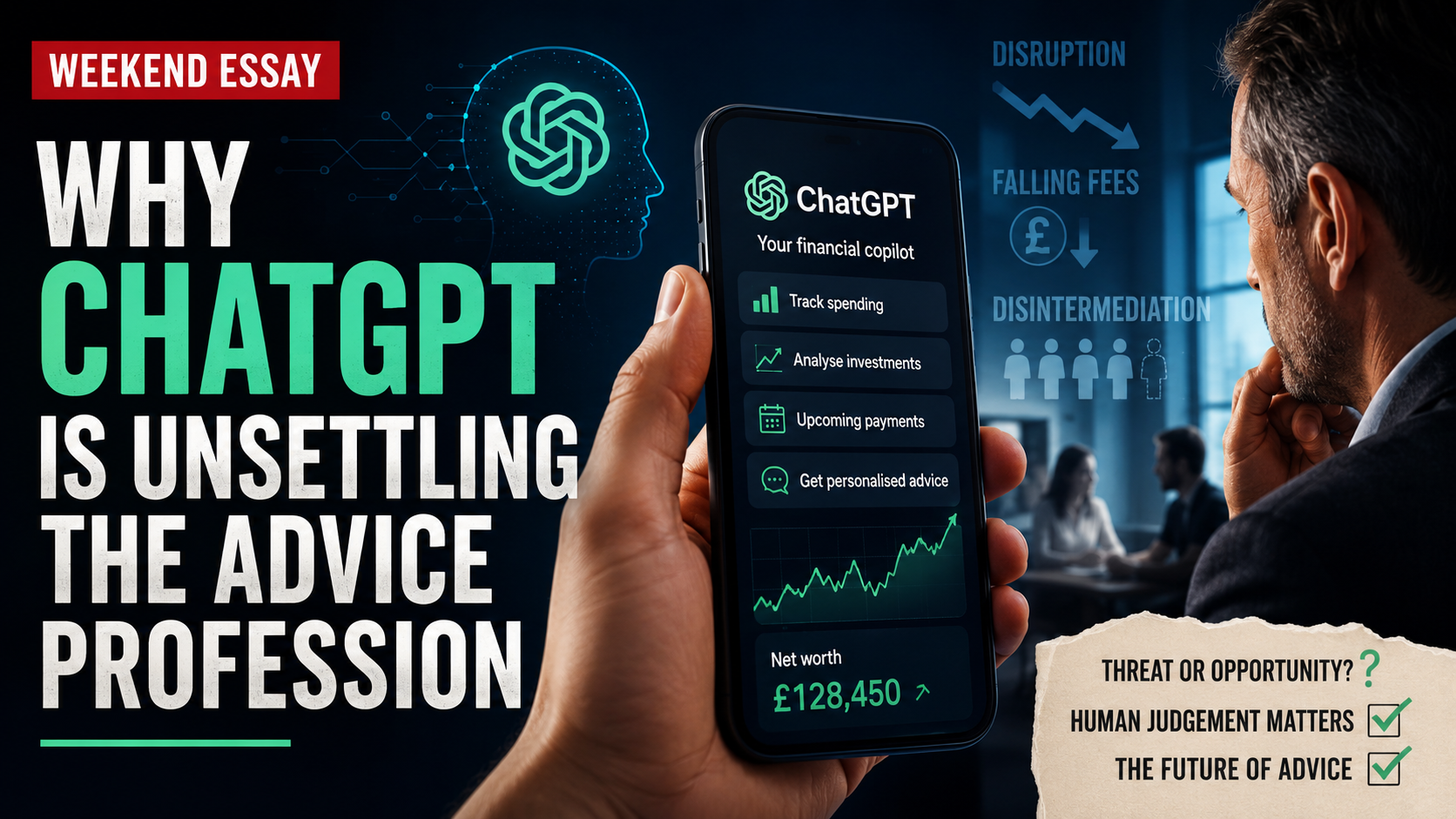
I think this is one of the more balanced pieces Money Marketing has published on AI and advice recently, but it still stops short of what I see as the most important question: not whether AI will replace advisers, but whether AI will restore human agency.
The article accurately identifies three major shifts:
- AI is becoming the first financial conversation.
- AI will compress the economics of advice.
- Human judgement, empathy and context still matter.
Those are all broadly correct observations.
Where I think the article is strongest
The strongest insight is that AI does not need to replace advisers to disrupt the profession.
Historically, advisers have been protected by information asymmetry. Consumers did not know what they did not know. Access to technical knowledge was expensive and controlled.
AI changes that.
If someone can obtain:
- pension explanations,
- tax guidance,
- investment education,
- cashflow modelling,
- behavioural prompts,
- retirement scenarios,
from a device in their pocket at virtually zero marginal cost, then a significant proportion of what consumers previously paid for becomes commoditised.
That doesn’t eliminate advisers.
It changes what clients are willing to pay advisers for.
I think the article is right to highlight this.
Where I think the article misses the bigger story
The article frames the debate as:
“AI versus advisers.”
I think the real debate is:
“AI plus individuals versus institutional dependency.”
For decades the financial services industry has largely organised itself around helping people access products, providers and regulated expertise.
But most of life happens outside the FCA perimeter.
People need help with:
- career decisions
- income generation
- life planning
- retirement purpose
- family decisions
- housing choices
- budgeting
- debt management
- resilience
- human capital development
Much of that has never required regulated advice.
AI is making those capabilities accessible to ordinary people for the first time.
That is the truly disruptive story.
The article discusses AI as a threat to advisers.
I would argue AI is a much bigger opportunity for citizens.
My concern with the adviser debate:
A recurring theme throughout the article is whether advisers survive.
That is understandable because it is a trade publication.
But consumers may ask a different question:
“How do I become more capable?”
From that perspective, AI is extraordinary.
A person who previously lacked:
- financial confidence,
- technical knowledge,
- planning skills,
- organisational ability,
can now access a thinking partner available 24/7.
Not perfect.
Not always accurate.
But dramatically more capable than they were before.
That capability uplift may be the most important development in personal finance since the internet itself.
The behavioural coaching argument
The article correctly notes that advisers often deal with:
- bereavement,
- divorce,
- illness,
- retirement anxiety,
- market panic.
I agree that human relationships remain valuable.
However, there is a blind spot here.
Many people currently receive no behavioural coaching at all.
The choice is not:
- Human adviser, or AI.
For most people the choice is:
- Nothing, or AI.
If AI helps millions of people think more clearly about money, goals and consequences than they otherwise would have done, that is a significant social good.
The regulatory challenge
The article also raises an important question:
“When does guidance become advice?”
This is where I think regulators face a profound challenge.
The traditional boundary was built around:
- humans,
- firms,
- recommendations,
- liability.
AI operates differently.
People increasingly use AI as a thought partner rather than a recommendation engine.
The regulatory framework may need to evolve from focusing solely on “advice” towards supporting safe capability-building and informed decision-making.
My conclusion
The article captures the profession’s anxiety well.
What it doesn’t fully capture is the scale of opportunity for ordinary people.
The most important question is not:
“Will AI replace advisers?”
The more important question is:
“What becomes possible when every individual has access to a capable planning partner?”
That is where I think the Academy of Life Planning has a distinctive perspective.
Most commentary focuses on how AI can make institutions more efficient.
The bigger opportunity is how AI can make individuals more capable.
That is not a story about replacing human beings.
It is a story about restoring human agency.
Curious how others see this.

