
Why AI Could Be the Greatest Empowerment Tool in Human History
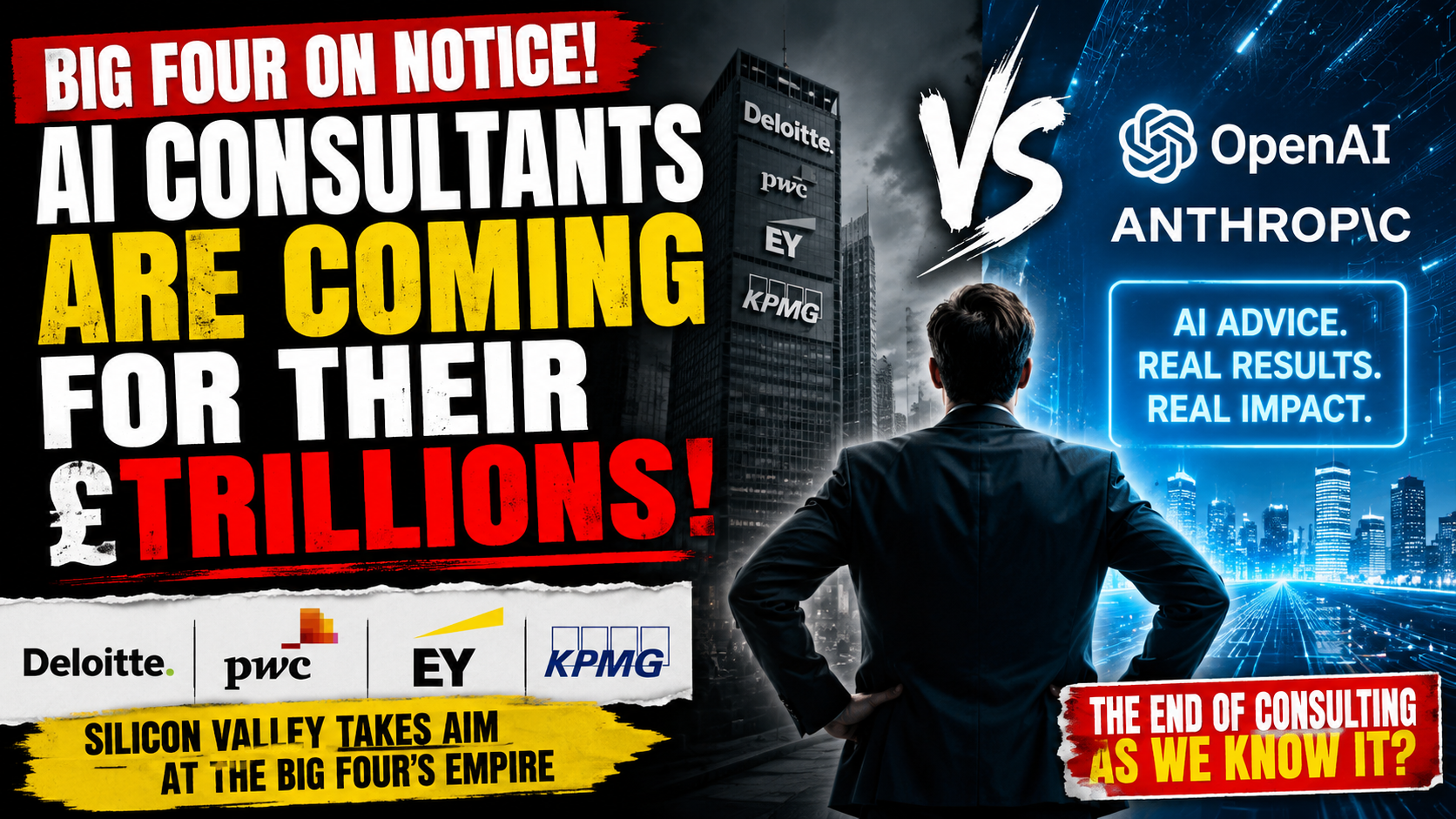
A recent newspaper article in the Telegraph explored an emerging battle between the world’s largest consulting firms and Silicon Valley AI companies.
The story focused on how firms such as OpenAI and Anthropic are moving beyond software and into consultancy services, challenging the dominance of the Big Four accountancy firms and traditional management consultancies.
Most commentators see this as a business story.
I see something much bigger.
I see a human story.
Because hidden beneath the headlines is a question that affects every one of us:
What happens when individuals gain access to capabilities that were previously available only to large organisations?
That question goes to the heart of human agency.
The End of Scale as a Competitive Advantage
For most of modern history, organisations possessed a decisive advantage over individuals.
If you wanted expertise, you needed specialists.
If you wanted research, you needed analysts.
If you wanted legal support, financial modelling, strategic planning, marketing campaigns, software development, or technical knowledge, you needed teams of people.
Large organisations could afford those teams.
Individuals could not.
This created an imbalance of power.
Institutions accumulated capability.
Individuals became dependent upon them.
The larger the institution became, the greater the advantage.
AI changes that.
For the first time in history, an individual sitting at a kitchen table can access capabilities that previously required entire departments.
Research can be completed in minutes.
Complex ideas can be explained instantly.
Business plans can be drafted.
Marketing campaigns can be designed.
Data can be analysed.
Software can be built.
Learning can be accelerated.
Productivity can be multiplied.
Not perfectly.
Not automatically.
But undeniably.
The question is no longer whether this is happening.
The question is whether individuals choose to take advantage of it.
The Wrong Debate
Much of the public conversation around AI focuses on fear.
Will jobs disappear?
Will machines replace people?
Will AI hallucinate?
Will AI become dangerous?
These are legitimate questions.
But they are not the only questions.
Nor are they necessarily the most important questions.
A different question deserves equal attention:
What becomes possible when ordinary people become dramatically more capable?
Because while many institutions are adopting AI aggressively to improve efficiency, reduce costs, and increase profitability, relatively little attention is being given to what AI means for individual empowerment.
That imbalance matters.
When only institutions embrace new capabilities, power concentrates.
When individuals embrace new capabilities, power distributes.
The future may depend on which of those outcomes prevails.
The Rise of the Augmented Individual
The most interesting thing about AI is not that it can replace people.
It is that it can amplify people.
Consider a financial planner.
In the past, building a comprehensive life plan required significant time spent gathering information, researching options, modelling scenarios, and preparing reports.
Today, many of those activities can be accelerated.
The planner is not replaced.
The planner becomes more capable.
The same applies to entrepreneurs.
Teachers.
Writers.
Researchers.
Campaigners.
Community leaders.
Citizen investigators.
Retirees.
Parents.
Students.
Anyone willing to learn.
The winners of the AI age may not be the largest organisations.
They may be the individuals who learn how to combine human judgement with machine capability.
Human Capital Is Becoming More Valuable
This is why the Academy of Life Planning places such importance on human capital.
Financial capital matters.
But human capital matters first.
Your knowledge.
Your experience.
Your relationships.
Your character.
Your creativity.
Your adaptability.
Your ability to learn.
These assets have always been valuable.
AI increases their value further.
Think of AI as a capability multiplier.
Someone with curiosity becomes more capable.
Someone with expertise becomes more capable.
Someone with initiative becomes more capable.
Someone with purpose becomes more capable.
AI does not create agency.
It amplifies agency.
The challenge therefore is not primarily technological.
It is developmental.
The question is not:
“What can AI do?”
The question is:
“What could I become with AI as my co-pilot?”
The New Opportunity
For decades, many people have felt powerless in the face of increasingly large institutions.
Banks.
Governments.
Corporations.
Platforms.
Professional firms.
Bureaucracies.
The common assumption has been that the individual cannot compete.
That assumption may no longer hold.
The cost of capability is collapsing.
The cost of expertise is falling.
The cost of creating value is reducing.
The barriers that once protected large organisations are weakening.
That does not mean institutions disappear.
Far from it.
But it does mean that individuals have an unprecedented opportunity to reclaim influence over their own lives.
The Academy Perspective
At the Academy of Life Planning, we believe planning begins with what is already present.
Before seeking more money, discover your existing assets.
Before outsourcing your future, develop your capability.
Before surrendering responsibility, strengthen your agency.
AI has the potential to become one of the most powerful tools ever created for human development.
Not because it thinks for us.
But because it helps us think better.
Not because it replaces us.
But because it expands what we can do.
The real opportunity is not AI versus humans.
The real opportunity is AI amplifying what capable humans can achieve.
Those who learn to work alongside these tools may find themselves competing effectively with organisations many times their size.
For perhaps the first time in modern history, the balance of capability is beginning to shift.
The question is whether we are prepared to use it.
Because the age of human agency may only just be beginning.

