
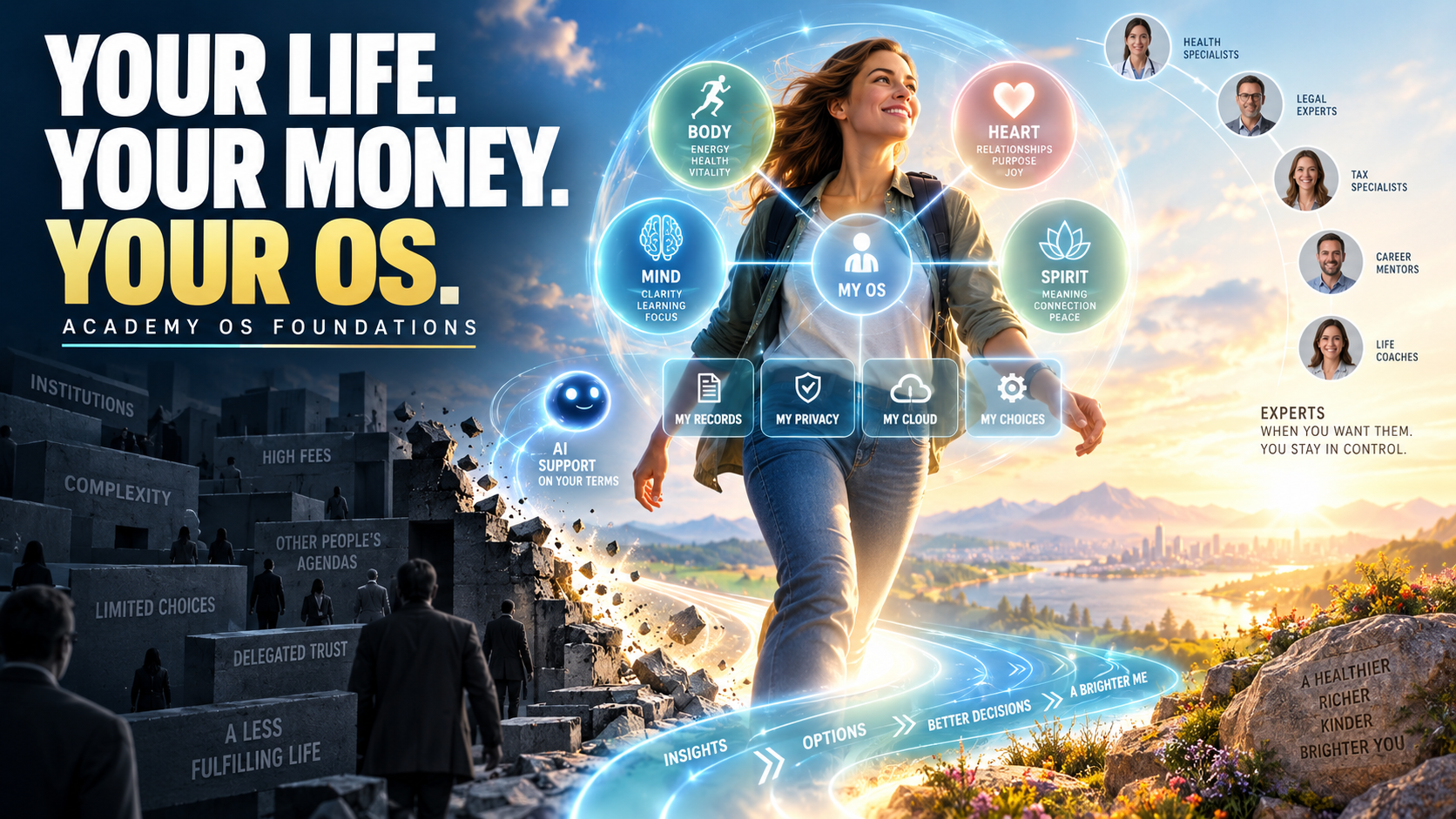
Academy OS Foundations introduces a new way to manage life and money—one in which the individual, not the institution, operates the system
Most people already have a financial operating system.
The problem is that it usually belongs to somebody else.
Their pension information sits with providers. Their financial plan sits in an adviser’s system. Their legal documents sit with a solicitor. Their health information sits elsewhere. Their priorities remain largely in their head. Important decisions disappear into emails, reports and half-remembered conversations.
Each professional sees a fragment. Nobody sees the whole life clearly.
Often, not even the individual.
When something changes, the person must return to an expert, explain everything again and wait to be told what happens next. The system may contain enormous amounts of information, yet leave the person unable to act without assistance.
That is not a shortage of information.
It is a shortage of agency.
What if the operating system belonged to you?
Academy OS starts with a different premise:
Your life, information, decisions and plan should remain yours.
Academy OS is a personal operating system for managing your life and finances. It helps you organise what matters, understand the resources available to you, make decisions, take action and respond when circumstances change.
Your essential planning record can sit privately within your own platform and Google Drive. You decide what to include, what to keep private and what to share.
Artificial intelligence helps you organise information, generate possibilities, expose assumptions and prepare better questions. Human specialists contribute when their expertise is genuinely needed.
But neither the technology nor the professional becomes the owner of the plan.
You remain at the centre.
AI is available continuously. Experts appear proportionately. The individual remains in control.
This is not another financial-planning portal
Most financial-planning technology is designed primarily for the professional organisation using it.
It helps advisers collect data, demonstrate compliance, analyse products, produce reports and manage clients. The individual may receive a portal or a polished document, but the underlying system still belongs to the firm.
Academy OS reverses that relationship.
It is not a regulated adviser’s financial-planning system.
It is not a wealth manager’s client-management system.
It is not a provider’s product dashboard.
It is your own management system for your own life.
That distinction changes everything.
Instead of asking, “Who should manage my affairs?”, Academy OS begins with a better question:
“What can I understand, organise and operate myself—and where would proportionate expertise genuinely improve the decision?”
This does not reject professional advice. It puts expertise in its proper place.
The individual operates the routine system. Technology provides continuous support. Professionals enter episodically when complexity, uncertainty, consequence, competence, capacity or conflict makes their contribution valuable.
The planner is no longer the client’s operating system.
The planner helps the client operate one.
Wealth is more than money
Traditional financial planning often begins with what can be placed on a balance sheet: income, expenditure, property, pensions, investments and debt.
These resources matter. But they do not describe the whole person or explain what makes a life possible.
Academy OS understands total wealth through four connected forms of capital:
- Body — physical capital: health, energy, time, shelter, safety and the living environment on which human life depends.
- Mind — intellectual capital: knowledge, information, skills, judgement, creativity and adaptability.
- Heart — emotional and social capital: emotional capacity, trust, care, relationships, belonging and reciprocal support.
- Spirit — spiritual capital: values, meaning, integrity, identity, conscience and contribution.
These are not four separate compartments. The person cannot be detached from relationships, society or the living world. Each form of capital develops through interaction with the others.
Money moves through this system. It can be held physically or represented through balances, contracts, pensions, debts, shares, rights and obligations. It circulates through trust and takes direction from purpose.
Money is important, but it is not the fifth human faculty.
Financial wealth records certain resources. Total wealth asks what the whole living system enables.
A higher income may create security while consuming health and family time. Education may use money and energy while creating knowledge, confidence and future choice. Caring for someone may reduce earnings while deepening relationship, meaning and reciprocal trust.
Every important decision allocates capital—but not merely financial capital.
From having a plan to operating one
A conventional plan is often treated as a finished product: a report prepared at one moment, based on information collected for a particular purpose.
Life does not behave like that.
Health changes. Relationships evolve. Work becomes more or less sustainable. New responsibilities appear. Values deepen. Evidence changes. What once looked sufficient may no longer feel like enough.
A living plan must be capable of absorbing change.
Academy OS uses the GAME Plan method:
- Goals: What is a life worth living, and what is enough?
- Actions: What choices and practical steps could move you towards it?
- Means: What forms of capital, resources, relationships and constraints affect what is possible?
- Execution: Who will act, what happens next and when should the decision be reviewed?
GAME turns whole-person understanding into an operating method. It connects purpose to evidence, evidence to choice and choice to action.
The result is not a prediction of the future. It is a usable record that helps you decide what to do when the future changes.
A Second Brain for important decisions
Human memory is selective. Under pressure, it becomes harder to remember what was agreed, where the evidence came from or which assumption supported an earlier decision.
Academy OS therefore includes My Life Record: a personal evidence and decision layer that can hold the information behind your plan.
It helps you distinguish:
- verified facts;
- estimates;
- assumptions;
- interpretations;
- AI-generated possibilities;
- professional opinions;
- unresolved questions;
- decisions; and
- review triggers.
This distinction matters.
An assumption repeated often enough can begin to look like a fact. A confident AI response can begin to resemble professional authority. A recommendation can become detached from the values and evidence that were supposed to support it.
My Life Record preserves the chain of reasoning.
It allows a future version of you to understand:
- what you knew;
- what you did not know;
- what alternatives you considered;
- what you decided;
- why you decided it;
- what happened next; and
- what should cause the decision to be reviewed.
It also gives you a better starting point when a specialist is needed. Instead of handing over your whole life or reconstructing it from memory, you can prepare a focused brief and share only what is relevant to the defined question.
AI without surrendering judgement
AI changes what an individual can do without continuous professional mediation.
It can explain unfamiliar concepts, organise scattered information, generate alternatives, identify missing questions, model provisional scenarios and turn notes into a structured planning record.
But fluent language is not evidence.
AI does not know automatically which facts are accurate, what matters most to you, what trade-offs you are willing to accept or what consequences you can carry. It can sound certain while relying on missing, outdated or invented information.
Academy OS therefore gives AI a governed role:
AI may generate possibilities. The individual chooses. Human expertise tests and challenges when needed.
Learners are taught to examine AI output for:
- sources and currency;
- assumptions and omissions;
- internal logic;
- excluded alternatives;
- false confidence;
- authority laundering; and
- the consequences of being wrong.
The aim is neither blind enthusiasm nor fearful rejection.
It is capable use.
Expertise when the situation warrants it
Restoring agency does not mean pretending that everyone can become their own solicitor, clinician, accountant, therapist, engineer or regulated specialist.
Nor does it mean treating every ordinary decision as a professional problem.
Academy OS uses six general triggers for human expertise:
- Complexity: several systems, people, rules or consequences interact.
- Uncertainty: important facts, outcomes or assumptions remain unclear.
- Consequence: an error could be harmful, costly or difficult to reverse.
- Competence: specialist knowledge, experience, permission or authority is required.
- Capacity: stress, illness, grief, time pressure or overload affects the ability to proceed.
- Conflict: evidence, incentives, recommendations, duties or interests pull in different directions.
These triggers apply across the whole life. Legal, clinical, tax, employment, property, business, care, technical and financial expertise are all examples. No single profession or regulatory perimeter defines the total-wealth landscape.
The question is not, “Can I avoid asking for help?”
It is:
“What help does this decision genuinely require, from whom and for what defined purpose?”
That is the difference between episodic expertise and dependency by default.
Introducing Academy OS Foundations
Academy OS Foundations is the complete introductory programme for this new operating model.
Across 27 modules and a Final Integration Project, learners explore:
- agency before advice;
- dependency-based and agency-led models;
- education, planning, advice, decision support and implementation;
- continuous capability and episodic support;
- the Academy ecosystem;
- total wealth beyond financial assets;
- defining enough across a whole life;
- the GAME Plan as a living method;
- Academy OS and My Life Record;
- evidence, assumptions and decisions;
- reviewing change and sharing controlled access;
- responsible human–AI planning;
- testing AI outputs and sources;
- privacy and responsible information handling;
- documenting AI-supported judgement;
- when self-operation is sufficient;
- triggers for human expertise;
- specialist preparation;
- capability-building professional engagements;
- competence, evidence and uncertainty;
- privacy, consent and information control;
- conflicts, commercial terms and authority;
- referral and scope of practice; and
- the construction and testing of a complete Academy OS case.
The programme is designed for individuals who want greater control of their own life and financial planning. It also provides the conceptual foundation for professionals exploring an agency-led model of practice.
Completing Foundations demonstrates understanding of the philosophy, method and operating model. It does not by itself confer professional accreditation, specialist competence or authority to undertake regulated or otherwise reserved activities.
That boundary is part of the learning.
What learners leave with
The outcome is not simply more knowledge.
Learners build a practical Academy OS case containing:
- a whole-person map;
- a definition of enough;
- a connected GAME Plan;
- an inventory of available means and constraints;
- a record of facts, evidence, assumptions and unanswered questions;
- a critically tested AI contribution;
- decisions and next actions;
- review dates and change triggers;
- identified expertise needs; and
- evidence that ownership remains with the individual.
The plan does not need to contain every detail of a life. It needs to be sufficiently clear and connected to support thoughtful action.
A living plan should help its owner answer:
- What matters now?
- What has changed?
- What do I know?
- What am I assuming?
- What options are available?
- What is enough?
- What will I do next?
- What help would improve this decision?
- When should I look again?
The capability loop
Academy OS gives learners a repeatable rhythm for operating their plan:
- Notice — What has changed?
- Orient — What does it affect, and why does it matter?
- Update — What information, assumption or priority needs revising?
- Decide — Can I proceed, or is more investigation or expertise needed?
- Act — What happens next, and who owns the action?
- Record — What was decided and why?
- Review — What event, condition or date should bring this back into attention?
Notice. Orient. Update. Decide. Act. Record. Review.
This is how a plan stays alive without becoming a permanent administrative burden.
A new relationship between people, technology and professionals
The old model assumed that expertise had to sit at the centre because information, analytical tools and professional knowledge were difficult for individuals to access.
That world is changing.
Information is abundant. AI can support thinking continuously. Secure personal tools can help individuals maintain their own records. Education can make sophisticated planning methods understandable.
But access to technology alone does not create agency.
People also need a structure for questioning outputs, organising evidence, seeing the whole system, making choices and recognising when human judgement is necessary.
That is the opportunity Academy OS Foundations addresses.
It is not automation replacing professionals.
It is not individuals being abandoned to manage complexity alone.
It is a new division of responsibility:
- the individual owns and operates the system;
- AI supports continuous exploration and organisation;
- specialists contribute proportionately and episodically; and
- the living plan remains with the person whose life it represents.
The beginning of a larger change
Academy OS Foundations is a course, but the proposition is larger than a course.
It represents a change in who owns the planning infrastructure.
When individuals can retain their information, understand their choices, challenge generated answers, call upon expertise deliberately and continue operating after an engagement ends, professional support no longer needs to depend upon information asymmetry or permanent control.
The individual becomes more capable.
The professional becomes more valuable where judgement genuinely matters.
Technology serves the relationship instead of quietly governing it.
That is not the end of planning.
It is the beginning of agency-led planning.
Your life. Your money. Your OS.
Academy OS Foundations is the place to begin.
Explore Academy OS Foundations and start building a living plan that remains yours.

