
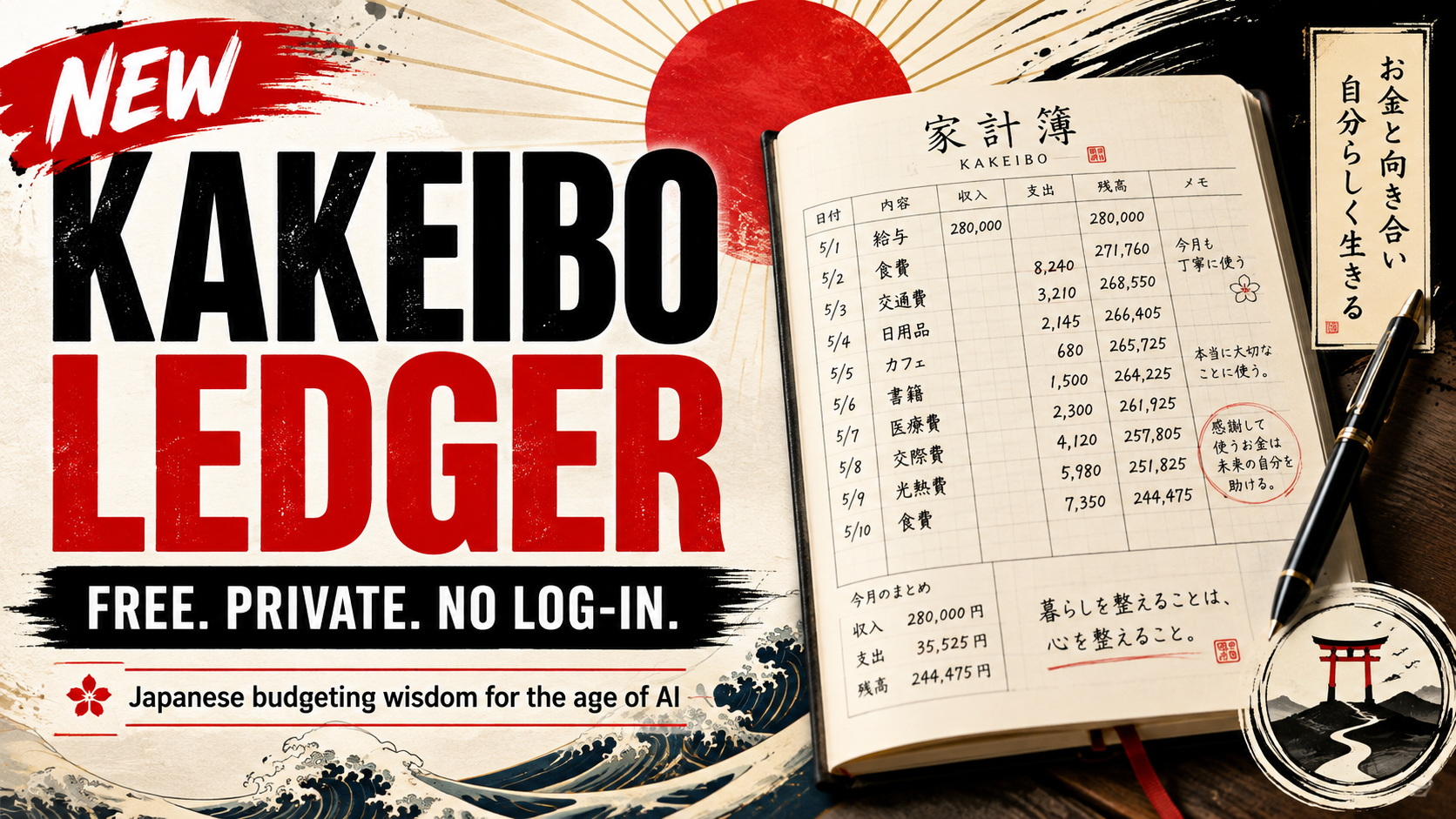
Kakeibo Ledger™: Sometimes the Best Technology Gets Out of Your Way
I have been fascinated by Japanese approaches to money, life and human flourishing for a long time.
I use Ikigai in life planning. I use Kokoro as a way of thinking about alignment between mind, body, heart and spirit. Even the Academy’s GAME Plan draws inspiration from the ancient Shinto natural cycle — moving from creation towards manifestation.
So perhaps it was only a matter of time before Kakeibo found its way into the Academy.
That time is now.
Today, I’m launching Kakeibo Ledger™ — a completely free digital household budgeting tool based on the Japanese Kakeibo method.
No subscription.
No registration.
No paywall.
No bank connection.
No requirement to hand your financial life over to somebody else before you can begin understanding it.
Just open it and use it.
Kakeibo Ledger™ is available free at:
https://www.kakeibo-ledger.app
And I have to say: I am extremely hopeful about this one.
Kakeibo is not really about budgeting
Kakeibo is often described simply as a Japanese budgeting method.
But I think that misses something important.
The point is not merely to record expenditure.
The point is to notice.
You write down what comes in.
You identify what must go out.
You consciously record what you spend.
You categorise it.
And then you reflect.
What surprised you?
What felt worthwhile?
What might you do differently next month?
The Academy version preserves that deliberate friction. Transactions are not automatically sucked out of your bank account and categorised for you.
You do it yourself.
That is not a technological limitation.
That is the mechanism.
The Kakeibo Ledger lets you establish your income, fixed bills and savings intention, record spending across the traditional categories, review the month and retain your reflections and history over time.
The technology does the arithmetic.
You do the thinking.
That distinction matters enormously.
I searched for Kakeibo. Something bothered me.
Before building the tool, I Googled Kakeibo.
Again and again, for pages of results, I encountered something standing between the person searching for help and their ability to act.
A registration wall.
A subscription.
A free trial.
An email capture form.
A bank connection.
A commercial app asking for your personal information before allowing you to begin.
Perhaps we have become so accustomed to this that we no longer notice how strange it is.
Someone wants to understand their own money, yet before they can do so an institution wants their identity, email address, bank transactions, attention or money.
The tool that supposedly gives you greater control begins by asking you to surrender some control.
That is exactly backwards.
The product proposition for Kakeibo Ledger™ starts from the opposite premise: it is free, local-first, requires no login and keeps the user’s information in their own browser rather than sending it to a central database.
Restoring agency sometimes means stepping out of the way
This is the principle I find most exciting.
There is no expert standing between you and the tool.
There is no institution demanding that you establish a relationship with it.
There is no salesperson waiting at the other side of the registration form.
And there is no business model dependent upon making you continually return.
You don’t even have to tell us who you are.
The core design principles are deliberately unusual: no login, no personal data leaving the browser, no automatic categorisation, user-owned exports and no future conversion of the free core into a paid service.
That is what Agency Before Advice looks like when you turn the principle into software.
Sometimes restoring human agency requires adding support.
Sometimes it requires removing barriers.
And sometimes it requires the expert to simply get out of the way.
AI should not make people more dependent on experts
There is a much bigger question underneath this little budgeting app.
What should technology actually do for human beings?
The prevailing technology model has often been:
Capture attention.
Capture data.
Capture the customer.
And much of financial services follows a similar logic:
Acquire the client.
Manage the money.
Retain the relationship.
Artificial intelligence could make those systems extraordinarily powerful.
It could enable institutions to know more about us, anticipate us more accurately, market to us more effectively and make dependency increasingly frictionless.
Or we can choose another direction.
We can use AI and technology to increase the capability of the individual.
That means helping people organise information.
Understand complexity.
Recognise patterns.
Explore alternatives.
Prepare for decisions.
Ask better questions.
Reflect.
Learn.
And act.
That is why I increasingly describe AI as a multiplier of human agency.
It should not replace human beings.
Nor should human beings become compulsory gatekeepers to capability.
The interesting model is the interaction between the two.
Technology can handle much of the cognitive scaffolding.
Humans can bring empathy, behavioural coaching, judgement, challenge, companionship and perspective where those qualities genuinely matter.
And regulated professional advice can be introduced when the nature of the decision actually requires it.
The objective is not AI instead of humans.
It is the right support, at the right time, in the right proportion.
And, I built Kakeibo Ledger™ using AI.
This matters most when life gets difficult
Financial capability is not a fixed personal characteristic.
People can be highly capable when life is straightforward and suddenly find themselves unable to cope when circumstances change.
Bereavement.
Divorce.
Illness.
Redundancy.
Debt.
Retirement.
Caring responsibilities.
Financial exploitation.
Fraud.
Complexity, stress and change consume cognitive capacity.
Organisation deteriorates.
Confidence disappears.
Things get postponed.
Letters remain unopened.
Decisions become overwhelming.
Human agency contracts.
That is why the Academy is building tools that people can reach for immediately.
I see this particularly clearly in our work supporting victims of financial exploitation and scams.
People who have already been harmed do not need another institution demanding information before providing help.
They need capability restored.
Structure.
Clarity.
A next step.
Then another.
The feedback we receive from people using Academy OS tools in these situations has reinforced my conviction that thoughtfully designed AI can make an extraordinary difference — emotionally, financially and sometimes across an entire family.
Kakeibo Ledger is deliberately small
Kakeibo Ledger isn’t pretending to solve your entire financial life.
I think that is another important principle.
It does one job.
It helps you see where your household money is going, think about what matters to you and develop greater consciousness around the choices you make.
If you later need to model the future, there is Navigator™.
If you need to understand an agreement or financial relationship, there is The Leveller™.
If life becomes sufficiently complicated that another human being would help, there is a Total Wealth Planner™.
And if someone has already suffered financial exploitation, there is Get SAFE.
Within the Academy ecosystem, Kakeibo Ledger™ is deliberately the lowest-barrier starting point: a free, anonymous way to begin understanding your own financial behaviour before deciding whether any further support is necessary.
Notice the philosophy.
The app is not designed to capture you.
It is designed to equip you and let you move on.
Success does not mean dependency
This also creates an unusual question for us as developers.
How do you measure success when your mission is human agency?
Most technology businesses measure engagement.
Daily active users.
Session duration.
Retention.
Recurring revenue.
Those metrics make perfect sense if your objective is to maximise the value of the customer relationship.
They make considerably less sense if your objective is to maximise the capability of the person.
So perhaps the ultimate measure of an Academy tool is rather different:
Did it help someone become more capable?
Did they understand something they didn’t understand before?
Did they organise something that felt overwhelming?
Did they make a decision?
Did they regain confidence?
Did they progress without needing us?
That last one matters.
Because dependency is not success simply because somebody keeps paying you.
Welcome to Kakeibo Ledger™
I expect this tool will become very popular.
Not because it does everything.
Because it doesn’t.
It asks almost nothing from you.
No account.
No credit card.
No personal data.
No commitment.
No permission.
It gives you somewhere private to begin.
And perhaps that is what financial technology should have been doing all along.
Your money.
Your data.
Your reflections.
Your decisions.
The technology assists.
The human decides.
That is what restoring human agency looks like in practice.
And that is what the Academy of Life Planning and Academy OS are being built for.
Try Kakeibo Ledger™
Free. Private. No registration. No paywall.
https://www.kakeibo-ledger.app
The expert steps out of the way.
You step back into your financial life.

