
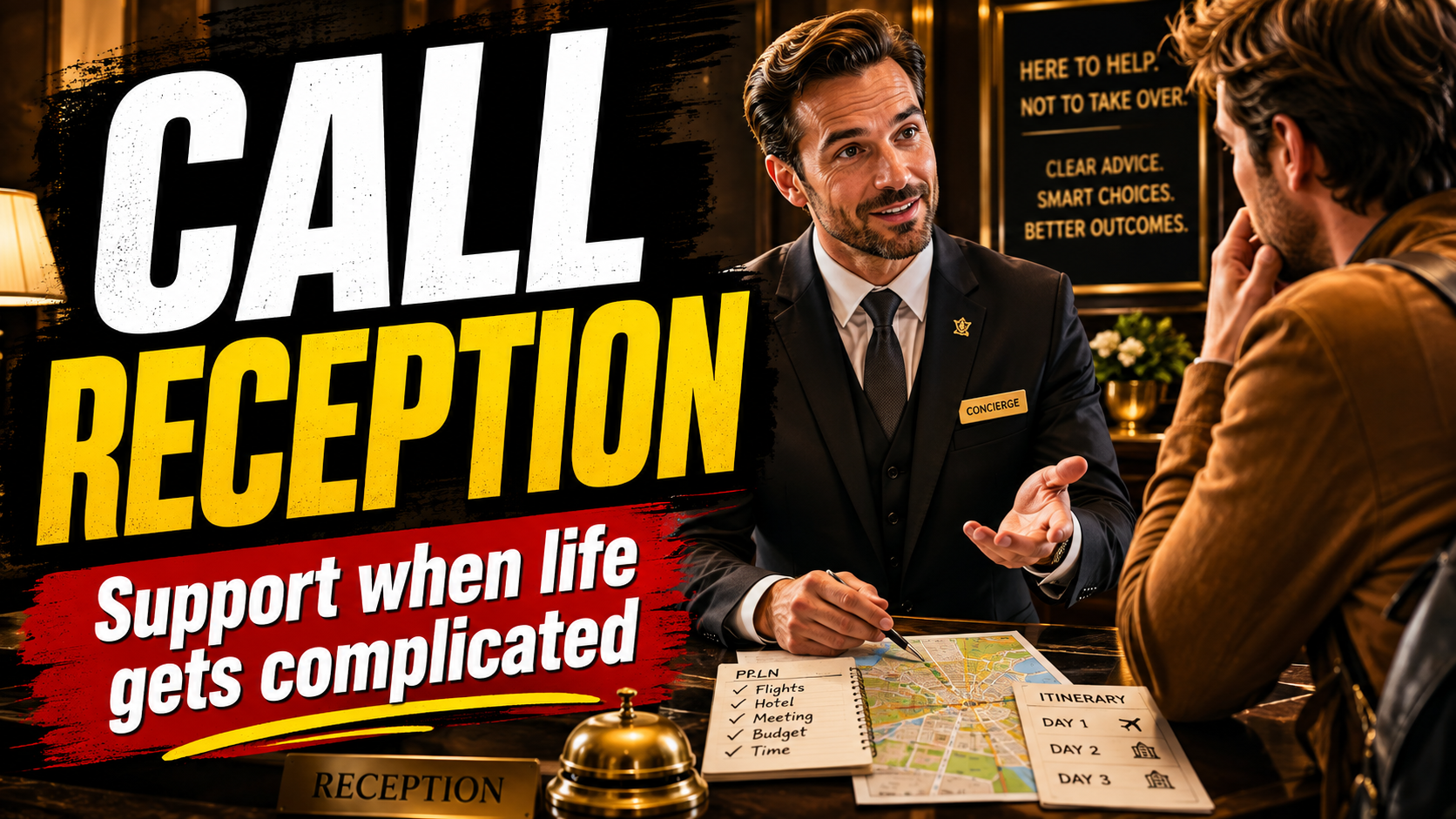
The professional’s job is not to occupy the pathway between the client and their money, but to keep that pathway clear.
Why a Total Wealth Planner should be at reception, not permanently in your room
For several years, I have described the emerging role of the holistic financial planner as a financial concierge.
I still think the metaphor is right.
But I think I misunderstood it.
And some of my earlier writing helped create the misunderstanding.
I described the planner as the client’s architect. Their quarterback. Their CFO. Their control tower. Their convener. The person who coordinated all the specialists around them.
It sounded empowering.
But look carefully and another model was quietly creeping back in.
The professional was still at the centre.
The client still had somebody standing between them and their life.
That is not the future I am trying to build.
It is another form of intermediation.
And I think we need to correct it.
Think About What a Concierge Actually Does
Imagine staying in a good hotel.
There is a concierge downstairs.
You do not telephone reception every morning and ask:
“What should I have for breakfast?”
You don’t call down before leaving your room and ask:
“Should I wear the blue shirt?”
You don’t ask the concierge to accompany you around the city, decide where you should walk, order your lunch and supervise your afternoon.
That would be absurd.
You get on with your life.
But suppose tomorrow is different.
You want to visit somewhere unfamiliar.
You are considering an experience you know little about.
You need to understand how to get there.
Perhaps other guests have tried it.
Perhaps there are things you should know before going.
So you call reception.
You might ask:
Where are the best places to visit?
What have other guests experienced?
What should I expect?
Are there mistakes people commonly make?
How might I prepare?
What questions should I ask?
The concierge does not need to take the trip for you.
Their value lies in helping you make the trip more intelligently.
That distinction matters enormously.
Financial Planning Has Confused Support With Substitution
Much of financial services is built around substitution.
You have a financial problem.
So somebody else takes over.
They choose.
They recommend.
They implement.
They monitor.
They rebalance.
They review.
And gradually an extraordinary thing happens.
The person whose life and money are supposedly being served becomes the least capable person in the system.
We call this service.
Sometimes it is.
But sometimes we have simply institutionalised dependency.
The customer becomes increasingly reliant upon professionals to perform activities they could reasonably understand and undertake themselves.
That is precisely the problem the Academy of Life Planning exists to solve.
Our objective is not merely to remove the product intermediary.
It is to remove unnecessary cognitive intermediation too.
Standing Beside Is Not Enough
I have often said that the planner should sit on the client’s side of the table.
I still believe that.
But I now think there is another step.
Sometimes the most empowering thing a professional can do is stand aside altogether.
This can be uncomfortable for apprentice Total Wealth Planners.
Professionals are trained to demonstrate value through activity.
If somebody is paying us, surely we should be doing something.
Reviewing something.
Monitoring something.
Managing something.
Coordinating something.
That instinct is understandable.
But it contains the seed of the very system we are trying to replace.
If the planner needs to remain continuously involved for the proposition to work, we should ask an uncomfortable question:
Have we built client capability, or simply created a different kind of dependency?
The Reception Test
Here is a useful test for a Total Wealth Planner.
Would the client reasonably call reception about this?
Routine budgeting?
Probably not.
Checking their pension balance?
Probably not.
Updating their financial records?
Probably not.
Running an everyday planning question through their AI tools?
Probably not.
But redundancy?
Divorce?
Bereavement?
Retirement?
An inheritance?
A suspicious investment?
A business sale?
A major career decision?
A complicated pension choice?
Suddenly the answer changes.
These are moments of complexity, stress or change.
And human beings often benefit enormously from having another capable mind available.
Not somebody to become their mind.
A second brain.
That, increasingly, is how I understand the Total Wealth Planner.
The Second Brain, Not the Substitute Brain
A good concierge possesses knowledge you do not have.
They have pattern recognition.
They may have seen hundreds of other people encounter something similar.
They know where useful resources are.
They know which questions matter.
They can spot things you may have overlooked.
They can introduce specialists where specialist expertise becomes necessary.
They can help you prepare.
And, perhaps most importantly, they can help you think when your own cognitive bandwidth has temporarily collapsed.
Stress does that.
Grief does that.
Fear does that.
Complexity does that.
Major life transitions do that.
At those moments, another human mind can be immensely valuable.
But there is a crucial difference between:
helping somebody think
and
taking over their thinking.
The first restores agency.
The second can quietly remove it.
From Continuous Advice to Episodic Support
This changes the service architecture.
The old model says:
We manage your financial life continuously.
The concierge model says:
Manage your life. We are here when you need another brain.
That means much of everyday planning belongs with the individual.
Supported by:
- AI
- education
- planning tools
- good records
- simple frameworks
- accessible information
- communities of lived experience
The human Total Wealth Planner becomes an escalation layer.
Not the operating system.
Not the permanent intermediary.
Not somebody watching over the client’s shoulder indefinitely.
The human appears when human support creates genuine additional value.
And then, wherever possible, withdraws again.
That last part matters.
Because successful support should often make itself progressively less necessary.
What About the Architect, Quarterback and CFO?
These metaphors appeared repeatedly in my earlier work.
I would use them much more carefully now.
The client is the architect.
It is their life.
The client is the quarterback.
They are making the plays.
The client is the CEO.
They carry the ultimate authority.
The Total Wealth Planner can certainly help them think architecturally.
They can help them understand the playing field.
They can help prepare information for decisions.
They can bring specialists into view.
But the planner should resist quietly promoting themselves into the command position.
Perhaps the better organisational metaphor is remarkably ordinary.
Reception.
Always accessible.
Knowledgeable.
Connected.
Calm.
Experienced.
Helpful when things become unfamiliar.
But not following you around the building.
The Concierge Should Strengthen the Guest
This also changes how we think about expertise.
Traditional professional services often create economic value by preserving an expertise gap.
The professional knows.
The customer does not.
Therefore the customer must keep returning.
Agency-based planning works in the opposite direction.
Our expertise should help close the capability gap.
The person should know more after working with us.
They should understand more.
They should recognise patterns earlier.
They should ask better questions.
They should become more confident navigating the next situation themselves.
That creates an unusual professional objective:
Every successful intervention should leave the client slightly less dependent than before.
This is what distinguishes an agency profession from a dependency industry.
AI Makes This Possible
There was a time when continuous professional involvement could be defended partly because knowledge was difficult to access.
That is rapidly changing.
AI can now help people organise information, understand terminology, explore scenarios, maintain records, prepare questions and work through many routine decisions themselves.
This does not make humans irrelevant.
It makes the proper role of humans clearer.
The machine can be present every day.
The professional does not need to be.
AI becomes the readily available cognitive infrastructure.
The planner becomes the human escalation point.
And the individual remains in control of both.
That is the hybrid model I now believe in.
Not:
AI + permanently involved adviser.
But:
Capable human + AI infrastructure + episodic expert support.
Agency sits at the centre.
Everything else sits around it.
A Different Measure of Success
This gives us a very different way of measuring whether a Total Wealth Planner is doing a good job.
Not:
How much money do you manage?
Not:
How many clients are on ongoing service agreements?
Not even:
How frequently do clients contact you?
Perhaps a better question is:
How much capability exists in the client when you are not there?
Can they make ordinary decisions?
Can they interrogate information?
Can they recognise when something exceeds their competence?
Can they find appropriate help?
Can they challenge a specialist intelligently?
Can they say no?
Can they change their mind?
Can they act?
That is financial resilience.
That is Decision Capital.
And unlike assets under management, it belongs entirely to the client.
The Total Wealth Planner’s Place
So I want to correct something in my own previous thinking.
A Total Wealth Planner is not supposed to become indispensable.
We are not building a more sophisticated version of ongoing advice.
We are not replacing one intermediary with another.
We are building agency infrastructure.
Most of the time, the person should be living their life, managing their affairs and using the tools available to them without needing us.
And when life becomes complicated, stressful or unfamiliar?
Reception is open.
Call us.
Ask what others have experienced.
Ask what you might expect.
Ask what questions you should be considering.
Ask how you might prepare.
Use our brain alongside yours.
Then make your decision.
Take your journey.
And when you no longer need us, we will stand aside again.
Because perhaps the highest expression of professional service is not having someone permanently standing between you and the world.
It is knowing that capable help is there when you need it —
without ever surrendering the agency to live your own life.
The Total Wealth Planner doesn’t stand in your way.
They stand aside — until you need a second brain.

