
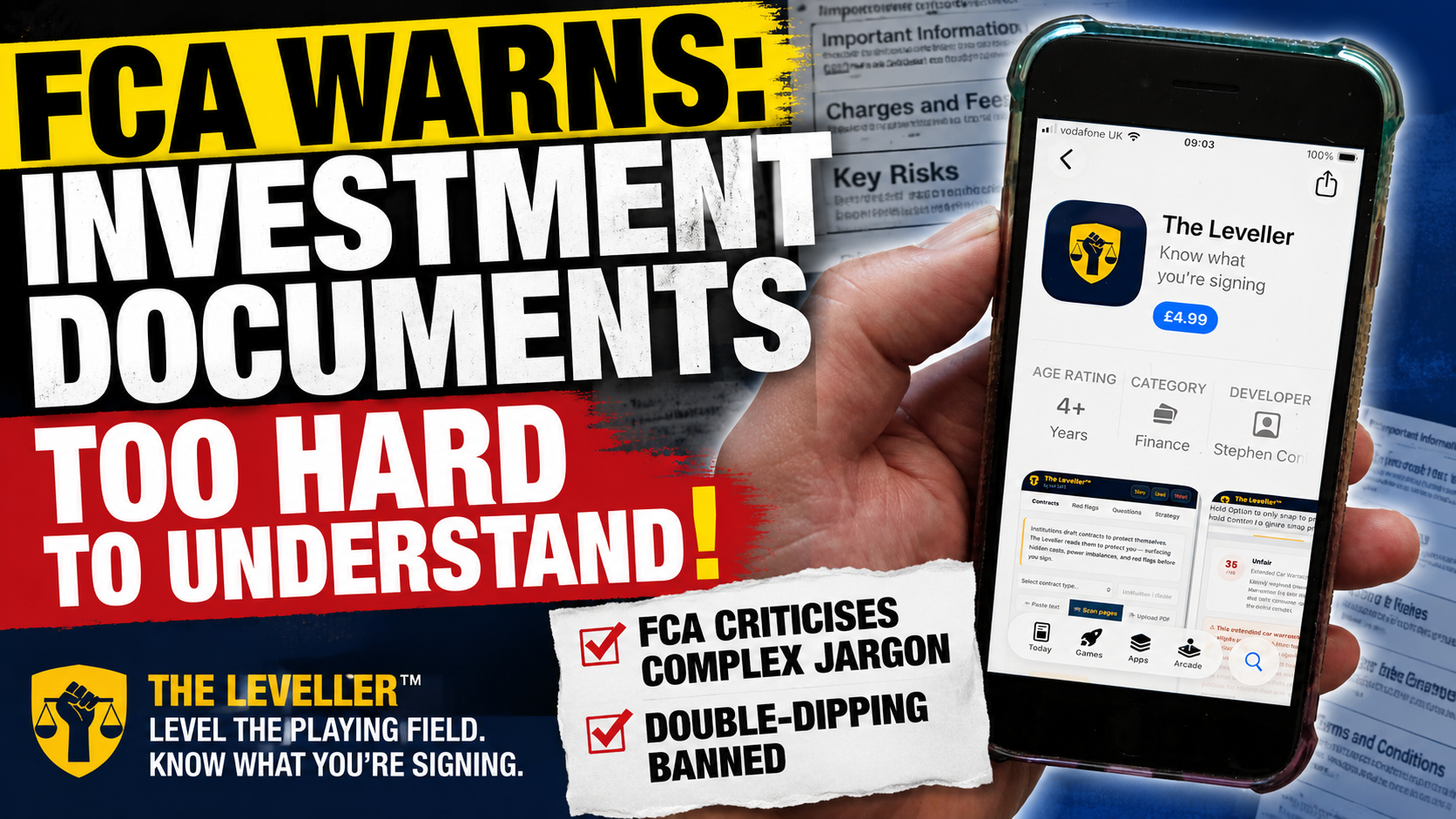
The Financial Conduct Authority has reached a striking conclusion.
After reviewing 172 investment disclosure documents, it found that almost all were written at a level too difficult for the average consumer to understand. Only 6% were considered to be written in plain English, and every single document reviewed fell below the level expected for someone with a GCSE-level education.
[Source: Financial regulator to simplify investment disclosure regime. 02/07/2026.]
That should concern all of us.
Because these are not marketing brochures.
They are the documents people are expected to rely upon before making decisions that may affect their life savings, retirement income and financial future.
The FCA is rightly calling for clearer communication and fairer charging. It has also moved to end practices such as firms charging fees while simultaneously retaining interest earned on clients’ cash balances—a practice it has previously described as inconsistent with acting in customers’ best interests.
These are welcome steps.
But they also expose a deeper problem.
Information Is Not Understanding
For decades, consumer protection has often assumed that if firms provide enough disclosure, consumers are adequately protected.
In practice, disclosure is only valuable if people can actually understand it.
Legal language.
Technical terminology.
Long sentences.
Cross-references.
Hidden assumptions.
Complex fee structures.
These do not create informed consent.
They create dependence.
People either sign because they trust the institution—or because they feel they have little alternative.
Neither represents genuine agency.
Why We Built The Leveller
The Leveller was created for precisely this problem.
Not to replace lawyers.
Not to replace advisers.
Not to tell people what decisions to make.
Instead, it helps people understand what they are being asked to agree to.
Users can upload agreements, contracts, investment documents or letters and receive a structured explanation of:
- unusually one-sided clauses
- areas that deserve further questioning
- language that may be difficult to understand
- practical implications for the individual
- questions worth asking before signing
The purpose is simple:
Restore the individual’s ability to think clearly before committing themselves.
Agency Is Better Protection Than Disclosure Alone
Regulation will always have an important role.
Firms should communicate more clearly.
Charges should be fair.
Products should deliver value.
But no regulator can read every document before every consumer signs it.
The strongest form of consumer protection is a citizen who understands enough to pause, ask questions and make informed choices.
That is what restored agency looks like.
AI Can Help Level the Playing Field
Artificial intelligence is often discussed as a tool for financial firms.
Yet consumers now have access to many of the same capabilities.
Used responsibly, AI can translate legal language, identify unusual clauses, explain technical terminology and help people prepare better questions before speaking to professionals.
That changes the relationship.
The goal is not to remove professional advice.
It is to ensure that people enter those conversations informed rather than intimidated.
The Future Is Capability, Not Dependency
The FCA’s findings are another reminder that complexity still creates unnecessary barriers between institutions and the people they serve.
At the Academy of Life Planning, we believe the answer is not simply to produce better disclosure documents.
It is to restore human agency.
The Leveller exists to help people understand before they agree.
Because fairness begins with comprehension.
And understanding should never be a privilege reserved for professionals.
The FCA’s own press release is here:
Financial regulator to simplify investment disclosure regime
It contains the key points behind the FT article, including:
- The FCA is consulting on simplifying how investment platforms, advisers and wealth managers communicate investment costs.
- Firms will be expected to communicate in plain English rather than jargon and will have greater freedom to present information in more engaging ways.
- The FCA found that only 6% of 132 disclosure documents reviewed were written in plain English, and all 172 documents assessed were more complex than GCSE reading level.
- Around 30% of non-advised platform users said they did not know how much they were being charged for investing.
- The consultation also addresses disclosure of fees on client cash and reinforces previous expectations around firms avoiding “double-dipping.”
- The consultation closes on 21 August 2026, with the new Consumer Composite Investments (CCI) disclosure regime due to take effect from June 2027.
One aspect of the FCA release is particularly interesting from an Academy of Life Planning perspective. It says:
“The changes will give firms more freedom to innovate and communicate in ways that build trust and support informed decisions…”
That is a welcome objective, but it still assumes the solution lies with firms communicating better.
The Academy’s position is subtly different.
Rather than relying solely on firms to simplify information, we argue that individuals should have AI tools that increase their own capability to understand whatever they are given. Even if every firm writes in plain English, people will still encounter contracts, legal documents, settlement agreements, warranties, employment contracts, investment memoranda and pension paperwork that are complex.
The Leveller isn’t a substitute for clearer writing. It’s a capability layer that sits alongside it.
That gives you a strong distinction:
The FCA is improving disclosure.
The Academy of Life Planning is improving comprehension.
I think that’s an even stronger message than “The FCA is asking firms to write more clearly.” It positions AoLP as complementing the regulator’s work rather than simply commenting on it.
If you believe the future of consumer protection lies not only in better disclosure, but in helping people understand, question and decide with confidence, you’re already thinking about the future of financial planning.
Explore Academy OS—our growing ecosystem of AI-supported tools designed to restore human agency, including The Leveller™, The Investigator™, Total Wealth Plan™, and many more.
Visit the Academy of Life Planning to discover how we’re building AI that empowers people—not replaces them.
 Academy of Life Planning