
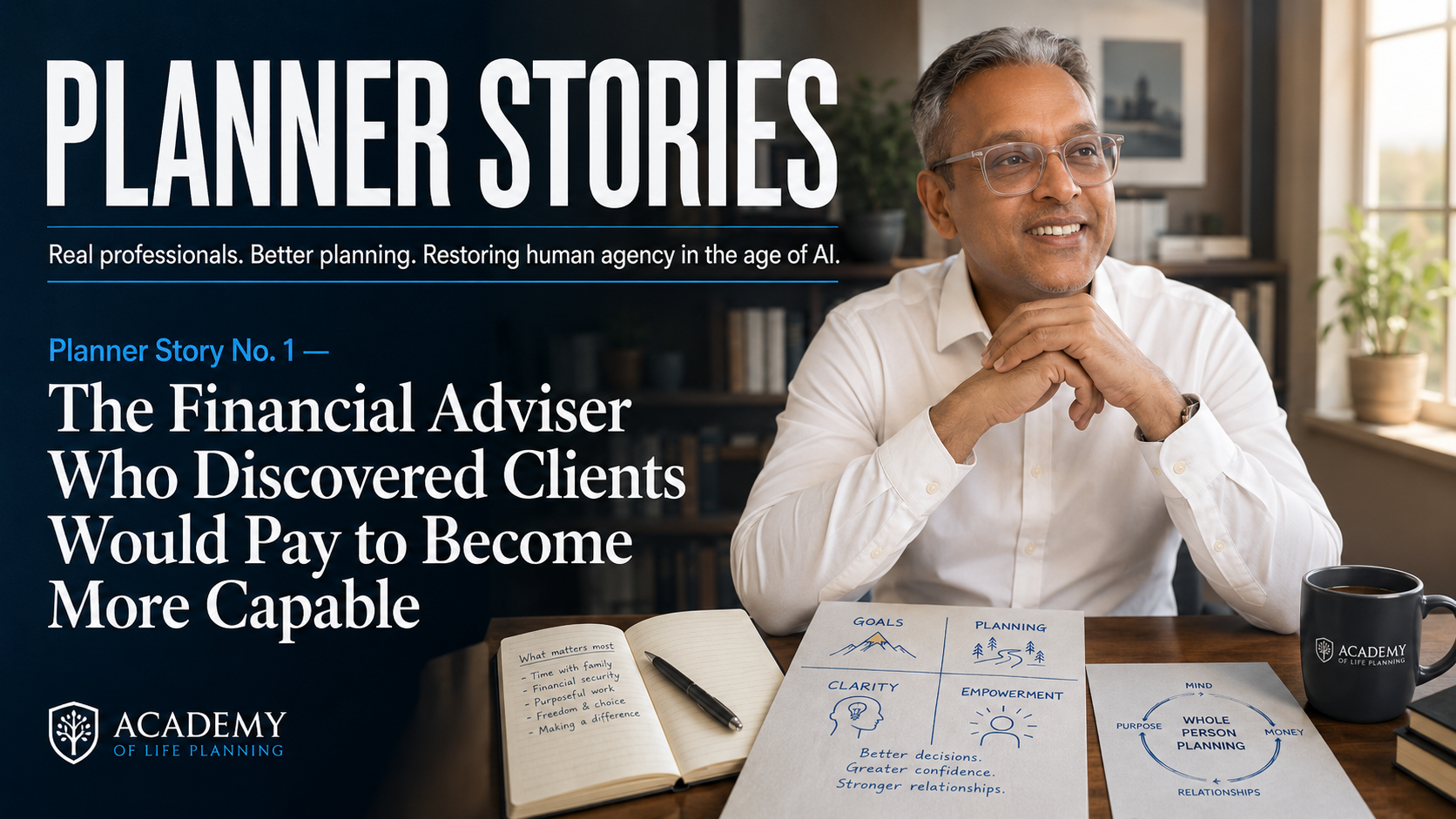
Planner Story No. 1
The Financial Adviser Who Discovered Clients Would Pay to Become More Capable
After more than twenty years in financial advice, Mushtaq Jaigirdar faced a question many experienced advisers quietly carry: would people still value his expertise if it was no longer attached to products, portfolios or permanent dependency?
The breakthrough did not arrive in a strategy document.
It arrived when someone agreed to pay him.
Not to transfer an investment portfolio. Not to arrange a pension. Not to place assets under management. Not to receive an annual review built around fund performance.
The client was willing to pay Mushtaq for education, guidance and independent thinking.
For someone who had spent more than twenty years within the financial-advice sector, that first engagement answered a question that qualifications and business planning could not.
Would people value planning when the planning itself was the service?
They would.
“That was the breakthrough,” Mushtaq later reflected. “Somebody was willing to pay me for this education and guidance thing.”
Two years after becoming an accredited GAME Plan practitioner, Mushtaq no longer describes this as an experiment.
For the right clients, he now sees it as a no-brainer.
An experienced adviser looking for a different model
Mushtaq did not enter the Academy of Life Planning as a newcomer to financial services.
He brought more than two decades of experience, particularly with dentists, medical professionals and other healthcare practitioners. He understood NHS pensions, business structures, taxation, investments, retirement planning and the financial realities of professional practice.
His problem was not a lack of knowledge.
It was that the established system organised that knowledge around a particular commercial objective.
Traditional advice commonly begins with a financial need and moves towards a regulated recommendation or product solution. The relationship is frequently sustained through ongoing fees connected to investments under management.
That model can work for people who want delegation and regulated implementation. It can also provide valuable protections and professional accountability.
But it shapes what the adviser is paid to notice.
A client may arrive with questions about career, health, business ownership, family, stress, retirement or purpose. Yet the commercial centre of gravity often pulls the conversation back towards the portfolio.
Mushtaq had seen this directly.
After leaving his previous firm, former clients told him that their annual conversations had become dominated by investments. The wider issues that mattered to their lives were no longer receiving the same attention.
The advisers were not necessarily acting improperly. They were operating within a model that made the portfolio the principal economic relationship.
The hidden professional problem was therefore not simply product bias.
It was attention bias.
The commercial model influenced which parts of the client’s life received professional attention.
Building the Business Plan of You
Mushtaq’s own GAME Plan was prepared in July 2024.
It did not begin with his business revenue or client acquisition targets. It began with his life.
His plan explored health, travel, family relationships, cultural identity, charitable ambitions, his father’s legacy and the possibility of developing sports facilities for disadvantaged children in Bangladesh.
His professional ambitions sat inside that wider life rather than above it.
The business proposition that emerged was clear: provide non-intermediating financial planning to dental practitioners and other healthcare professionals, combining technical expertise with education, empowerment and consideration of the client’s wider well-being.
The original plan identified a central distinction.
Mushtaq would not merely help clients preserve wealth. He would help them understand their position, make better decisions and become more capable of navigating their own financial lives.
The plan described his work using words such as education, mentoring, empowerment and clarity.
At the time, these were partly design principles.
Two years later, they have become measurable client outcomes.
From proposition to proof
Early business plans often look persuasive on paper.
The harder test is whether a real person will pay for the proposition.
Mushtaq initially carried the understandable doubts of an experienced professional leaving a familiar commercial structure.
Would clients understand the service?
Would they value planning without product implementation?
Would they pay for education and guidance?
Would an independent planning practice be commercially sustainable?
Those questions did not disappear because he became accredited. They were resolved gradually through practice.
The first paying client reduced the uncertainty.
Each subsequent client provided further evidence.
Over approximately two years, Mushtaq estimates that he has worked with close to 50 people through a mixture of one-off projects and ongoing relationships.
That figure matters, but not because volume alone defines success.
During many years in his former firm, Mushtaq built a book of approximately 45 ongoing clients. In his new model, he has been able to help a similar number of people in a much shorter period because every engagement does not need to become a permanent relationship.
Some clients need a defined piece of work.
They may need help understanding an NHS pension, evaluating retirement options, planning a business exit, assessing tax choices or deciding whether they can afford a major life change.
The work can be completed. The client can act. The relationship can pause.
The commercial model does not require the planner to remain permanently necessary.
That creates a different measure of professional success.
Not: how many people remain attached to the adviser?
But: how many people are now in a better position because the adviser helped them?
Mushtaq expresses it more simply:
“I am looking to help people be in a better place.”
The second brain, not the controlling mind
One client illustrates the difference.
The client was a GP partner trapped in a toxic professional partnership. He had spent years in the organisation and was considering leaving, but the decision involved career, income, pension, business and emotional consequences.
Mushtaq’s role was not to recommend an investment product.
He helped the client examine whether he could afford to leave, understand the implications for his NHS pension, consider the financial foundation for the decision and think through the development of a separate business.
They met regularly.
For around eighteen months, no financial product was implemented.
Nothing was transferred. No portfolio was gathered. No investment recommendation sat at the centre of the work.
Yet the client repeatedly told Mushtaq that he might not have made the change without those conversations.
The client eventually resigned from the partnership and was able to focus more fully on his new business.
Mushtaq had not taken over the decision.
He had created a safe place in which the client could examine it.
Steve Conley describes this role as a second brain: an informed, independent thinking partner without an ulterior product motive.
The phrase captures an important distinction.
A controlling mind tells the client what to do.
A second brain helps the client see more clearly, test assumptions, understand consequences and remain the author of the decision.
That is not passive facilitation.
It requires technical knowledge, judgement, challenge, structure and the willingness to identify risks the client may not see.
But those capabilities are used to strengthen the client’s agency rather than replace it.
Measuring what the old model overlooked
Mushtaq has also begun measuring a different kind of outcome.
He developed a client assessment based on four areas:
- education;
- mentoring;
- empowerment; and
- clarity.
Clients are asked how they felt before engaging him and how they feel now.
In one completed assessment, the client scored each category at the lowest level before the engagement. Their current scores had risen to fours and fives.
The client wrote:
“We are extremely happy with the service and advice from Smile Financial. We feel more empowered and confident to handle our future financial commitments.”
The wording matters.
The client did not principally praise investment performance.
They described increased empowerment and confidence.
Mushtaq intends to repeat the assessment annually. It will help him identify service gaps, agree future priorities and judge whether he has delivered what he promised.
It is therefore more than a satisfaction survey.
It is a capability audit.
Traditional advice businesses often measure assets, recurring income, retention and investment performance. These are commercially relevant, but they reveal little about whether the client has become more knowledgeable or capable.
Mushtaq’s assessment asks a different question:
Is the client stronger because of the relationship?
That may become one of the defining professional questions of Total Wealth Planning.
Knowing when not to displace another professional
Moving from advice to agency does not require rejecting regulated advisers, investment managers or product specialists.
Mushtaq is explicit about this.
He does not regard IFAs as competitors. Some clients want delegation. Some need regulated recommendations. Some will eventually become unwilling or unable to manage their own investments.
In those circumstances, the right adviser or discretionary investment manager can become part of the solution.
Mushtaq describes his role as sitting on the same side of the table as the client.
He helps the client understand the wider picture. Where implementation is required, the client can engage a suitable regulated professional.
This creates the possibility of a more modular professional ecosystem:
- the Total Wealth Planner supports life planning, decision-making and capability;
- the regulated adviser provides specific recommendations where required;
- the investment manager manages assets where delegation is appropriate;
- the accountant or solicitor contributes specialist legal or tax expertise.
The planner does not need to own every part of the relationship to remain valuable.
In fact, independence from implementation can make the planner more trusted as the person helping the client decide which expertise is needed.
AI as the missing technical team
Mushtaq’s development has also coincided with the arrival of generative AI.
For a sole practitioner, this has practical significance.
In a larger advice firm, a recommendation or technical calculation might pass through several people. A paraplanner, compliance officer or pension specialist may notice something the original adviser missed.
An independent practitioner may not have that internal infrastructure.
Mushtaq now uses AI as an additional quality-assurance layer.
In one case, a client had taken NHS pension benefits before April 2024 and held individual protection. Mushtaq calculated that the client should qualify for substantially more tax-free cash under the post-lifetime-allowance regime.
The pension provider accepted the figures and appeared ready to proceed.
Before authorising the payment, Mushtaq submitted his analysis to AI for a final challenge.
The system raised the possible need for a Transitional Tax-Free Amount Certificate.
Mushtaq stopped the payment, investigated the issue and confirmed that the certificate was required.
The intervention potentially protected a substantial amount of the client’s tax-free entitlement.
AI did not make the decision.
It identified a question that required professional investigation.
Mushtaq has since created separate AI workspaces for different technical areas. He uses them much as a practitioner might consult members of a virtual technical team.
The workflow is disciplined:
- Mushtaq completes the initial analysis.
- AI is asked to identify omissions, risks or alternative interpretations.
- Mushtaq researches the issues raised.
- He applies his own professional judgement.
This is not expertise being replaced.
It is expertise being extended.
The practitioner still needs enough knowledge to recognise when the AI is wrong, when its warning is material and when further verification is required.
In the age of AI, the value of experience may shift from remembering every answer to knowing which answers need to be challenged.
A practice built around capability
Two years after accreditation, Mushtaq’s most important development is not that he has discarded his former expertise.
He has changed its purpose.
His pension knowledge, tax experience and understanding of professional practices remain essential. But they are no longer organised mainly around acquiring assets, arranging products or maintaining permanent control of the relationship.
They are used to help people understand, choose and act.
This has also changed how Mushtaq sees competition.
He does not worry that more practitioners will adopt the same model. Healthcare and public-sector pension markets contain millions of people. Different planners bring different personalities, relationships and specialist knowledge.
“The more of us doing this, the better,” he says.
That confidence reflects a profession understood less as a contest for assets and more as shared infrastructure for human capability.
When the plan changes
Mushtaq’s life has also changed.
During the meeting, he joked that his previous life plan had gone out of the window.
But this does not mean the GAME Plan failed.
It reveals what a plan is for.
A plan is not a prediction that life must obey.
It is a platform of capability from which someone can respond when life changes.
The business Mushtaq built now gives him greater flexibility over where he works, how he supports clients and how he organises his time. The earlier goals may need revision, but the independence and capability created through the process remain.
The plan changed.
The planner became more capable of changing with it.
A different definition of professional success
The established advice model often rewards the adviser for remaining necessary.
The agency model rewards the planner for making the client more capable.
That does not mean every relationship should end. Complexity, stress and change recur throughout life. Clients may return precisely because they trust a planner who did not seek to create unnecessary dependency.
Mushtaq is building a business around that possibility.
Some clients engage him for a project. Some value an ongoing second-brain relationship. Some may eventually require regulated implementation or delegated investment management.
The support is proportional to the need.
The professional value lies not in controlling every answer, but in helping the client remain capable of making the decisions they can—and recognising when specialist help adds value.
Advice solves the decision.
Agency strengthens the decision-maker.
Mushtaq’s story suggests that this distinction is not merely ethical or philosophical.
It can also support a practical, credible and commercially viable planning business.
As AI makes information and technical assistance more widely available, the question facing the profession may no longer be whether clients can obtain answers without an adviser.
It may be this:
Will the planners of the future be paid for remaining indispensable—or for helping people become more capable?
The Planner Lesson
Professional expertise becomes more valuable when it is used to increase the client’s capability rather than preserve the planner’s control.
Planner Stories follow professionals who are developing a different model of planning: one that combines human judgement, structured planning and AI to strengthen the client rather than preserve dependency. They show what it means, in practice, to become a Total Wealth Planner.
For more information on Total Wealth Planning, please visit www.academyoflifeplanning.com.

