
Restoring human agency in a structurally untrustworthy system
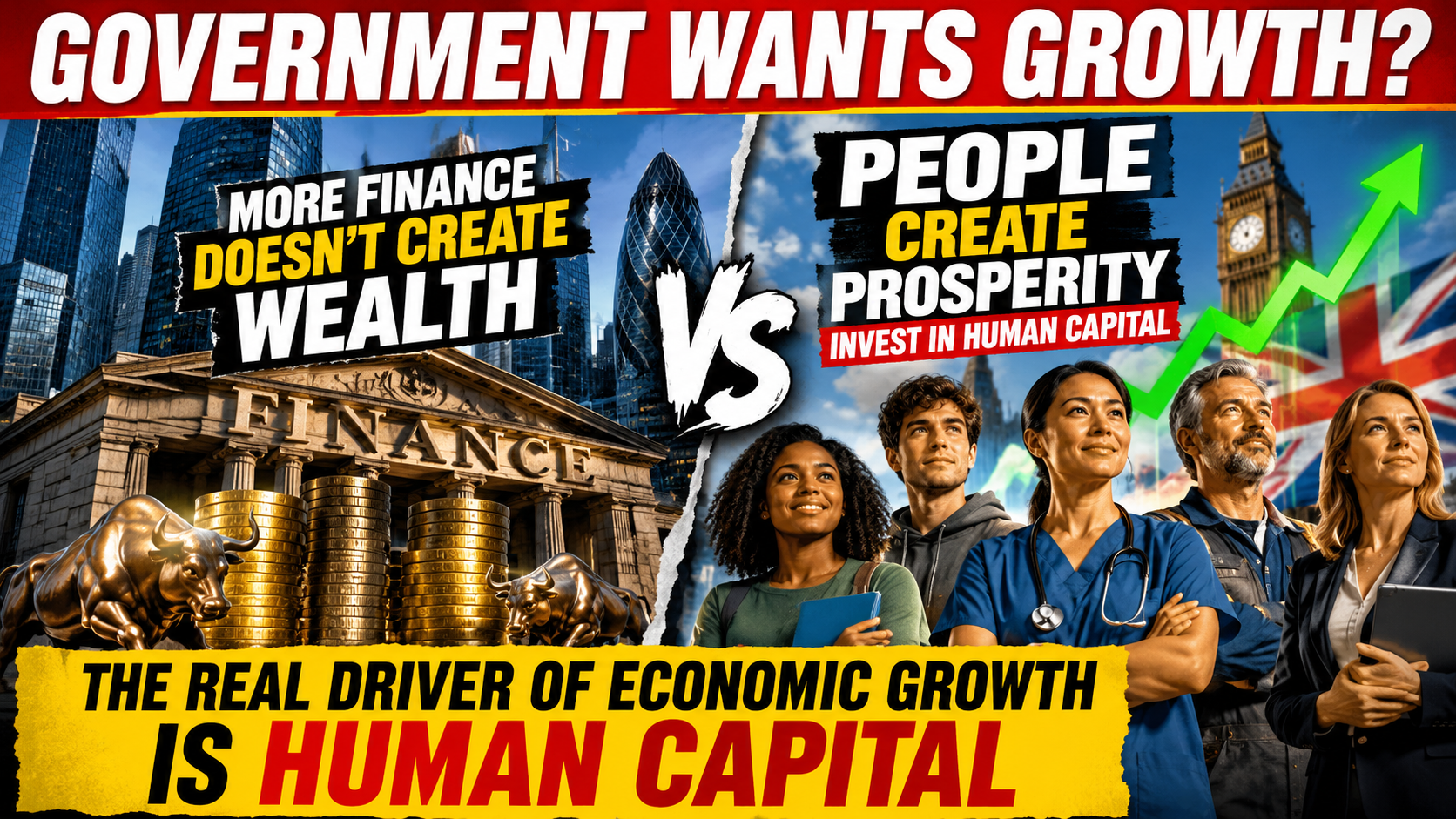
The Government says it wants growth.
Few would disagree with the objective. Britain needs greater productivity, stronger businesses, higher incomes and sustainable public finances.
The more important question is:
What actually causes an economy to grow?
The Government’s Financial Services and Markets Bill appears to begin with a familiar answer: modernise regulation, improve the competitiveness of financial services, enable the sector to expand and encourage it to lend and invest more.
Lord Stockwood, the minister responsible for taking the Bill through the House of Lords, has described it as a way to modernise regulation, support the growth of the financial sector and enable more lending to businesses. The Government also argues that the FCA and PRA should consider the consequences of regulation for the competitiveness of the financial sector and for wider economic growth.
At first glance, this sounds reasonable.
Finance matters. Infrastructure matters. Investment matters.
But beneath the language sits an assumption that Parliament should examine much more carefully:
If we make financial markets larger, freer and more competitive, economic growth will follow.
That assumption is not self-evidently true.
More importantly, it confuses the system that allocates wealth with the capabilities that create it.
Financial capital allocates wealth. Human capital creates it.
For decades, economic policy has focused heavily on financial capital:
- savings
- investment funds
- pension assets
- business lending
- capital markets
- physical infrastructure
- institutional investment
These things can support growth.
But none of them produces prosperity independently.
A railway contributes little if people lack the skills, health or opportunity to make productive use of it.
A business loan creates no sustainable value if the borrower lacks the knowledge, capability or market access needed to build a viable enterprise.
An investment fund does not create innovation simply because it contains money.
Financial capital becomes productive only when it is combined with human capability, useful knowledge, functioning institutions and real economic opportunity.
That leads to a distinction our growth debate repeatedly overlooks:
Financial capital is stored productive capacity. Human capital is living productive capacity.
The former can help the latter grow.
It cannot replace it.
What the evidence actually says
The case for human capital is not a philosophical preference. It rests upon a substantial body of international economic research.
The World Bank describes human capital as the cornerstone of economic growth and job creation. Its work defines human capital through the health, knowledge, skills and experience people accumulate throughout their lives.
The World Bank’s comprehensive wealth accounts also show that human capital is the largest component of national wealth. Its 2024 analysis estimates that human capital represents around 63% of wealth in Europe and Central Asia, 65% in Latin America, and between approximately 55% and 60% across other world regions.
A recent World Bank review goes further, estimating that differences in human capital account for roughly two-thirds of the difference in per-capita GDP between richer and poorer countries.
OECD research similarly finds strong empirical links between human capital and productivity. Improved measures incorporating the quality and quantity of education help explain productivity differences across OECD countries and over time. The OECD has also concluded that improving the quality of human capital can offer productivity gains comparable in scale to reforms of product-market regulation, although the benefits emerge over a longer period.
Earlier OECD studies found a positive and significant relationship between human capital accumulation and output per person, while recognising that physical capital also contributes.
That last qualification matters.
The evidence does not say that infrastructure and financial capital are useless.
It says something more important:
Capital investment works best when people possess the capability to convert it into productive activity.
Human capital is not an alternative destination for surplus money after the “serious” economic investments have been made.
It is the productive foundation upon which those investments depend.
The growth model may have the sequence backwards
The prevailing model often looks like this:
Strengthen financial markets → increase investment → stimulate businesses → create jobs and prosperity
But the evidence suggests that the more durable sequence is:
Develop human capability → enable productive participation → create viable enterprises → attract and use capital effectively → generate sustainable growth
The difference is not semantic.
It changes where government begins.
Under the first model, citizens are largely passive. Money is moved through institutions in the hope that prosperity eventually reaches households.
Under the second, people are treated as productive assets capable of learning, adapting, creating and contributing.
One model begins with capital markets.
The other begins with human agency.
Growth for the financial sector is not necessarily growth for the country
There is another distinction Parliament should make.
The growth of the financial services industry is not synonymous with the growth of the productive economy.
A larger financial sector may produce:
- higher institutional revenues
- larger assets under management
- more transactions
- more lending
- increased financial intermediation
- greater profits for regulated firms
Some of that activity may support productive enterprise.
Some may simply increase the volume of claims, fees, leverage and transactions circulating within the financial system.
The critical question is therefore not merely whether the Bill will help financial institutions grow.
It is:
How will that growth increase the productive capability, income and resilience of ordinary citizens?
Without a convincing answer, “growth” risks becoming a word through which sectoral advantage is presented as national interest.
Can Parliament safely rely on the FCA and FOS?
The Bill also appears to depend upon another major assumption: that Parliament can rely upon the existing regulatory and redress architecture to protect the public while the financial sector is encouraged to become more competitive.
That assumption should not be accepted without evidence either.
The Government presents the Bill as maintaining high standards of regulation, oversight, consumer protection and redress.
But the FCA is already being asked to pursue several objectives simultaneously:
- consumer protection
- market integrity
- competition
- international competitiveness
- economic growth
These objectives do not always point in the same direction.
A regulator encouraged to reduce burdens on firms may become more hesitant to impose costs upon those firms.
A regulator judged partly by industry competitiveness may be less willing to acknowledge systemic harm.
A redress system dependent upon the institutions surrounding it may gradually learn to manage complaints rather than confront the structures producing them.
This does not require corruption or conspiracy.
It can emerge through incentives.
Institutions pay greatest attention to the outcomes by which they are measured, the stakeholders with whom they interact most frequently and the risks for which they are held accountable.
That is why parliamentary scrutiny matters.
Before Parliament places greater reliance upon the FCA or FOS, it should ask:
- What independent evidence demonstrates that existing consumer protections are working?
- How are repeated patterns of harm identified and corrected?
- What happens when the regulator’s competitiveness objective conflicts with consumer protection?
- Who represents citizens who do not possess the knowledge, confidence or resources to navigate the system?
- How does the regulatory structure increase public capability rather than institutional dependency?
The present Bill has already prompted amendments relating to financial inclusion, fraud prevention and financial capability. During the Lords debate, it was explicitly argued that better-informed consumers are less vulnerable to fraud, better able to compare products and more capable of exercising choice—supporting competition as well as personal resilience.
That insight should sit at the centre of the growth debate, not at its edge.
Trust is productive infrastructure
Economic models often treat trust as a social value.
It is also an economic asset.
People invest, start businesses, enter contracts and make long-term plans because they believe institutions will behave predictably and disputes will be handled fairly.
When confidence in regulators, ombudsmen, banks or courts deteriorates, economic energy is diverted into:
- defensive behaviour
- disputes
- due diligence
- legal costs
- complaint handling
- recovery processes
- institutional avoidance
That is not productive growth.
It is the economic cost of mistrust.
A structurally untrustworthy system does not merely harm individual victims. It reduces the willingness and ability of citizens to participate.
Trust is therefore not a soft alternative to competitiveness.
It is part of the infrastructure through which productive economies function.
What a human capital growth strategy would look like
A serious human capital strategy would begin by asking where productive capability is being wasted.
Consider:
- young people outside employment, education or training
- experienced workers pushed out of employment in their fifties
- people whose health prevents economic participation
- carers whose capabilities remain economically invisible
- small-business owners unable to obtain proportionate support
- people displaced by AI without practical routes into new livelihoods
- victims of financial harm spending years trying to navigate inaccessible institutions
- communities with ideas and talent but little access to knowledge, confidence or networks
These are not merely social-policy problems.
They are stranded productive assets.
A Government committed to growth would invest in helping people:
- identify their capabilities
- acquire useful skills
- protect their health
- use AI productively
- find entrepreneurial opportunities
- build sustainable livelihoods
- understand financial decisions
- access proportionate support
- recover after economic or financial harm
This is not about abandoning investment in infrastructure or finance.
It is about recognising the correct order of operations.
Build capable people. Build trustworthy institutions. Then capital has somewhere productive to go.
AI changes what is possible
For much of history, personalised education, financial planning, business support and professional analysis were expensive.
Artificial intelligence changes that constraint.
AI can help individuals:
- understand complex information
- explore their skills and experience
- identify viable opportunities
- examine financial decisions
- review professional communications
- test assumptions
- create plans
- maintain records
- investigate potential harm
This does not eliminate the need for professional support.
It makes proportionate support possible.
Most people, most of the time, can act independently when given the right tools. Human help can then be introduced when complexity, vulnerability or consequence makes it valuable.
This is the emerging role of public-interest AI:
Not replacing human agency.
Restoring it.
The question Parliament should ask
The Financial Services and Markets Bill asks Parliament to accept that a more competitive financial system will contribute to growth.
Parliament should reverse the burden of proof.
It should ask the Government:
What empirical evidence demonstrates that expanding financial intermediation and easing regulatory constraints will create more sustainable national prosperity than investing directly in the health, knowledge, capability and agency of the population?
It should also ask:
Why is Parliament being asked to place greater confidence in the FCA and FOS without first establishing—independently—that the existing system is trusted, effective and capable of identifying structural harm?
These are not arguments against finance.
They are arguments against financial reductionism.
Finance is a tool.
Infrastructure is a platform.
Institutions establish the conditions.
But people create value.
The real wealth of the country does not sit in pension funds, bank balance sheets or investment portfolios.
It lives in the health, knowledge, creativity, relationships and productive agency of its citizens.
The Government says it wants growth.
The question is whether it is prepared to invest in the asset that produces it.
Financial capital can fund the future.
Human capital must create it.

