
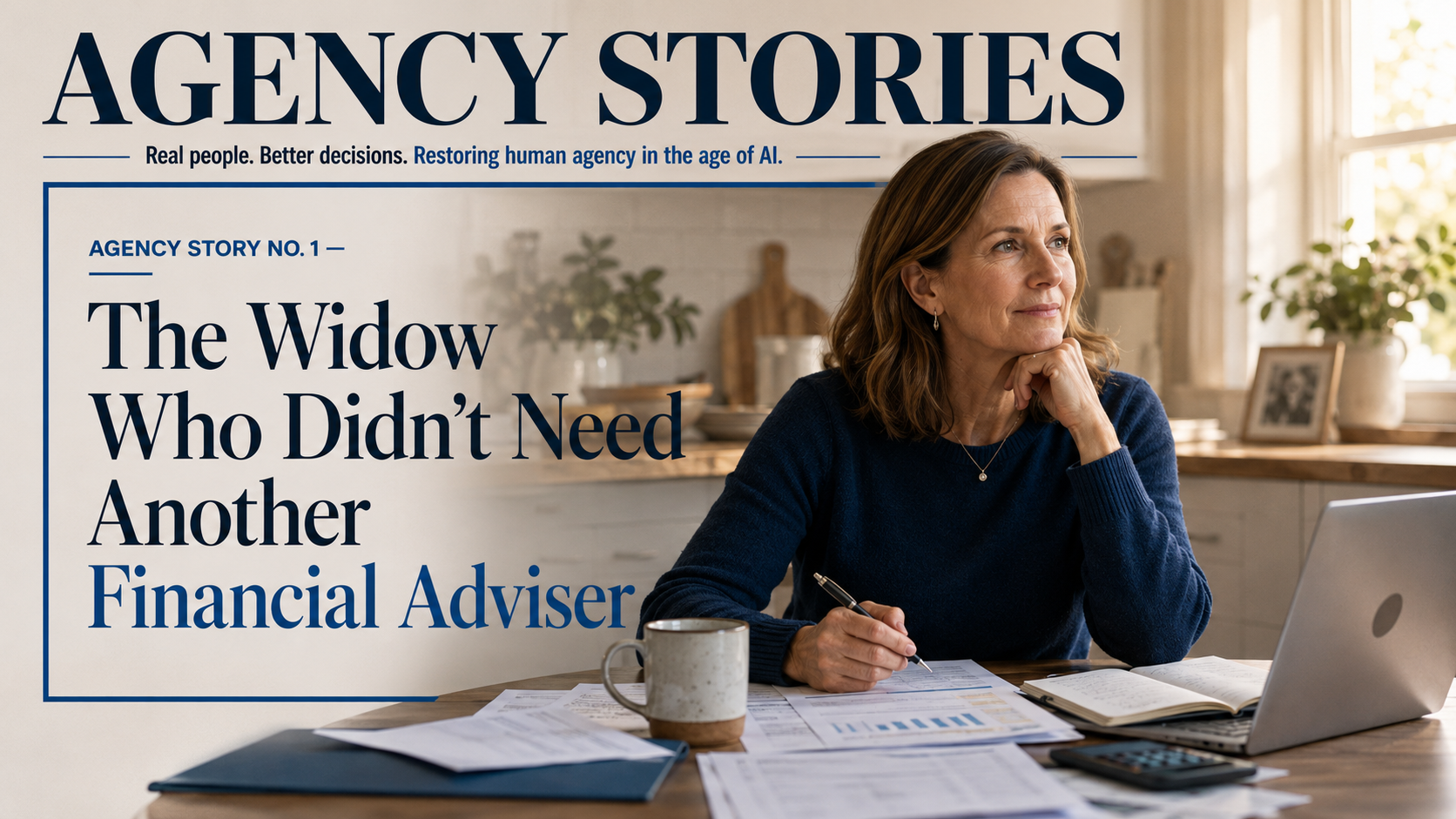
 Success should not always mean client retention
Our inner circle discussed yesterday the example of a recently widowed client who initially lacked the confidence to manage her finances.
After 18 months of patient explanation and practical support, she became capable of managing them independently.
The planner became progressively less necessary.
That is not a failed commercial relationship. It is a successful restoration of agency.
“The purpose of good financial planning isn’t to make people dependent on advice. It’s to help them become capable without it.”
When Lisa first came to me, she thought she needed a financial adviser.
She had recently lost her husband after a long illness. A short time later she lost her father too. Grief had brought what she described as “brain fog”. At the very moment she needed to make some of the biggest financial decisions of her life, she no longer trusted herself to make them.
She had inherited significant assets. Bank deposits were maturing. Investments needed reviewing. Pensions had to be understood. Estate planning suddenly mattered.
Like many widows, she assumed the answer was to find someone to take over.
But there was a problem.
A previous adviser had proposed fees so high that, in Lisa’s words, “I may as well have given him the keys to my flat.”
That sentence captures one of the biggest problems in financial planning today.
When confidence is at its lowest, dependency is at its highest.
The problem wasn’t money
Lisa’s finances weren’t actually in bad shape.
The real problem was capability.
She had hundreds of thousands of pounds sitting in savings accounts because she didn’t feel confident investing them. She worried about Financial Services Compensation Scheme limits. She had forgotten pensions. She wanted to understand inheritance tax, gifts to family, ethical investing, and how to organise her affairs after death. Every question seemed connected to another.
None of these questions were unusual.
What was unusual was the approach we took.
Advice wasn’t the objective
We didn’t begin by choosing products.
We began by building understanding.
Over the following months we worked through every major decision together.
We explored why inflation quietly destroys purchasing power.
We discussed the difference between volatility and permanent loss.
We looked at globally diversified tracker funds and why low costs matter.
We reorganised savings to improve Financial Services Compensation Scheme protection.
We built a cash-flow forecast so Lisa could see what “enough” actually looked like.
We reviewed pensions, inheritance tax, gifting, document storage, executor planning and future spending.
Every meeting had the same objective.
Not to make the next decision for Lisa.
To make the following decision easier for Lisa to make herself.
Something changed
At first, Lisa arrived with lists of questions.
Should I sell these shares?
Where should I keep this cash?
What does this report mean?
Can you explain this pension?
Gradually the questions changed.
Instead of asking me what to do, she began explaining her own thinking.
She challenged assumptions.
She explored alternatives.
She understood the trade-offs.
Confidence was returning.
Not because someone had taken responsibility away from her.
Because someone had helped her understand it.
The moment that mattered
After our final review meeting, my notes contained one sentence.
“Lisa expressed her satisfaction with the meeting and her intention to manage her finances independently going forward.”
That wasn’t the end of a client relationship.
It was the successful completion of it.
Later, Lisa wrote
“Steve charged a much more reasonable fee to help me get my finances in order and was incredibly good at patiently explaining things to me. My bereavements meant I suffered from brain fog, so found it hard to grasp things.
Our regular meetings ‘forced’ me to take action and empowered me to make decisions about my financial planning.
Steve is incredibly kind, supportive and knowledgeable and I really appreciated his help during one of the most stressful periods of my life.”
For me, the most important sentence isn’t the recommendation.
It’s this one:
“…empowered me to make decisions about my financial planning.”
That is the outcome we should be measuring.
A different definition of success
Much of financial services measures success by assets under management.
We measure success by agency restored.
The best planner isn’t the one who stays indispensable forever.
It’s the one who leaves people more capable than when they arrived.
Sometimes they’ll still want support.
Sometimes they’ll ask for a second opinion.
Sometimes life becomes complicated again.
But the relationship has fundamentally changed.
It is no longer based on dependency.
It is based on confidence.
Agency before advice
Artificial intelligence is changing financial planning.
Many people assume that means replacing advisers.
I think it means changing what good advisers do.
The future isn’t advisers versus AI.
The future is advisers, AI and education working together to restore human agency.
Lisa’s story isn’t really about investments.
It’s about what happens when someone who has lost confidence discovers they can think clearly again.
That’s the future the Academy of Life Planning exists to build.
Agency Restored
Situation: Recently widowed, grieving, overwhelmed by complex financial decisions.
Challenge: Confidence, not money, was the scarce resource.
Approach: Education, AI-enabled planning tools and proportional human support.
Outcome: Lisa now manages her finances independently, returning for support only when it adds value.

