
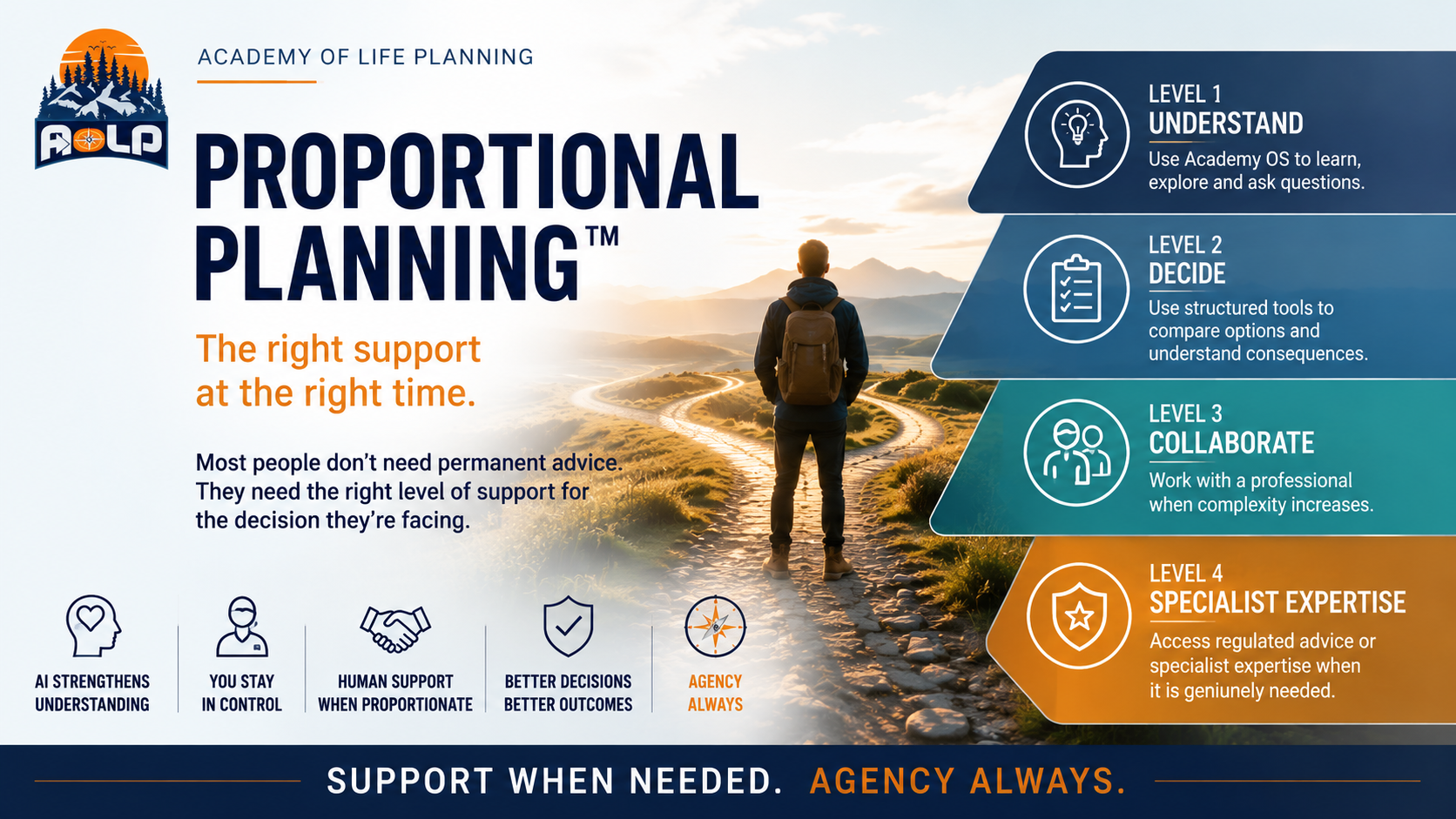
The right support at the right time.
For decades, we have framed financial planning as a choice between two extremes.
Do it yourself.
Or hand responsibility to an adviser.
Neither reflects how most people actually make decisions.
Most of us are capable of managing much of our own lives. We seek help when life becomes more complex, more uncertain, or when the consequences of getting it wrong become more significant.
We don’t have a permanent architect because we occasionally renovate our home. We don’t keep a solicitor on retainer because we might one day move house. We don’t visit a doctor every week simply because illness is possible.
We seek the right support at the right time.
So why has financial planning evolved differently?
A profession built for another age
Traditional financial advice developed during a period of profound information asymmetry.
Professionals had access to research, analytical tools, legislation, technical knowledge and modelling capabilities that ordinary people simply didn’t.
If you wanted to understand your pension, compare investments or model retirement income, you needed access to specialist expertise.
Ongoing relationships made sense because the adviser held information and capability that the client could not reasonably obtain for themselves.
Artificial intelligence changes that equation.
Today, millions of people can explore scenarios, understand technical concepts, analyse documents and ask sophisticated questions using AI-powered tools.
That doesn’t eliminate the need for professionals.
But it fundamentally changes when they add the greatest value.
The emergence of proportional planning
This led me to a simple idea that now underpins Academy OS.
Support should be proportional to complexity.
Not proportional to assets under management.
Not proportional to product sales.
Not proportional to business models.
Proportional to the decision itself.
Many everyday financial decisions require structure more than expertise.
People benefit from clear questions, thoughtful prompts, scenario modelling and the confidence to explore alternatives before acting.
Academy OS has been designed to provide exactly that.
It helps people think.
Not simply receive answers.
Four levels of support
Every decision sits somewhere on a spectrum.
Level 1 — Understand
Learn.
Explore.
Ask questions.
Build confidence.
Understand the landscape before making decisions.
Level 2 — Decide
Compare options.
Model scenarios.
Clarify trade-offs.
Organise your thinking.
Remain firmly in control.
Level 3 — Collaborate
When complexity genuinely increases, involve another human.
Not because you’ve failed.
Because experience, judgement and perspective now add value.
A Total Wealth Planner becomes a thinking partner rather than an information gatekeeper.
Level 4 — Specialist Expertise
Some situations require regulated financial advice.
Others require legal, tax, medical or specialist expertise.
Academy OS doesn’t attempt to replace these professions.
It helps people recognise when they become appropriate.
AI doesn’t replace judgement
Much of today’s conversation asks whether AI will replace advisers.
I think that’s the wrong question.
The better question is this:
What should AI do, and what should remain fundamentally human?
AI is exceptionally good at organising information, exploring possibilities, modelling scenarios and helping us think more systematically.
Humans remain uniquely valuable when decisions involve uncertainty, competing values, relationships, emotion, ethics and lived experience.
The future isn’t AI or humans.
It’s AI supporting humans, with humans supporting other humans when complexity requires it.
From dependency to capability
Perhaps the biggest shift is philosophical.
The purpose of planning should not be to create permanent dependence on professionals.
It should be to build capability.
Every conversation should leave someone more confident, more informed and better equipped to make future decisions for themselves.
Support becomes something we draw upon when it genuinely improves outcomes—not something we remain attached to indefinitely.
A new relationship between people and professionals
This doesn’t diminish the role of financial planners.
It elevates it.
As AI increasingly handles information gathering and technical modelling, planners have an opportunity to focus on the things technology cannot easily replicate.
Helping people clarify what matters.
Navigating ambiguity.
Testing assumptions.
Recognising blind spots.
Supporting wiser decisions.
That is a richer, more human role than simply being the person who knows the answers.
The right support at the right time
Proportional Planning™ isn’t just a model for financial planning.
It’s a way of thinking about support itself.
It recognises that autonomy and expertise are not opposites.
They complement one another.
People should be encouraged to do for themselves what they reasonably can.
Professionals should contribute where they genuinely make a difference.
And when that contribution has been made, agency should return to where it belongs—with the individual.
In an age of increasingly capable AI, that may prove to be the most important transition of all.
Find out more by visiting our website.
The Academy of Life Planning believes that the future belongs neither to unthinking self-service nor permanent dependency, but to people equipped with the confidence, capability and judgement to navigate life well—supported when needed, and always in control.

