
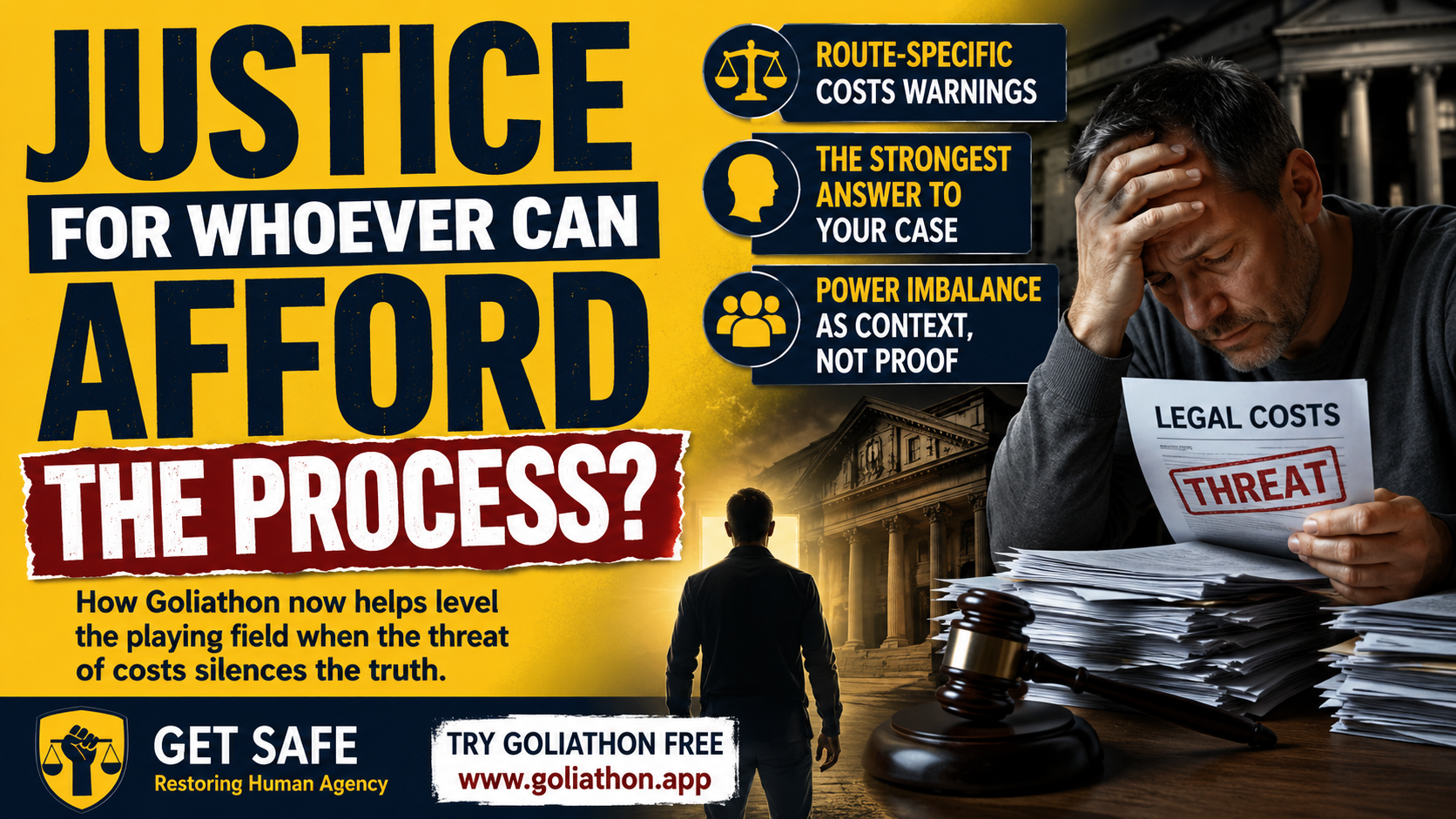
Justice for Whoever Can Afford the Process?
A lawyer recently shared a story about a litigant in person who arrived in court convinced that an AI system had already proved his case.
The AI had apparently identified multiple causes of action, described the matter as complex and encouraged the claimant to believe he had a near-certain victory.
The judge disagreed.
The claim was struck out. Costs were awarded. The individual discovered too late that losing a substantial civil claim could mean becoming liable for the other side’s legal bill.
The lawyer’s conclusion was understandable:
AI is a powerful tool in skilled hands. In untrained hands, it can become a liability.
That warning matters.
An AI system should not tell people what they want to hear. It should not manufacture certainty, invent legal arguments or turn a deeply felt grievance into an unsupported accusation.
But that is not the only lesson.
The choice is rarely AI or lawyer
The story was framed as though the individual had chosen AI instead of obtaining proper legal advice.
For many people, that is not the choice available.
The real choice is often:
Use imperfect AI.
Represent yourself without support.
Abandon the case.
Or accept what you believe to be an injustice.
“Get legal advice” sounds sensible until the person discovers that obtaining it may cost thousands of pounds before the merits of the case have even been properly examined.
For individuals facing banks, insurers, employers, investment firms or other large institutions, the central problem is often not the absence of evidence.
It is the absence of capital.
The institution has legal teams, professional indemnity insurance, internal records, established procedures and the financial capacity to sustain a dispute for years.
The individual may have emails, contracts, payment records, recordings, witness evidence and a clear chronology of what happened.
But they may not have the money required to make anyone examine it.
That is not equal access to justice.
It is equal access to a courtroom in theory, combined with radically unequal capacity to survive the process in practice.
Justice for whom?
The lawyer rightly asked an important question:
Justice for whom?
Justice must protect the accused as well as the accuser.
Nobody should be forced to spend time, money and emotional energy defending allegations that have no evidential or legal foundation. An AI system that simply validates the user’s version of events can cause real harm.
But that principle cuts both ways.
An institution should not be able to avoid answering credible evidence simply because the individual cannot withstand the threat of costs.
A claim abandoned under financial pressure has not necessarily been disproved.
It may simply have encountered an opponent with more capital.
Theoretically, both parties face litigation risk.
Practically, the risks are not symmetrical.
For an institution, litigation may be a business expense.
For an individual, it may threaten their home, savings, health and family security.
The legal system may treat those risks as equivalent. Human beings cannot.
When costs become a weapon
Costs rules serve an important purpose. They discourage speculative claims and compensate people who have been forced to defend themselves unnecessarily.
But the same mechanism can also be used as leverage.
We have seen thousands of cases in which individuals possess concrete evidence, yet the institutional response is not to engage substantively with that evidence.
Instead, the response may be:
You have misunderstood the law.
Your allegations are denied.
Our lawyers will seek costs.
Proceed at your own risk.
Sometimes those warnings are entirely justified.
Sometimes they are part of a legitimate defence.
But sometimes the threat of process becomes a substitute for answering the substance of the case.
That creates a dangerous distortion.
The question stops being:
What does the evidence show?
It becomes:
Who can afford to continue?
A justice system is not effective merely because a person has the theoretical right to bring a claim.
It is effective only when credible evidence can be examined without requiring the weaker party to risk financial ruin.
What this debate changed in Goliathon
This debate led directly to improvements in Goliathon, Get SAFE’s free evidence-building application.
Goliathon was created to help people organise complex evidence, construct a clear chronology and present their case in a form that another person can understand.
It does not decide who is right.
It does not replace a court, ombudsman, regulator or legal professional.
Its role is to help individuals turn fragmented information into an intelligible, evidence-governed record.
The recent debate highlighted the need to go further.
It is not enough to help someone explain their case.
A responsible system must also help them test it.
Four refinements have now been built into Goliathon.
1. Route-specific warnings about costs and risk
Where Goliathon recommends a possible next step, it now explains the financial and procedural implications of that particular route.
It distinguishes between three very different forms of escalation.
Internal complaints and Financial Ombudsman referrals
These routes are free for individuals and do not ordinarily expose the complainant to an adverse costs order.
Goliathon now says so clearly.
People should not be frightened away from a free complaint process by a generic litigation warning that does not apply.
FCA and regulatory reporting
Regulators may use reports to identify patterns, supervise firms or consider enforcement action.
But regulatory reporting does not normally resolve an individual dispute or obtain compensation for the person reporting it.
Goliathon now makes that limitation explicit.
Reporting misconduct and obtaining personal redress are not the same thing.
Civil litigation
Court proceedings may involve court fees, professional fees and the risk of an adverse costs order, depending on the type of claim, the procedural track and the decisions made during the case.
Where litigation is contemplated, Goliathon now provides a clear warning.
The purpose is not to deter a credible claimant.
It is to ensure that the person understands the risk before escalation, rather than discovering it after proceedings have begun.
The principle is simple:
Different routes create different risks.
2. The Strongest Answer to Your Case
Every evidence upload now contributes to a new panel:
The Strongest Answer to Your Case
This section identifies the strongest reasonable argument that the institution may make in response to the evidence.
It does not speculate.
It does not invent motives, defences or missing facts.
It follows four rules:
- identify the strongest argument supported by the existing evidence;
- explain where the evidence contradicts that argument;
- explain where the evidence leaves the matter open;
- state plainly when no reliable prediction can yet be made.
This changes the role of the system.
Goliathon does not simply help a person build the strongest version of their grievance.
It also helps them understand where the case may be challenged.
That may reveal that further evidence is needed.
It may expose an innocent alternative explanation.
It may show that the institution’s likely defence is contradicted by the documents already available.
Or it may show that the current evidence is not sufficient to reach a conclusion.
That is not disloyalty to the user.
It is respect for the evidence.
The strongest legal AI should not begin as an advocate.
It should begin as a disciplined case-testing system.
3. Power imbalance as context, not proof
Goliathon’s Decision-Maker Summary now includes an assessment of any significant difference in the parties’ ability to sustain the dispute.
This may include differences in:
- financial resources;
- access to legal representation;
- possession of information;
- institutional knowledge;
- time and administrative capacity;
- ability to absorb delay and cost.
The system does not treat inequality itself as evidence of wrongdoing.
A large institution having more money than an individual does not prove that the institution has behaved improperly.
That distinction matters.
Power imbalance is context. Abuse of power requires evidence.
Where the evidence shows that costs threats, procedural demands or delay have actually been used, Goliathon describes them precisely.
Where the evidence shows only unequal capacity, it says that instead.
This gives a decision-maker a fuller picture without asking them to presume misconduct.
The question is not merely whether the parties had the same formal rights.
It is whether they had a remotely comparable capacity to exercise them.
4. From imagined adversary to disciplined testing
The original name for the counter-argument panel was:
“What They Will Likely Argue.”
It has now been renamed:
The Strongest Answer to Your Case
That may appear to be a small change, but language shapes how people think.
“What they will argue” encourages the user to imagine an opponent.
“The strongest answer to your case” encourages the user to test the evidence.
The distinction moves the user away from adversarial thinking and towards disciplined enquiry.
The institution is not assumed to be dishonest.
The individual is not assumed to be mistaken.
Both propositions must be tested against the record.
Evidence before advocacy
These improvements reflect a broader philosophy.
Legal and complaints technology should not be designed to tell people that they are right.
Nor should it be designed to discourage people simply because the organisation on the other side has more resources.
It should help people distinguish:
- what happened;
- what can be proved;
- what remains uncertain;
- what the other party may reasonably say;
- which route may be appropriate;
- what that route could cost;
- where power affects the practical ability to continue.
This is the difference between automated advocacy and evidence governance.
Automated advocacy asks:
How can we make the user’s argument stronger?
Evidence governance asks:
What does the evidence support, what does it not support, and what must be tested next?
That is the standard we are trying to build into Goliathon.
Agency without impunity
Restoring human agency does not mean helping people make unchecked accusations.
It means giving them the capability to understand, document and test what has happened.
It also means ensuring that institutions cannot rely solely on superior capital, procedural knowledge or the threat of costs to avoid scrutiny.
The governing principle is:
Agency without impunity.
Individuals should have the means to bring credible evidence forward.
Those accused should be protected from unsupported allegations.
Institutions should not be presumed guilty because they are powerful.
Nor should individuals be presumed wrong because they cannot afford a lawyer.
Justice requires more than access to rules.
It requires access to the capability needed to use them.
Try Goliathon free
Goliathon is a free application for people who need to organise evidence, reconstruct what happened and present a complex case clearly.
It may be particularly useful where financial constraints make conventional legal support inaccessible.
You can use it to:
- build a structured chronology;
- organise supporting evidence;
- identify gaps and contradictions;
- understand the strongest answer to your case;
- prepare a decision-maker summary;
- consider proportionate next steps;
- create a downloadable evidence dossier.
Goliathon does not promise that you will win.
It does not tell you what you want to hear.
It helps you build a clearer record of what the evidence actually shows.
Because for many people, the real choice is not between AI and a lawyer.
It is between having some meaningful capability to pursue justice and having none at all.
Try Goliathon free at www.goliathon.app
Get SAFE exists to help people understand what happened, preserve evidence and restore agency after financial exploitation.
The law may determine whether a claim succeeds.
Access to capital should not determine whether the evidence is ever heard.

