
Financial services is entering a new phase.
For decades, the industry has been organised around products, advice, distribution, regulation, platforms, documentation, and disclosure. The consumer has usually sat at the end of that chain: informed, nudged, sold to, advised, protected, categorised, risk-rated, and asked to consent.
But something deeper is now changing.
Artificial intelligence is not merely making existing financial services faster. It is beginning to alter the interface between people and the financial system itself.
The FCA’s Emerging Technology Horizon Scan 2026 describes this shift clearly. It identifies three major areas of technological convergence: Personalised Intelligence, synthetic insecurity, and programmable finance. Taken together, they point toward a future in which financial services become more automated, more personalised, more embedded, more persuasive, and more difficult for ordinary people to interrogate.
That future may bring enormous benefit.
It may help people budget, compare, switch, claim, challenge, understand, organise, and act with far greater confidence than before. It may reduce friction. It may widen access. It may help people who have been excluded from traditional advice models. It may allow people to understand complex documents and financial choices in minutes rather than days.
But there is another possibility.
The same technologies could create a world in which people become passive endpoints in increasingly automated financial ecosystems. Their choices may be shaped by systems they cannot see. Their consent may become routine and shallow. Their data may be used to personalise products in ways they do not fully understand. Their attention may be bypassed. Their judgement may be outsourced. Their agency may be quietly eroded.
That is the central question for the next era of financial planning.
Will AI restore human agency?
Or will it simply automate dependency?
The FCA has described the world Academy OS was built for
The FCA’s report introduces the idea of “Personalised Intelligence”: widely available AI, combined with emerging technologies, changing the financial outcomes people experience.
This is not just about chatbots answering questions. It is about AI agents becoming the main interface between consumers and firms. These agents may compare products, pre-fill forms, flag risks, negotiate prices, optimise payments, manage subscriptions, dispute charges, reallocate investments, or support people through complex life events.
The FCA describes a possible move from assistive AI to advisory AI, and eventually to “do it for me” AI.
That is a profound shift.
In assistive mode, the tool helps the person understand.
In advisory mode, the tool recommends what the person should do.
In “do it for me” mode, the tool acts on the person’s behalf.
Each stage may be useful. Each stage may also carry risk. The more the system acts, the more the person may stop looking. The more the person stops looking, the more control moves from the human being to the infrastructure around them.
That is why Academy OS exists.
Academy OS, delivered through totalwealthplans.com, is a form of Personalised Intelligence. But it is designed around a very specific principle:
AI should restore human agency, not replace it.
“Done by you, done, with you, never done for you.”
That means the system must not become another hidden authority. It must not create dependency. It must not tell people what to do and then measure success by whether they comply. It must not become a digital adviser in a different wrapper.
Its job is to help people see.
To stabilise.
To structure.
To surface options.
To understand consequences.
To ask better questions.
To notice asymmetry.
To reclaim authorship over their own financial life.
That is a different proposition from advice automation. It is not a robo-adviser. It is not a product recommendation engine. It is not a sales funnel. It is not a behavioural manipulation layer dressed up as support.
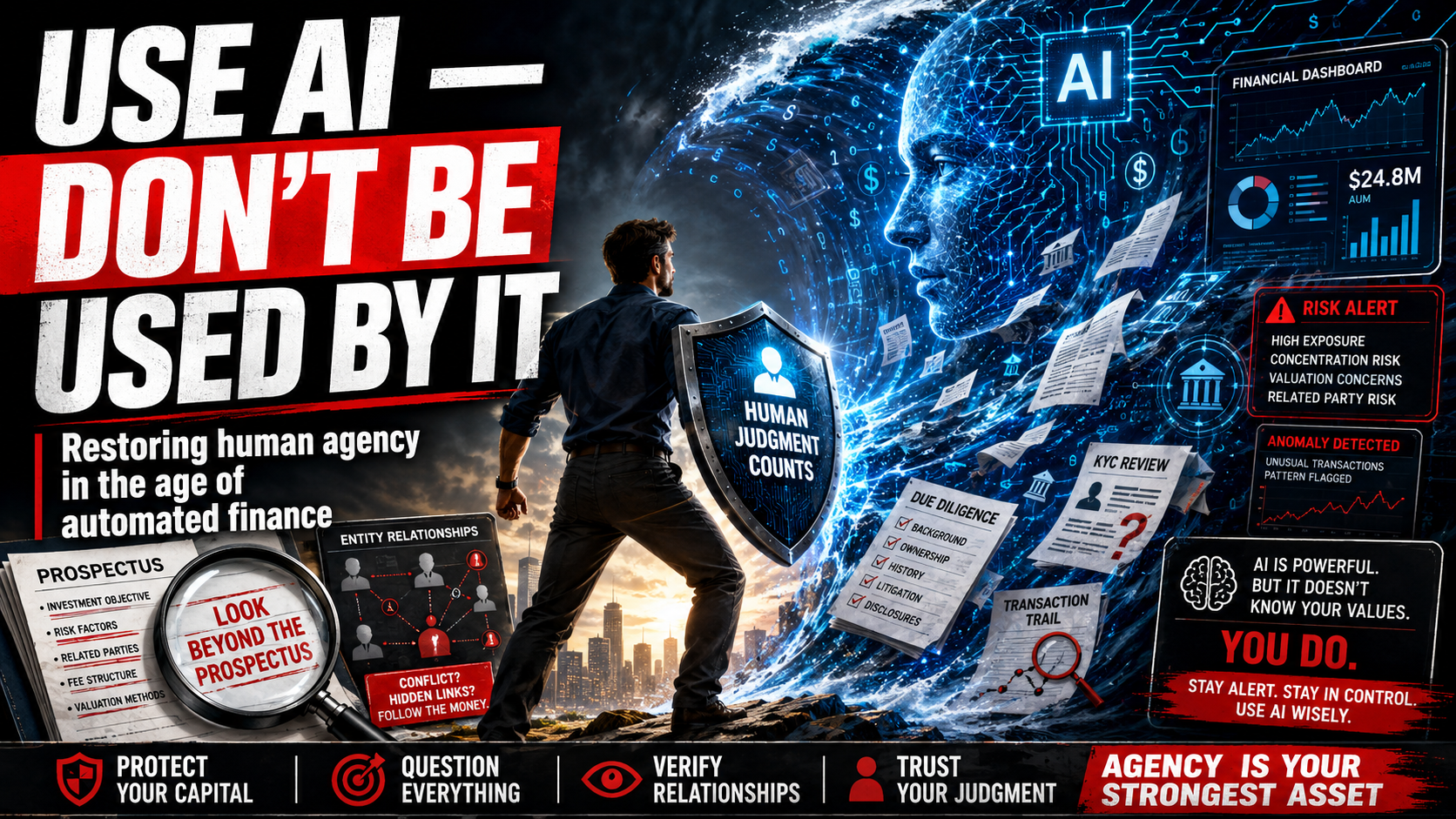
It is a trusted agency-restoration layer that helps people use AI without being used by AI.
Not anti-technology. Not anti-advice. Something more developmental.
The Academy of Life Planning is not anti-technology.
That would be a mistake. AI can help people who have been excluded, overwhelmed, misled, exploited, ignored, or priced out. It can read documents at speed. It can simplify legal and financial language. It can organise evidence. It can model scenarios. It can help people prepare for conversations. It can surface hidden risks. It can challenge unfair terms. It can give people a second brain when stress has reduced their ability to think clearly.
Nor is AoLP anti-advice.
Good advice has value. Good professionals matter. Human judgement still matters. Regulated advice still has a role where a personal recommendation about a specific regulated product is required.
But advice is not the same thing as agency.
Advice may help someone make a better decision. Agency helps someone become more capable of making decisions.
That distinction matters because the next wave of financial technology could easily wrap the old dependency model in new language. The industry may talk about AI, wellbeing, trust, accessibility, behavioural insight, life transitions, vulnerability and personalisation — while still leaving the individual dependent on systems and professionals that hold the real power.
Academy OS takes a different starting point.
The aim is not to make people more dependent on better advice.
The aim is to make people less dependent on advice where they can safely and confidently navigate for themselves.
That does not mean leaving people alone. It means giving them the tools, structure, language and confidence to participate as the primary authority in their own life.
This is why Academy OS is protective and developmental.
Protective, because it helps people spot risks, asymmetry, pressure, exploitation, unfairness and hidden consequences.
Developmental, because it helps people build capability over time.
The user should not merely receive an answer. They should become more able to think, question and act.
The risk of the proxy economy
One of the most important ideas in the FCA report is the emergence of a possible “proxy economy”.
In the current attention economy, firms compete for human attention. They try to get people to click, compare, buy, stay, upgrade, renew, or accept.
In a proxy economy, the competition shifts. The firm may no longer be trying to persuade the person directly. It may be trying to persuade the person’s AI agent.
That changes everything.
Marketing may become machine-readable.
Product design may be optimised for algorithmic filters.
Disclosures may be written to pass proxy checks while still leaving the consumer exposed.
Dark patterns may target AI systems rather than human eyes.
Mis-selling may become less about persuasive human sales scripts and more about adversarial optimisation: designing products, documents and journeys to appear acceptable to the proxy while preserving commercial advantage.
This is not science fiction. It is the logical consequence of financial services becoming increasingly machine-mediated.
For consumers, this creates a new vulnerability.
They may think the AI is acting for them. But who designed it? Who funds it? What data trained it? What interests does it serve? What options does it exclude? When does it escalate? What does it treat as “best”? Does it understand the person’s values, or only their observable behaviour? Does it support long-term capability, or simply reduce friction?
A low-friction journey is not always an empowering journey.
Sometimes friction is where reflection happens.
Sometimes a pause protects the person.
Sometimes the most important function of AI is not to speed up the transaction, but to slow down the decision.
That is one of the practical design principles behind Academy OS.
It should not simply remove friction. It should distinguish harmful friction from protective friction.
Harmful friction is sludge: unnecessary complexity, delay, jargon, opacity, poor access, procedural exhaustion, and institutional obstruction.
Protective friction is different. It creates space to think before acting. It asks, “What are you being asked to believe?” It invites the user to check consequences. It helps them consider alternative explanations. It encourages them to verify before trusting.
The future of consumer protection may depend on knowing the difference.
Fraud is becoming sense-making warfare
The FCA’s section on synthetic insecurity is especially important for Get SAFE and the development of Investigator™.
The report describes a shift in financial crime from crude deception to credibility engineering.
Fraud is no longer only about fake emails, false websites, cloned voices or deepfake videos. Those threats are serious enough. But the deeper risk is that AI can manufacture entire ecosystems of plausibility.
A scam may arrive with polished documents, realistic people, plausible histories, technical jargon, social proof, professional branding, domain-specific explanations, synthetic testimonials, fake audit trails, fabricated correspondence, and emotionally intelligent interactions.
It may not look suspicious.
It may look complete.
It may not feel crude.
It may feel reassuring.
It may not pressure the victim through obvious fear.
It may build trust over time through shared values, apparent empathy, and carefully constructed logic.
This is why traditional “red flag” education is no longer sufficient.
People cannot be expected to defend themselves against industrialised deception using only a checklist and a vague instruction to “be careful”.
The problem is not simply that fraudsters can fake what people see and hear.
The deeper problem is that they can manipulate how people make sense of what is happening.
They can shape the story.
They can frame the choice.
They can engineer credibility.
They can exploit attention, stress, hope, shame, urgency, aspiration, grief, loneliness, financial pressure, professional trust, and the human desire to believe that an opportunity is real.
That is why the Academy OS needs tools that protect sense-making, not just information.
Investigator: looking beyond the prospectus
This is the rationale for Investigator™.
Investigator™ is being developed as an AI-assisted due diligence tool for people considering an investment, opportunity, scheme, proposition, or financial arrangement. Its purpose is not to give investment advice. It is not there to say, “invest” or “do not invest”.
Its purpose is to help the person think clearly before they commit.
Most due diligence starts with the document in front of the person: the prospectus, brochure, pitch deck, contract, terms, website, or email.
That is necessary, but it is not enough.
Fraud, mis-selling and exploitation often hide behind documents that look competent. A prospectus may be polished. The financial projections may be attractive. The legal wording may be impressive. The risk warnings may exist. The structure may appear professional.
But the real question is often not only, “What does the prospectus say?”
The real question is:
Who is behind it?
Who benefits?
What is their history?
What is their regulatory status?
What entities are involved?
What jurisdictions are being used?
Are there related-party transactions?
Are there insolvencies, disqualifications, complaints, enforcement actions, phoenix companies, offshore structures, unexplained intermediaries, or conflicts of interest?
Is the person being asked to waive protections?
Is the investor being classified in a way that reduces their rights?
Is there urgency, scarcity, social pressure, or emotional manipulation?
Does the story rely on trust that has not been independently earned?
Investigator™ is therefore designed to look at the people behind the prospectus, not just the prospectus itself.
That phrase matters.
A document can be engineered.
A narrative can be polished.
A website can be cloned.
A testimonial can be fabricated.
A voice can be simulated.
A company can be newly incorporated.
A professional identity can be exaggerated.
A chain of entities can obscure responsibility.
A risk warning can be technically present but practically ineffective.
Investigator™ should help users step back from the surface presentation and examine the structure behind it.
That includes public checks, document analysis, consequence mapping, protection warnings, entity mapping, jurisdictional awareness, pressure detection, and plain-English questions the user can ask before taking the next step.
In an age of synthetic credibility, due diligence must move from document-reading to reality-testing.
Try it, the Investigator™ web app is free.
The new consumer protection question: what would need to be true?
One of the most useful questions Academy OS can ask is:
“What would need to be true for this to be safe?”
That question changes the user’s posture.
Instead of asking, “Do I believe this?” the person asks, “What facts would have to be independently verified before belief would be reasonable?”
This matters because fraud often works by pulling people inside the story too early.
Once inside the story, they start interpreting evidence through the frame the promoter has provided. A delay becomes “normal administration”. A missing document becomes “commercial sensitivity”. An offshore structure becomes “tax efficiency”. A high return becomes “exclusive access”. A lack of regulation becomes “innovation”. A pushy salesperson becomes “helpful urgency”. A warning from a bank becomes “the banks don’t understand this opportunity”.
Investigator™ should help people step outside the story.
It should ask:
What is the claim?
Who is making it?
What independent evidence supports it?
What evidence contradicts it?
What is missing?
What protections are being waived?
What happens if the claim is wrong?
What is the realistic downside?
Who carries the loss?
Who gets paid first?
Can the user exit?
What would a cautious person verify before proceeding?
This is not fear-based. It is agency-based.
The aim is not to frighten people away from every opportunity. The aim is to help them become capable of distinguishing opportunity from engineered belief.
The Academy OS design principles
Academy OS design principle 1: the human remains the author
The first design principle is simple.
The human remains the author.
AI can support the process, but it should not become the authority over the person’s life.
This means Academy OS should avoid the language and behaviour of command. It should not say, “You should do this.” It should say, “Here is what appears to be happening. Here are the options. Here are the risks. Here are the trade-offs. Here are the questions worth asking. Here is what you may wish to verify. Here are the consequences to consider.”
This is more than careful wording. It is a philosophy of power.
The system should not replace judgement. It should strengthen judgement.
It should not produce compliance. It should produce clarity.
It should not reward passive acceptance. It should invite active participation.
Where the user is vulnerable, stressed, bereaved, harmed, pressured or confused, the system should slow down, simplify and stabilise. It should not rush them toward action. It should create enough safety for them to think again.
Academy OS design principle 2: stabilise before solving
People do not make good decisions when they are flooded.
After financial harm, coercion, bereavement, divorce, illness, debt pressure, family conflict, business crisis or institutional obstruction, the first need is often not advice. It is stabilisation.
The person needs to breathe.
They need to know they are not stupid.
They need to know there is a process.
They need to know what to do next and what not to do next.
They need to stop the immediate escalation of harm.
This is where Get SAFE and Academy OS align strongly.
The first step is not to take over the case. It is to restore enough clarity for the person to participate safely.
That may mean organising documents, creating a timeline, identifying deadlines, separating facts from feelings, identifying immediate risks, preparing questions, and surfacing support options.
Stabilise. Structure. Surface options.
Not rescue.
Not command.
Not dependency.
Agency begins when panic becomes sequence.
Academy OS design principle 3: structure before interpretation
One of the great risks in financial disputes, fraud cases and complex life decisions is premature interpretation.
People jump to conclusions because they are under stress. Institutions may impose their own narrative. Professionals may focus only on the part they understand. Victims may feel forced to explain everything before the evidence is organised.
Academy OS should do the opposite.
First, structure.
What happened?
When?
Who was involved?
What documents exist?
What money moved?
What was promised?
What was signed?
What was disclosed?
What was hidden?
What was relied upon?
What changed?
What harm resulted?
Only then should interpretation begin.
This is why Goliathon™ is such an important part of the ecosystem. It helps people turn a chaotic pile of documents into an evidence-linked bundle, timeline, narrative and question set. It gives shape to complexity.
That matters because structure restores dignity.
A person who cannot explain what happened may be dismissed as confused, emotional, obsessive or unreliable. A person who can show a clear timeline, document trail and consequence map is harder to ignore.
Agency is not only internal confidence. It is also external legibility.
Academy OS design principle 4: surface options, do not narrow prematurely
Many financial systems narrow people too quickly.
They move from data capture to recommendation. From problem to product. From vulnerability to process. From complaint to template. From life complexity to a regulated advice category.
Academy OS should resist premature narrowing.
It should help users see the wider field before acting.
That includes financial capital, housing capital, human capital, social capital, family dynamics, health, care needs, earning capacity, emotional bandwidth, purpose, legal context, regulatory protections, and practical constraints.
A person facing a later-life decision, for example, may not simply need an equity release product, an investment solution or a pension withdrawal strategy. They may need to understand their home, family support, care trajectory, work potential, community resources, benefits, tax, estate wishes, health, grief, fear, independence and legacy.
That is Total Wealth Planning.
It does not begin with the product menu.
It begins with what is already present.
The role of AI is to help reveal the field, not collapse it too quickly into a transaction.
Academy OS design principle 5: make asymmetry visible
Financial harm often happens in conditions of asymmetry.
One party knows more.
One party drafts the terms.
One party controls the process.
One party has legal support.
One party understands the jargon.
One party has more time.
One party has more money.
One party can absorb loss.
One party benefits from delay.
One party frames the narrative.
One party carries the downside.
Traditional disclosure does not remove asymmetry. It often merely documents it.
Academy OS should make asymmetry visible.
That means highlighting where liability is transferred, where rights are waived, where consent may be weak, where exit is restricted, where incentives conflict, where fees continue without service, where the user carries losses they may not understand, and where the other party has discretion without equivalent accountability.
This is exactly where The Leveller fits.
The Leveller™ helps people read terms, contracts and agreements with a fairness lens. It is not just asking, “What does this clause say?” It is asking, “What does this clause do to the balance of power?”
That question is central to human agency.
A person cannot give meaningful consent to a structure they cannot understand.
Academy OS design principle 6: consequence before commitment
Many harmful financial decisions are made because the upside is vivid and the downside is abstract.
The investment return is specific.
The dream is emotionally alive.
The reassurance is immediate.
The risk warning is generic.
Academy OS should reverse that imbalance.
Before commitment, the user should be helped to understand consequences in lived terms.
What happens if this fails?
What happens to your home?
Your income?
Your marriage?
Your retirement?
Your care options?
Your ability to sleep?
Your relationship with your children?
Your tax position?
Your future choices?
Your sense of self?
This is not melodrama. It is proper decision architecture.
A financial loss is rarely only financial. It can affect identity, trust, health, confidence, family, purpose and future agency.
Investigator™ should therefore include consequence cards. Not to scare people, but to make the downside real enough to be weighed properly.
Good decisions require emotionally honest downside visibility.
Academy OS design principle 7: plain English is a safeguarding tool
Plain English is not a cosmetic preference.
It is a safeguarding tool.
Jargon creates dependency. Complexity protects power. Dense documents exhaust attention. Technical language can make people feel stupid when the real problem is that the system has been designed around professional convenience rather than human comprehension.
Academy OS should translate complexity without patronising the user.
It should explain terms.
It should show what matters.
It should separate essential from peripheral.
It should use short steps when the user is under stress.
It should never confuse sophistication with obscurity.
The aim is not to dumb down financial planning. The aim is to open the door.
People cannot exercise agency in a language they have been trained to fear.
Academy OS design principle 8: AI should reveal uncertainty, not hide it
One of the risks of AI is overconfidence.
A polished answer can feel authoritative even when it is incomplete, uncertain or wrong. This becomes especially dangerous in financial contexts, where people may act on outputs they do not know how to challenge.
Academy OS should therefore be designed to reveal uncertainty.
It should distinguish facts, inferences, assumptions, missing evidence and possible next checks.
It should say, “This appears to show…” rather than pretending to know more than it does.
It should identify what cannot yet be concluded.
It should help the user ask, “What would change this view?”
That is vital in contentious cases, due diligence, fraud prevention, complaints, contracts and life planning.
Agency depends on knowing the difference between evidence and interpretation.
Academy OS design principle 9: AI should support better human conversations
The future is not human or AI.
The best future is human plus AI, with the human still sovereign.
Academy OS should help users prepare for better conversations with advisers, solicitors, banks, insurers, employers, family members, trustees, regulators, ombudsmen, support workers and community allies.
It should generate questions.
It should prepare summaries.
It should identify what to ask for.
It should help users explain their situation calmly.
It should reduce the cognitive burden of engaging with professional systems.
It should help people arrive at conversations more prepared, not more dependent.
This is also important for ethical professionals.
A Total Wealth Planner does not need a passive client. They need a more capable participant.
The better the client understands their own life, the better the planning conversation becomes.
Academy OS design principle 10: build capability over time
The final design principle is developmental.
Every interaction should leave the person more capable than before.
Not just better served.
More capable.
That is the difference between an advice system and an agency-restoration system.
A good Academy OS output should help the user understand the pattern, not just the answer. It should help them recognise similar situations in the future. It should build financial dexterity, procedural confidence, emotional steadiness and practical self-trust.
This is where Total Wealth Planning becomes more than financial planning.
It becomes a capability-building discipline for a world of complexity, persuasion, automation and institutional power.
Total Wealth Planning as the human-agency layer
The FCA’s report points toward a future in which financial systems become increasingly intelligent, synthetic, programmable and interoperable.
That future will need regulation. It will need cybersecurity. It will need institutional governance. It will need ethical design. It will need professional standards.
But it will also need something else.
It will need a human-agency layer.
A layer that helps people remain awake inside automated systems.
A layer that helps them understand what is being done to them, for them, around them and in their name.
A layer that helps them use AI without surrendering themselves to it.
That is the role of Academy OS.
Academy OS / totalwealthplans.com is not trying to become the next financial institution. It is not trying to capture assets. It is not trying to turn every life question into a regulated product journey. It is not trying to replace human advisers, planners, lawyers or support workers.
It is trying to restore the person to the centre.
The person with values.
The person with context.
The person with assets beyond money.
The person with relationships, fears, hopes, obligations, skills, grief, energy, purpose and limits.
The person who must live with the consequences.
Technology should serve that person.
Advice should serve that person.
Systems should serve that person.
When they do not, Academy OS should help the person see clearly enough to pause, question and choose.
The strategic opportunity
The financial services industry is beginning to talk seriously about AI. That is welcome.
But much of the conversation still focuses on firms.
How can firms use AI?
How can firms become more efficient?
How can firms personalise services?
How can firms manage risk?
How can firms satisfy regulators?
Those questions matter.
But they are incomplete.
The public interest question is different:
How can individuals use AI to restore their own agency in financial and life decisions?
That is the question AoLP is answering.
It is the question behind The Leveller™.
It is the question behind Goliathon™.
It is the question behind Navigator™.
It is the question behind Get Secure™.
It is the question behind Investigator™.
And it is the question behind Academy OS as a whole.
The future of financial services will not be won by better advice alone. It will be won by systems that help people preserve agency in environments designed to automate, personalise and persuade.
That is why the trusted layer matters.
Not anti-technology.
Not anti-advice.
But protective.
Developmental.
Human-centred.
Agency-restoring.
The future will not wait for consumers to become experts in AI, programmable finance, synthetic fraud, digital identity, tokenisation, behavioural data, smart contracts, cyber risk and machine-mediated decision-making.
Nor should it.
The job now is to build tools that meet people where they are, translate complexity into clarity, and help them act under their own energy.
That is the promise of Academy OS.
Helping people use AI without being used by AI.
Referenced report: FCA, Emerging Technology Horizon Scan 2026, Emerging Tech & Research Team, June 2026.

