
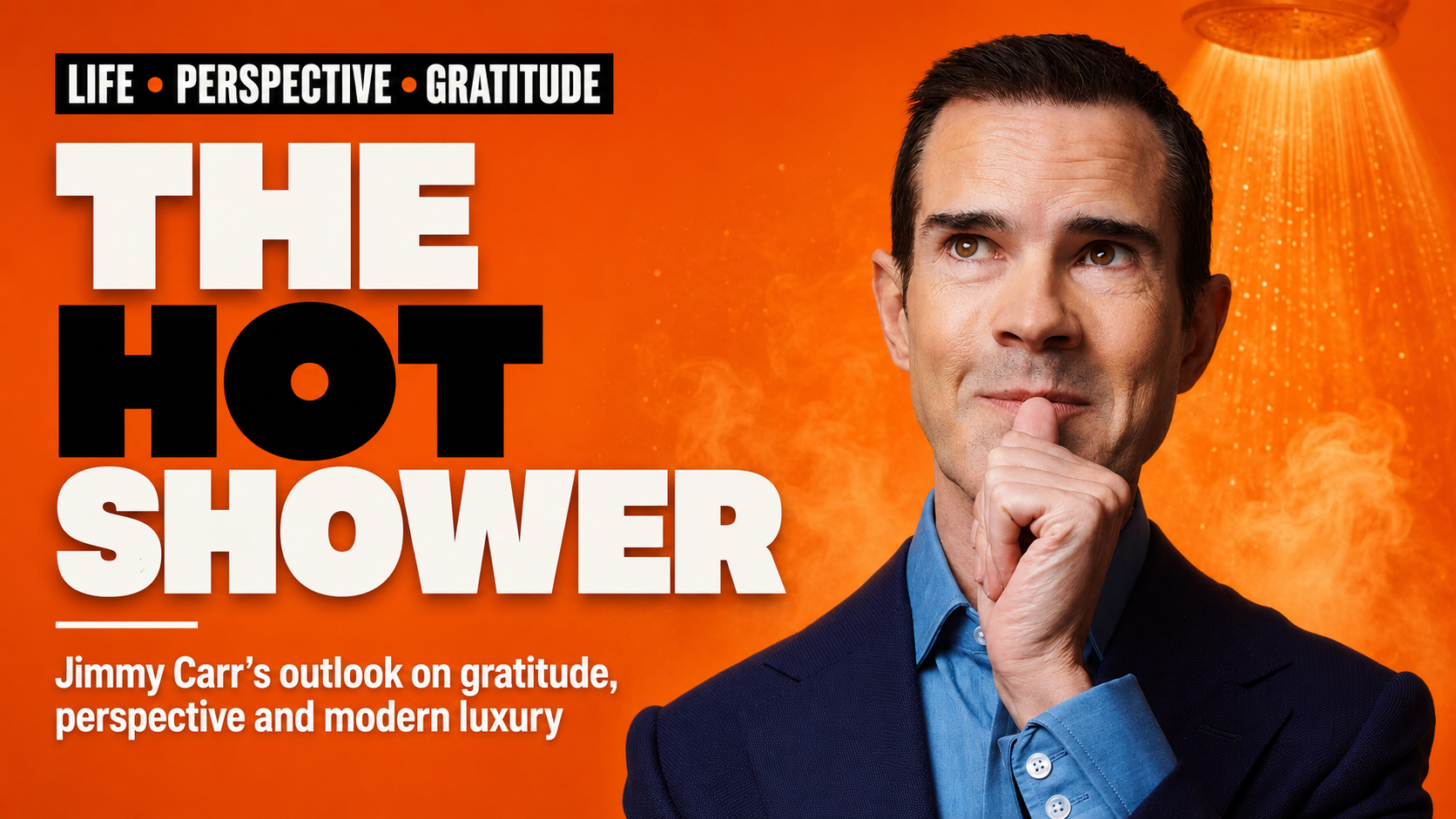
The Hot Shower Thought
Most of us step into a hot shower without giving it a second thought.
Jimmy Carr suggests we should.
He points out that no king, emperor or celebrated figure from a century ago could reliably enjoy what millions of ordinary people now experience every morning: clean, instantly available hot water, delivered at the turn of a handle.
The shower is not merely a convenience. It is evidence of how extraordinarily privileged modern life has become.
Of the estimated 100 billion human beings who have ever lived, those alive today occupy an exceptional historical position. We benefit from abundant food, advanced medicine, instant communication, entertainment on demand and access to more knowledge than any previous generation could have imagined.
In material terms, many of us live like royalty.
Yet modern life often feels subjectively worse rather than better.
Carr captures the paradox in a simple equation:
Happiness = Quality of life − Envy
Our quality of life may be high, but comparison constantly erodes our experience of it. We do not compare ourselves with kings from the past. We compare ourselves with the people on our screens who appear richer, healthier, more successful or more admired.
The hot shower disappears from view.
What remains is the sense that someone else has more.
Carr’s observation is therefore about more than gratitude. It is about perspective, desire and the status games that shape what we believe a successful life should look like.
Before asking how to get more, perhaps we should first notice how much we already have—and question who taught us that it was not enough.
The Hot Shower: Jimmy Carr’s Outlook on Gratitude, Perspective and Modern Luxury
Most of us step into a hot shower without thinking.
We turn a handle. Warm water arrives. We stand there, half awake, already thinking about the day ahead.
Jimmy Carr suggests we pause.
A king living a century ago could have possessed palaces, servants and enormous wealth, yet still lacked many of the comforts ordinary people now take for granted. Reliable hot water. Modern medicine. Instant communication. Access to almost the whole of human knowledge.
The hot shower is therefore more than a convenience.
It is a reminder that we are surrounded by forms of wealth we have stopped noticing.
Objectively better, subjectively worse
Carr’s observation points towards a paradox of modern life.
Our objective quality of life has improved enormously. Yet many people do not feel correspondingly richer, safer or more fulfilled.
We compare ourselves not with people from previous generations, but with people appearing to have more than us today.
The hot shower disappears from view.
The larger house, newer car, higher income and more impressive lifestyle move into focus.
Carr captures this with a simple idea:
Happiness is quality of life minus envy.
The problem is not necessarily that our lives are poor.
The problem is that our attention is constantly directed towards lives that appear better.
We live with comforts once reserved for royalty, while feeling inadequate because someone on a screen has a larger kitchen.
The goals we inherit
Carr’s wider philosophy goes beyond gratitude.
He argues that many of our desires are mimetic. We want things because other people want them, possess them or appear to gain status from them.
The watch is not simply a watch.
The car is not simply transport.
The job title is not simply work.
Each becomes part of a status game: a way of communicating who we hope other people will believe us to be.
This raises a deeper question:
Are we pursuing our own goals, or performing goals we inherited from our environment?
Our upbringing, education, peer group, profession, advertising and algorithms all shape what appears desirable.
Over time, these influences can become so familiar that we mistake conditioning for identity.
We believe we are choosing.
But sometimes the choice was made for us long before we became conscious of it.
The true self and the false self
At the Academy of Life Planning, the GAME Plan begins before money.
It begins with Goals.
But not goals selected from a catalogue of socially approved achievements.
We begin with two more fundamental questions:
Who am I?
Why am I here?
We explore the person’s values, talents, character, interests and sense of purpose. From those foundations, we help them imagine their favourite future.
This is the distinction between goals arising from the true self and goals generated by the false self.
The true self reflects who we are when we are acting from our values, abilities and considered sense of purpose.
The false self is the identity assembled through conditioning: the expectations of family, school, employers, professions, markets and social comparison.
The false self asks:
What should someone like me want?
The true self asks:
What kind of life would allow me to become more fully myself?
This does not mean rejecting our upbringing or environment. They are part of us.
It means examining their influence before allowing them to write the script for the rest of our lives.
What do you think about in the shower?
Carr offers another useful observation.
The shower may be one of the few remaining places where many people are briefly free from external input.
No email.
No social feed.
No podcast.
No meeting.
No advertisement.
In that short interval, the mind is allowed to wander.
Carr suggests that what we think about in the shower may reveal what we genuinely care about.
It is a deceptively powerful idea.
Our attention is usually occupied by other people’s priorities. The shower creates a small space in which our own thoughts can reappear.
What returns when the noise stops?
What problem does your mind keep trying to solve?
What possibility keeps presenting itself?
What work feels important even when nobody is asking you to do it?
Carr describes the answers as existing in “the silence you’re avoiding.”
That silence is not empty.
It may be where the true self has been waiting to be heard.
Life is self-assignment
Carr imagines life as a game and asks what we are solving for.
What is the scoreboard?
What counts as winning?
Who decided?
His conclusion is that life is a form of self-assignment. We are not merely here to perform well against criteria chosen by somebody else. We must decide what the assignment is.
This closely mirrors the philosophy of the GAME Plan.
First, understand who you are and why you are here.
Then decide what a life built around those answers might look like.
Only after that should money enter the conversation.
Money is not the purpose of the plan.
It is one of the resources used to support the life.
This reverses the conventional planning sequence.
Traditional financial planning often begins with financial goals: retirement income, investment returns, property, inheritance or accumulated wealth.
The GAME Plan asks whether those goals belong to the person in the first place.
Are they expressions of purpose?
Or are they simply familiar symbols of success?
Your favourite future
Carr says that the first great adventure is deciding what you want. The second is going out and getting it.
The Academy would add an important qualification.
Before deciding what you want, discover who is doing the wanting.
A favourite future is not merely a collection of desirable outcomes.
It is a coherent life built around the person’s values, talents, relationships, contribution and wellbeing.
It asks:
What would you love to do?
What are you naturally good at?
What does the world need from you?
What could support a sustainable livelihood?
What kind of person do you want to become?
What would “enough” look like?
These questions move us away from borrowed ambition and towards authentic direction.
The goal is not to create the most impressive future.
It is to create the future that fits.
The life and the lifestyle
Carr also makes a valuable distinction between wanting a particular life and wanting the lifestyle associated with it.
Many people want the visible outcome but not the daily reality required to produce it.
They want to be a writer, but not to write.
They want to be an entrepreneur, but not to tolerate uncertainty.
They want to be financially independent, but not to examine their spending, assumptions or trade-offs.
They want the stage, but not the years of empty rooms.
Carr’s test is practical:
What looks like play to you but work to everyone else?
The answer may reveal where your talents and motivations intersect. It may also show which forms of difficulty you are willing to accept.
Purpose does not remove struggle.
It makes some struggles worth choosing.
A favourite future therefore cannot be assessed only by its rewards.
We must also ask whether we are willing to inhabit the process required to create it.
Gratitude without passivity
The hot-shower philosophy should not be misunderstood as an argument for accepting everything as it is.
Gratitude does not require passivity.
We can appreciate what previous generations built while recognising what remains unjust, harmful or incomplete.
We can be thankful for material progress while questioning whether our economic and social systems are helping people live meaningful lives.
Gratitude tells us that we already possess more than we notice.
Agency asks what we will do with it.
The hot shower is not an instruction to stop aspiring.
It is an invitation to begin from abundance rather than deficiency.
To recognise what is already enough.
To distinguish genuine purpose from manufactured dissatisfaction.
And to pursue a better future because it is ours—not because somebody else taught us to envy theirs.
Before setting goals, find the goal-setter
Jimmy Carr’s reflections on gratitude, status, silence and self-assignment are closely aligned with the Academy’s approach to life planning.
Both begin with the recognition that a successful life cannot be defined solely from the outside.
The challenge is not simply to achieve more.
It is to decide consciously what is worth achieving.
The hot shower reminds us how wealthy we already are.
The silence helps us hear what matters.
Our values and talents reveal who we may become.
And the GAME Plan helps us build a favourite future around those answers.
Perhaps the most important question in planning is therefore not:
What are your goals?
It is:
Who are you when the world is not telling you what to want?

