
Many regulated financial advisers can see that the relationship between clients, technology and professional expertise is changing.
They understand the argument for greater client capability.
They recognise that AI is reducing information asymmetry.
They may even agree that financial planning should leave people more able to understand, choose and act for themselves.
But agreement does not create a commercial reason to change.
For many successful IFAs, the existing model still works.
They have recurring income, established clients, assets under advice and a steady flow of regulated work. The business may be profitable, familiar and operationally efficient.
There is little incentive to dismantle it.
So they wait.
They may believe Total Wealth Planning represents the future, while concluding that the time to adopt it has not yet arrived.
That may be the wrong choice being presented.
Perhaps the immediate question is not:
Should an IFA replace the existing business model?
Perhaps it is:
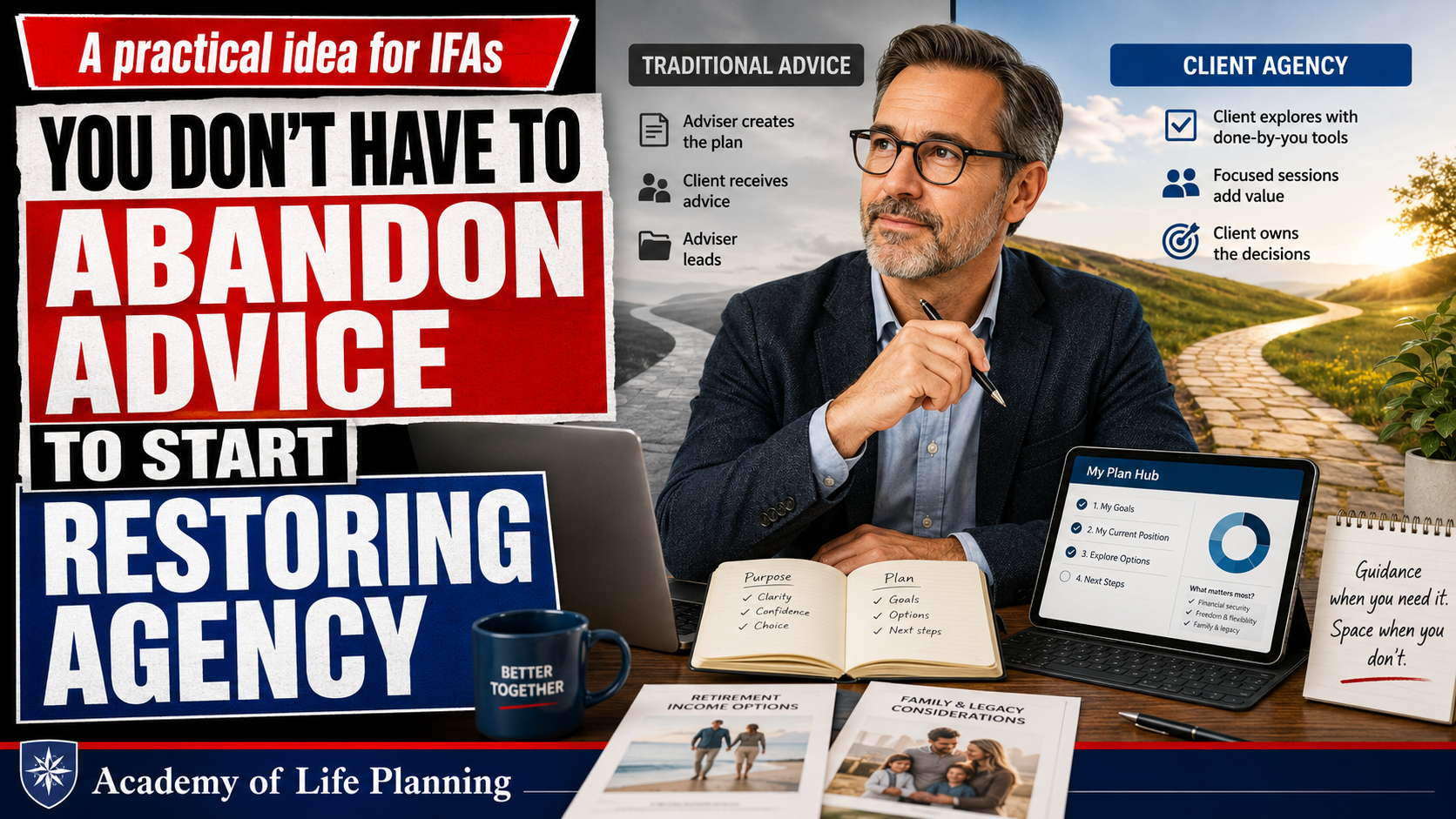
Could an IFA add a proportional planning pathway alongside it?
That creates a much smaller—and potentially more useful—first step.
The problem with the conventional front door
Most regulated advice firms have a relatively narrow entry point.
A prospect is expected to have a recognisable advice need, sufficient assets and enough willingness to enter a formal process.
The firm then gathers information, establishes objectives, assesses suitability and recommends products or strategies.
This works well for people who already know that they want regulated advice.
But many prospective clients are not yet at that point.
They may be asking:
- Can I afford to retire?
- Should I reduce my working hours?
- What information am I missing?
- How do all my pensions fit together?
- Is my concern serious enough to justify advice?
- Do I need a recommendation, or do I simply need help thinking?
These people may be capable and financially secure.
They are not necessarily unwilling to pay.
They are simply not ready to commit to a full advisory relationship before they understand the decision they are facing.
The traditional model often treats them as immature leads.
They are asked to book an introductory meeting, complete a fact-find or enter a sales process designed to establish whether regulated work can be generated.
That creates friction for both sides.
The client fears being sold to.
The adviser spends time qualifying people who may not proceed.
The business pays for marketing, lead generation and initial meetings before knowing whether a genuine advice need exists.
The problem may not be a shortage of prospects.
It may be that the front door asks for too much commitment, too early.
A wider front door
Proportional Planning™ offers a different entry point.
The principle is simple:
The level of support should be proportionate to the complexity of the decision.
Some people can make substantial progress with education and structured tools.
Some need a focused conversation.
Some need regulated advice.
Some need implementation.
The client does not have to be forced into the highest-support category at the beginning.
Instead, the relationship can develop in stages.
An IFA could give prospects access to the free Academy OS tools.
The prospect uses them to organise information, explore options, test assumptions and identify the questions that remain unresolved.
When human judgement would help, the adviser offers a paid Second Brain Session at the firm’s normal hourly rate.
One focused question.
One decision.
No obligation beyond that meeting.
Where the session reveals a need for regulated work, the adviser can provide it through the existing business.
The sequence becomes:
Free done-by-you tools → better-informed prospect → paid focused session → regulated advice where genuinely required
This does not require the IFA to abandon regulated advice.
It creates a more intelligent route into it.
The prospect does some of the discovery
Traditional advice often begins with the professional extracting information from the client.
What assets do you have?
Which pensions?
What income?
What expenditure?
What are your objectives?
The Academy OS model reverses part of that process.
The person begins exploring before the meeting.
They use the tools to gather what they know, recognise what they do not know and begin forming a view of the decision.
This changes the quality of the eventual conversation.
The prospect no longer arrives empty-handed, waiting for the adviser to construct the issue.
They may arrive with:
- a planning report;
- alternative scenarios;
- a list of pension questions;
- estimated future expenditure;
- missing information they have identified;
- assumptions they want challenged;
- and a clearer explanation of what they are trying to decide.
The adviser’s time can then be concentrated where professional judgement adds most value.
Less extraction.
More interpretation.
Less form-filling.
More examination of trade-offs.
Less time persuading the prospect that planning matters.
More time helping them understand the decision that already matters to them.
Agency Story No. 2
Agency Story No. 2 provides a practical example.
The client—anonymised as Rachel—had worked with me several years earlier.
She was later invited to try the Total Wealth Plan app.
She began using it independently, changing assumptions and running repeated “What if?” scenarios around retirement, working patterns, pension access and future expenditure.
She described using it “pretty much non-stop” to understand her pensions and test possibilities.
She then created her own spreadsheets and used further Academy OS tools to investigate the pension issues and build a more detailed retirement model.
Only after this did she ask for a conversation.
Her wording was important:
“I’d like to have a chat to confirm my thinking.”
She was not asking someone to take over.
She was asking for her reasoning to be tested.
The resulting Second Brain Session focused on the real planning issue: not simply whether the couple possessed enough wealth, but how to bridge the years between stopping work and later pension income beginning.
The session notes show that the planning question moved from “Can we afford to retire?” to “Which assets should provide income, and when?”
Afterwards, she updated the model herself.
She later wrote:
“Steve’s guidance helped us feel confident in our decision making without feeling pressured or taking the decisions away from us.”
That is not a rejection of professional expertise.
It is a different use of it.
The tools helped the client reach the edge of her capability.
The human session helped her go further.
The client retained the decision.
And future regulated work remained available if the eventual pension or investment choices required it.
A lead-generation model that starts with usefulness
Most financial lead generation begins with interruption.
Advertising.
Purchased enquiries.
Webinars.
Lead magnets.
Calls to action designed to persuade someone to reveal their details and enter a funnel.
Proportional Planning™ can begin with usefulness instead.
The firm gives the prospect something that has value before the prospect becomes a client.
The tools help the person clarify their position.
That creates several commercial advantages.
First, the prospect experiences the firm’s planning philosophy before being asked to buy.
Second, the process filters for engagement. Someone who has used the tools, gathered information and identified a genuine question is more likely to value a professional conversation.
Third, the adviser can charge for the focused session rather than providing increasing amounts of exploratory work for free.
Fourth, where regulated work emerges, it emerges from an understood need rather than a manufactured sales opportunity.
This is lead generation through capability-building.
The prospect is not captured.
The need is surfaced.
A bridge between two business models
For some IFAs, the biggest obstacle to Total Wealth Planning is not philosophical disagreement.
It is transition risk.
How do you replace recurring income?
What happens to the existing client bank?
How do you explain a new proposition?
Will clients pay for planning without product implementation?
Can a capability-based model produce sustainable revenue?
These are legitimate commercial questions.
But an IFA does not need to resolve all of them before experimenting.
Proportional Planning™ can operate as a bridge.
The regulated practice remains intact.
The firm adds:
- access to Academy OS;
- a clear done-by-you pathway;
- paid Second Brain Sessions;
- and a route into regulated advice when required.
The IFA can observe what happens.
Which prospects use the tools?
What questions do they bring?
How many sessions lead to regulated work?
Which clients only need focused support?
What hourly rate makes the model viable?
Does it improve conversion?
Does it reduce the cost of acquisition?
Does it attract people who would never have entered the traditional process?
This turns business-model transition from a theoretical argument into a practical experiment.
Do not dismantle the existing bridge before testing the new road.
Add a lane.
The economics may be better than they first appear
A Second Brain Session need not be priced at £297.
That is my current price for a focused 90-minute session.
An IFA could use their own normal hourly rate.
The commercial calculation is not simply the fee earned from the meeting.
The session may also:
- reduce unpaid discovery time;
- improve prospect qualification;
- create goodwill and referrals;
- demonstrate the adviser’s judgement;
- uncover regulated needs;
- accelerate later fact-finding;
- and differentiate the firm from advisers offering only a conventional full-service process.
Even where no regulated work follows, the session can still be commercially valid.
The adviser has been paid for useful professional time.
The client has received proportionate support.
No one needs to manufacture a continuing relationship to justify the encounter.
That matters because not every valuable client interaction should be converted into permanence.
Sometimes the right outcome is a clearer person who leaves.
And may return later.
Where the boundaries still matter
This approach does not remove the regulatory perimeter.
A done-by-you tool must not be presented as personalised regulated advice where it is not.
A Second Brain Session must be clear about whether it is education, coaching, planning support or regulated advice.
Where the discussion moves into a personal recommendation concerning regulated products, the appropriate advice process and protections must apply.
The distinction should not be blurred for convenience.
Proportionality does not mean informality without boundaries.
It means matching the right form of support to the actual need.
The tools can help someone understand the landscape.
The Second Brain Session can help them organise and test the decision.
Regulated advice can be used when a recommendation or implementation decision requires it.
Each layer has a proper role.
The Academy can help you design and operate a compliant “two-hat” practice, with clear boundaries between regulated and non-regulated work, appropriate disclosures, robust referral pathways and effective Chinese walls.
The IFA does not become less valuable
There may be an instinctive concern that giving prospects free tools will reduce their need for an adviser.
In some cases, it may.
A person may use the tools, gain sufficient clarity and continue independently.
That is not necessarily a commercial failure.
They may recommend the firm.
They may return when complexity increases.
They may purchase a focused session.
They may become a future client when a regulated need arises.
More importantly, the tools can make the adviser more valuable by removing the work that does not require the adviser.
AI is increasingly capable of organising information, explaining concepts and modelling broad scenarios.
Trying to preserve professional value by keeping those activities inaccessible is unlikely to be a durable strategy.
The stronger position is to move towards the work that remains distinctly human:
- judgement;
- challenge;
- context;
- empathy;
- trade-offs;
- uncertainty;
- and responsibility for regulated recommendations.
The future adviser may not be the person who holds all the information.
They may be the person who helps the client know what the information means.
An addition, not an ultimatum
The message to IFAs is not:
Abandon your current business before you are ready.
It is:
Begin building the next capability inside the business you already have.
Offer Academy OS to prospects.
Let them explore.
Invite them to book a focused session when they reach a genuine decision point.
Charge properly for your time.
Provide regulated advice where it is needed.
Learn from the pattern.
Some IFAs may eventually discover that proportional planning becomes a larger part of their practice.
Others may keep it as an additional route for people who do not fit the conventional proposition.
Both are legitimate.
The important shift is that the prospect gains a way to begin without surrendering control.
A practical experiment
An IFA could test this with a small group.
Choose ten or twenty prospects, former clients or professional contacts approaching a significant financial decision.
Give them access to the relevant Academy OS tools.
Explain that they can use them freely and independently.
Offer a paid Second Brain Session if they want help examining one question.
Track what happens.
Not merely how much regulated business is generated.
Also observe:
- whether the conversations improve;
- whether prospects arrive better prepared;
- whether planning time is used more effectively;
- whether the client feels more confident;
- whether the relationship feels less sales-driven;
- and whether the adviser enjoys the work.
The test is not only commercial.
It is professional.
Does this way of working allow the adviser to use more judgement and less persuasion?
Start where the incentive exists
It is easy to tell advisers that the old model should change.
It is harder to create a commercially credible first step.
The incentive to replace a profitable advice business may not exist today.
But the incentive to widen the front door may already exist.
Lower-cost lead generation.
Paid discovery.
Better-informed prospects.
Improved conversion.
A differentiated client experience.
A practical introduction to AI-enabled planning.
And a route to regulated advice that begins with demonstrated need rather than assumed dependency.
That may be enough to start.
The future of planning does not have to arrive as a sudden replacement of everything that came before.
It can begin as an addition.
One free tool.
One better-prepared prospect.
One focused question.
One paid conversation.
One client who receives the support they need without being required to buy the relationship they do not.
That is Proportional Planning™.
And for many IFAs, it may be the most practical first step from advice towards agency.
Explore the model
Academy OS contains free, done-by-you planning tools that advisers can share with prospective clients to help them organise information, explore possibilities and identify where human support may add value.
The question is not whether every IFA should replace their existing business model now.
It is whether the business they already have could open one more door.

