
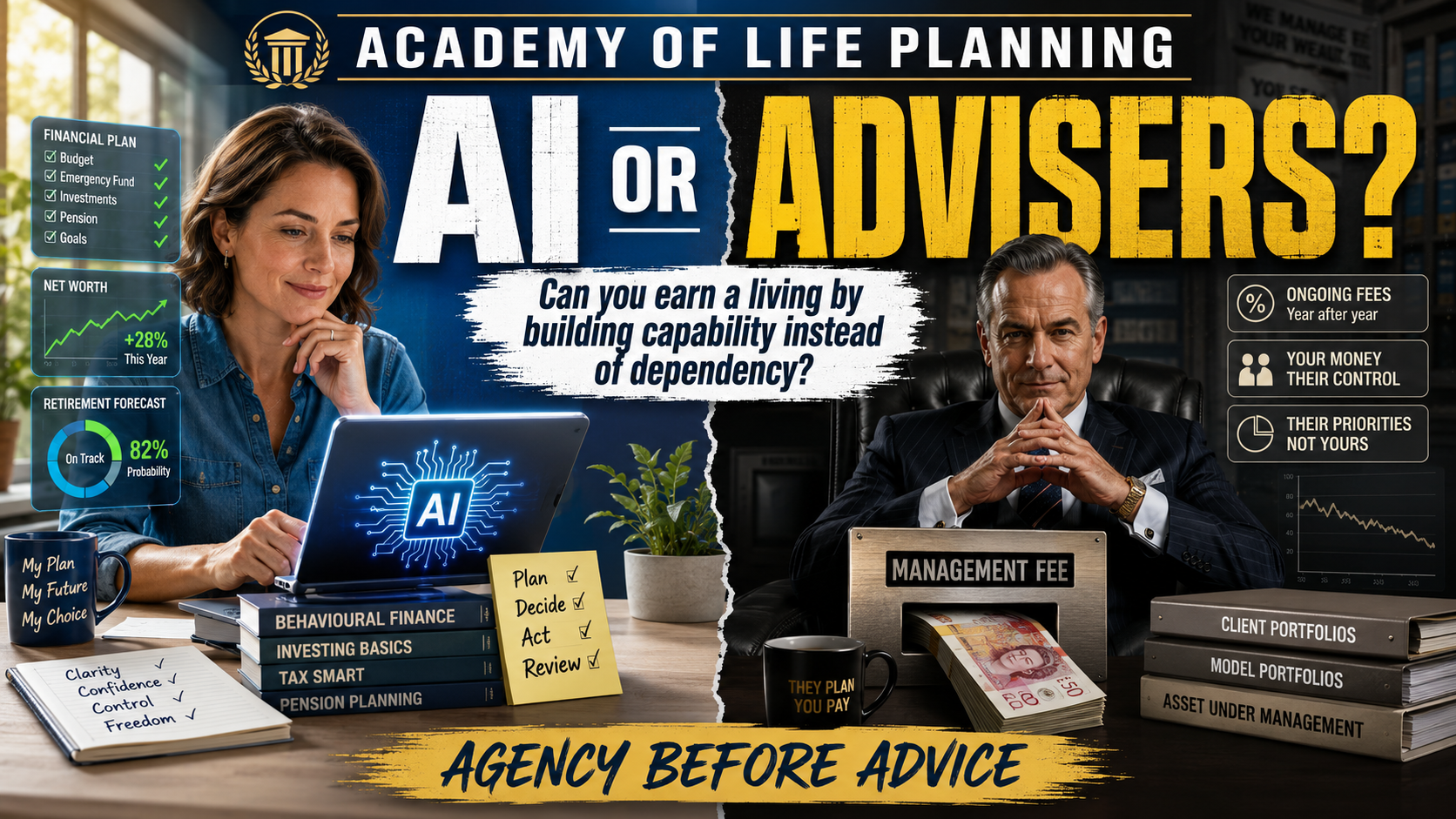
From Assets Under Management to Agency Under Development.
For decades, the financial-services business model has been built around a simple proposition:
People do not understand money well enough to manage it themselves.
So they should delegate.
Delegate the analysis.
Delegate the decisions.
Delegate the implementation.
Delegate the ongoing management.
Then pay someone, often indefinitely, for the privilege.
Artificial intelligence changes that equation.
Not because AI is perfect. It is not.
Not because human judgement no longer matters. It does.
But because, for the first time, ordinary citizens can access a level of analytical support, explanation and decision assistance that was previously available mainly through professionals.
That raises an uncomfortable question for the financial-planning profession:
Could you make a living showing citizens how to use AI to improve their financial capability, rather than encouraging them to delegate their money management so you can continue taking fees from it?
The skill AI will not replace
A recent article argued that AI will not replace the human skills involved in building financial confidence.
The author’s formula was:
Knowledge + Confidence + Action
There is much to agree with here.
Knowing what to do is not the same as doing it.
People still need to make sense of uncertainty, understand trade-offs, challenge their own assumptions and act when circumstances change.
But this leads to a different conclusion from the one often reached by the advice profession.
It does not necessarily prove that people will always need an adviser to manage their money.
It may prove that they need better tools, education and support to develop their own capability.
The real opportunity is not to preserve dependence on experts.
It is to help people become more expert in their own lives.
Advice asks: “What should I do for you?”
Agency asks:
“What do you need to understand so you can decide?”
That is a fundamentally different relationship.
Traditional advice often begins with the assumption that the professional knows and the client follows.
An agency-restoring model begins with the citizen’s goals, values, circumstances and existing knowledge.
The professional does not disappear.
Their role changes.
They become an educator, interpreter, challenger, facilitator and capability builder.
They help the person:
- frame the right question;
- identify the information that matters;
- use AI safely and intelligently;
- test assumptions and alternative scenarios;
- recognise uncertainty;
- understand risks and trade-offs;
- and make a decision they can explain and live with.
The person remains the decision-maker.
That is not the end of professional value.
It is a more demanding form of it.
From managing assets to activating people
The traditional model makes money from assets under management.
The agency model makes money from people becoming more capable.
These models create different incentives.
Under an assets-under-management model, the firm benefits when more money remains under management for longer.
The fee may appear small as a percentage, but it continues year after year. The adviser’s income is connected to the value of the client’s accumulated savings.
This creates a structural tension.
The client’s objective is to use their money to support their life.
The firm’s commercial objective is often to retain and grow the pool from which fees are deducted.
Nobody needs to behave dishonestly for the incentive conflict to exist.
The model itself creates it.
By contrast, a capability-based model is paid for the value of the work performed:
A planning session.
A decision review.
An educational programme.
A scenario analysis.
An AI-supported plan.
A second opinion.
Support during a major life transition.
The citizen pays for help when help is needed.
They do not surrender a permanent share of their wealth in exchange for ongoing reassurance.
One model monetises dependency.
The other monetises activation.
What would an AI financial capability professional actually do?
They would not simply sit beside someone and type questions into a chatbot.
The value is not in accessing AI.
Anyone can access AI.
The value is in knowing how to use it well.
A capable practitioner might help a citizen build a personal financial operating system.
That could include:
- organising financial information;
- clarifying life goals;
- mapping income, expenditure, assets and liabilities;
- exploring retirement scenarios;
- understanding pension options;
- testing the impact of inflation or market falls;
- comparing mortgage repayment with pension contributions;
- preparing questions for regulated advisers or product providers;
- reviewing documents and identifying areas requiring specialist attention;
- and creating a process for updating decisions as life changes.
The practitioner would also teach critical AI skills.
How should a question be framed?
What information should not be disclosed?
When should outputs be checked?
What assumptions is the model making?
What evidence supports the answer?
Where does general planning end and regulated advice begin?
When is a solicitor, accountant, pension specialist or regulated financial adviser genuinely required?
This is not blind reliance on AI.
It is AI-assisted judgement.
The false comparison
Critics often compare the worst imagined version of AI with the best imagined version of human advice.
AI may be wrong.
AI may misunderstand context.
AI may confirm a person’s biases.
All true.
But human advisers can also be wrong.
They may misunderstand the client.
They may recommend unsuitable products.
They may be influenced by fees, commissions, sales targets or business models.
They may overcomplicate matters in ways that preserve their own role.
And in the most serious cases, human intermediaries have misused, misappropriated or stolen client money.
This does not make AI safe by default.
Nor does it make human advice untrustworthy by default.
It means we should compare risks neutrally.
The relevant questions are:
Who has access to the money?
Who has authority to act?
Who benefits financially from the decision?
Who controls the information?
Who is accountable when things go wrong?
And does the relationship leave the citizen more capable, or more dependent?
AI does not need access to your savings
There is an important distinction between access to information and authority over assets.
An AI tool may help someone interpret a bank statement, pension document or investment report.
That does not mean it can transfer the money.
It does not automatically have custody of assets.
It does not receive a percentage of the portfolio.
It does not benefit from keeping money invested.
It does not need to persuade the person to remain a client for the next twenty years.
Of course, sensitive information should be handled carefully.
Citizens should understand privacy settings, remove unnecessary identifying details and use appropriate services.
But a legitimate privacy discussion should not become a vague warning designed to frighten people away from using tools that could improve their capability.
We should teach people to use AI safely.
Not teach them that they are safer only when dependent on an intermediary.
Can this become a viable profession?
Yes—but only if professionals are prepared to change what they believe they are selling.
If they believe they sell answers, AI will place pressure on their value.
If they believe they sell product selection, implementation and ongoing asset management, automation will continue to compress margins.
But if they help people build judgement, confidence and decision-making capability, the opportunity is substantial.
Millions of people cannot afford, do not want or will never qualify for traditional financial advice.
For them, the current choice is not:
Human adviser or AI.
It is often:
AI or nothing.
A professional who can help people use AI effectively could serve citizens who have historically been excluded from financial planning.
They could charge transparently for time, expertise and support.
They could work with individuals, families, employers, community groups, charities and public bodies.
They could develop workshops, planning tools, membership services, decision clinics and specialist support for life events.
They could build a livelihood without requiring control over a person’s assets.
That may be the emerging profession:
Not a manager of other people’s money, but an activator of other people’s capability.
The harder commercial question
There is, however, a genuine difficulty.
It is easier to build recurring revenue from assets than from independence.
A firm that charges a percentage of wealth can receive income automatically.
A professional who teaches people to become more self-reliant may eventually become less necessary.
That is exactly why so few businesses are designed this way.
The most ethical outcome for the client may appear commercially unattractive to the provider.
But perhaps this is the test.
Can we create a model where professional success is not measured by how long the client remains dependent, but by how much capability the client gains?
Can we build services people return to because they value them, rather than because leaving feels dangerous?
Can we earn a good living by helping citizens make better decisions without acquiring a continuing claim on their wealth?
At the Academy of Life Planning, we believe the answer is yes.
The model is not advice at scale.
It is agency at scale.
Agency before advice
There will still be times when regulated advice is necessary.
Complex tax planning, pension transfers, specific investment recommendations and legally binding arrangements may require appropriately authorised professionals.
But specialist advice should sit within a wider capability system.
It should not replace the citizen’s understanding.
The goal should be to help people know:
What they are trying to achieve.
What options they have.
What assumptions are being made.
What risks they are accepting.
What they are paying.
And why the recommendation serves their life.
That is agency before advice.
The person may still choose to delegate certain tasks.
But delegation becomes conscious and informed.
It is no longer surrender disguised as service.
A new question for the profession
The question is no longer simply:
What can a financial adviser do that AI cannot?
A more important question is:
What can a financial professional help a citizen do that they could not previously do for themselves?
The future may not belong to the professional who protects their expertise from AI.
It may belong to the one who uses AI to distribute expertise more widely.
Could you build a living helping citizens understand, choose and act?
Could you teach them to use AI without becoming dependent on it—or on you?
Could your success be measured not by the assets you retain, but by the agency you restore?
That is the opportunity.
Not managing more money.
Activating more people.

