
Fifteen years ago, I completed the Registered Life Planner pathway with the Kinder Institute.
It changed the way I listened, the way I planned and the way I understood the relationship between money and life.
Today, I am a Total Wealth Planner.
That journey was not a rejection of life planning. It was the next progression.
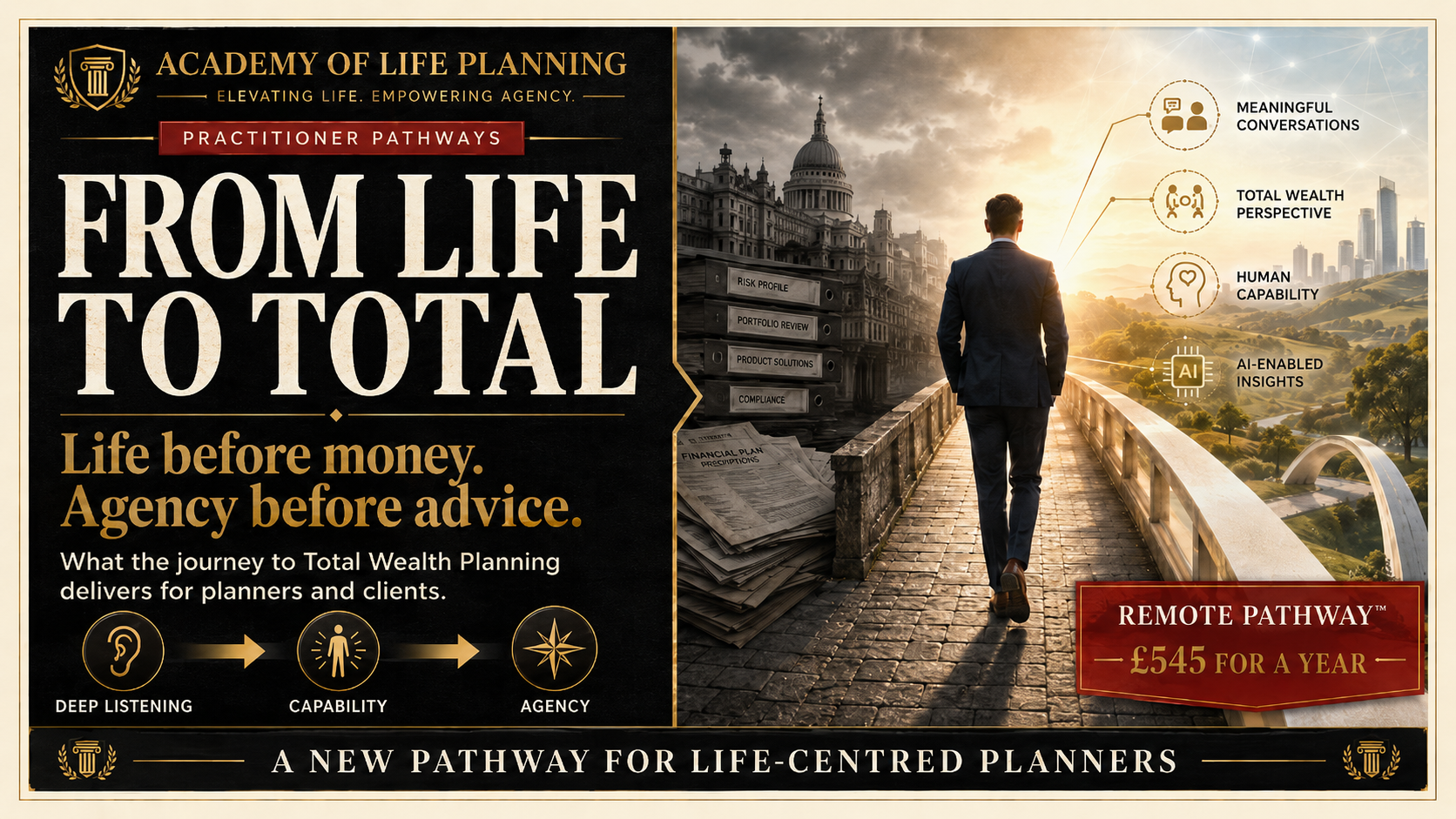
Life planning taught me to put life before money. Total Wealth Planning taught me to put agency before advice.
In this article, I want to show you why that distinction matters, what the journey from RLP to TWP delivers for you and your clients, and how you can follow the same path through a low-cost, fast-track Remote Pathway designed for experienced life-centred planners.
From Registered Life Planner to Total Wealth Planner
You learned to put life before money. The next step is to put agency before advice.
The Registered Life Planner® journey changes how a financial planner listens.
You learn to look beyond products, portfolios and conventional financial goals. You learn to explore the life behind the money: the aspirations people struggle to express, the obstacles preventing movement and the future they would choose if fear were removed.
For many planners, that is transformative.
I know because I made the journey myself.
Around 15 years ago, I invested approximately £10,000 in completing the Kinder Institute pathway and attaining Registered Life Planner status. The experience helped shape my understanding of life-centred financial planning and reinforced a principle that remains central to my work today:
Money is not the purpose of planning.
Money is a resource in service of life.
The Kinder tradition helped financial planning move from products to plans, and from plans to people.
But the world has changed.
Artificial intelligence is rapidly reducing the information advantage once held by professionals. People can increasingly access explanations, modelling, frameworks and decision support for themselves.
The next challenge is therefore not simply to create better conversations between clients and advisers.
It is to ensure that people leave those conversations more capable than when they entered.
That is the journey from Registered Life Planner to Total Wealth Planner.
Life planning changed the conversation
Traditional financial advice often began with the solution.
Which pension?
Which investment?
Which policy?
Financial planning improved the process by beginning with the goal.
When do you want to retire?
How much income will you need?
What legacy would you like to leave?
Life planning went deeper still.
What would make your life meaningful?
What have you always wanted to do?
What is preventing you from doing it?
That was an important progression:
Products → goals → life
Total Wealth Planning introduces the next step:
Products → goals → life → capability
It asks not only what life the client wants, but what resources, relationships, knowledge, confidence and decision-making capability must be activated to help them create it.
What Total Wealth Planning adds
Registered Life Planners are already trained to listen beneath the financial facts. They understand that a meaningful financial plan must begin with the person.
Total Wealth Planning builds on that foundation in five important ways.
1. From financial capital to total wealth
Most financial planning remains organised around money, even when the conversation begins with life.
The client’s aspirations are explored, but the eventual plan is commonly translated back into financial assets, expenditure, pensions, investments and protection.
Total Wealth Planning widens the field.
It recognises four interconnected forms of wealth:
- financial resources;
- human capability;
- social relationships and networks;
- environmental and spiritual well-being.
A person may not need more invested capital. They may need to activate knowledge, confidence, health, relationships, purpose or earning capacity.
The question changes from:
How much money will fund your life?
to:
What wealth is already present in your life, and what must be activated?
2. From client insight to client capability
A powerful life-planning conversation can help someone see what matters.
But insight alone does not necessarily create independent capability.
The planner may still retain:
- the planning process;
- the technical interpretation;
- the scenario modelling;
- the client record;
- the decision framework;
- the ability to update the plan.
The client understands their desired life more clearly, but may still depend on the professional to translate that understanding into action.
Total Wealth Planning is designed to leave capability behind.
Clients receive tools, frameworks and records they can continue using themselves. They can revisit assumptions, explore scenarios, organise evidence and prepare better questions before seeking professional support.
The measure of success is not simply whether the client felt heard.
It is whether they became more able to understand, choose and act.
3. From comprehensive engagement to proportional support
Conventional advice often assumes that every client needs an ongoing adviser relationship.
Life-centred planning may make that relationship more valuable, but it does not necessarily challenge its permanence.
Total Wealth Planning introduces Proportional Planning™.
The level of human support should reflect the complexity, risk and emotional weight of the decision—not the commercial need to retain the client indefinitely.
A person may need:
- independent tools for straightforward matters;
- a short Second Brain Session for one difficult decision;
- a structured Total Wealth Plan;
- regulated financial advice where a specific product recommendation is required;
- sustained human support during bereavement, exploitation or major life transition.
Different problems require different amounts of professional involvement.
The client should not have to buy a permanent relationship to obtain temporary help.
4. From adviser-held process to client-owned infrastructure
Artificial intelligence is changing what people can do for themselves.
This does not eliminate the need for human planners. It changes where human value lies.
Total Wealth Planning uses AI to help people:
- organise their financial and life information;
- understand unfamiliar concepts;
- identify gaps and inconsistencies;
- explore alternative scenarios;
- prepare for professional conversations;
- record decisions and their reasoning;
- maintain a living plan rather than receive a static report.
The planner becomes a second brain, mentor, challenger and safeguard—not the sole owner of the intelligence.
The aim is not to replace the human relationship.
It is to ensure that the relationship restores agency rather than unintentionally absorbing it.
5. From adviser dependency to progressive independence
The deepest distinction concerns the purpose of professional expertise.
In many advice models, commercial success depends on continuing intermediation. The adviser remains valuable because the client continues to need the adviser.
Total Wealth Planning proposes a different professional ethic:
The ultimate success is becoming progressively less needed.
That does not mean abandoning the client.
It means helping the client become capable enough to decide when support is genuinely required.
A Total Wealth Planner can remain trusted and available without making dependency the basis of the relationship.
What the journey delivers for RLPs
For a Registered Life Planner, Total Wealth Planning is not a repudiation of what you have learned.
It is the next application of it.
You already know how to uncover the life behind the money. The Total Wealth Planner pathway helps you turn that insight into durable capability.
You learn how to:
- extend planning beyond financial capital;
- activate human and social resources;
- integrate AI without losing humanity;
- give clients usable planning infrastructure;
- separate educational planning from regulated product advice;
- offer proportional rather than automatically ongoing support;
- create services that do not depend on assets under management;
- measure what the client can understand and do after the engagement;
- build a future-ready practice around agency rather than intermediation.
This gives the RLP an additional professional identity.
You are no longer only helping clients articulate a meaningful life.
You are helping them build the capability to pursue it.
What the journey delivers for clients
Clients gain more than a richer conversation or a beautifully expressed vision.
They gain:
A broader understanding of wealth.
They see money as one resource among many, rather than the sole determinant of possibility.
A plan they can participate in.
The process is visible, understandable and reusable rather than hidden inside professional software.
Greater confidence.
They learn how decisions are made, not simply what the planner recommends.
Control of their information.
Their personal and financial record becomes an asset they can maintain and use.
Proportional access to expertise.
They can obtain support when needed without automatically entering a permanent advice arrangement.
Increasing independence.
Each interaction should strengthen their capacity to navigate the next decision.
The outcome is not a client who knows everything.
It is a client who knows more, can do more and understands when to ask for help.
Learning should belong to the learner
There is another important distinction in the Academy model.
Professional education often operates through a designation economy.
The learner pays to acquire knowledge and capability, but may then continue paying simply to retain the public identity attached to what they have already earned.
There are legitimate reasons for continuing professional development, ethical oversight and evidence of current competence.
But these should be distinguished from ownership of the original learning.
The Academy’s principle is simple:
Learning belongs to the learner.
When you complete a programme and demonstrate competence, that achievement forms part of your professional history.
It should not disappear merely because you stop paying a subscription.
Current practising status may reasonably require current evidence. Membership may reasonably provide ongoing services, software, community and professional support. Directory visibility may require active participation.
But earned learning should remain earned.
In the spirit of restored human agency:
- achievement belongs to the learner;
- current competence is demonstrated through evidence;
- membership is purchased for continuing value;
- professional identity should not be held hostage to continuing rent.
This is the philosophy behind the Academy’s remote pathway.
Remote Pathway™ — £545 one-off for accreditation and a year of membership
The Remote Pathway™ provides Academy membership and a flexible route towards Total Wealth Planner accreditation for £545.
It is designed for established planners who already possess substantial professional knowledge and do not need to begin again as novices.
This is particularly relevant for Registered Life Planners.
You have already invested in deep listening, client-centred discovery and life planning. The Remote Pathway helps you extend that capability into the emerging discipline of agency-restoring practice.
The pathway enables you to:
- learn remotely and apply the principles within your existing practice;
- work through the Academy’s Total Wealth Planning frameworks;
- use Academy tools and emerging AI infrastructure;
- participate in the practitioner community;
- submit evidence of learning and practical application;
- develop towards accreditation without the cost and disruption of a traditional residential programme.
The purpose is not to make you repeat what you already know.
It is to help you integrate what you know with what comes next.
Not life planning versus Total Wealth Planning
This should not be framed as a contest between two schools.
Kinder’s contribution matters.
It helped financial planners recognise that clients are not collections of assets, risk tolerances and retirement dates. They are people trying to create meaningful lives.
Total Wealth Planning builds upon that inheritance.
The distinction is developmental:
Life planning centres the person in the conversation.
Total Wealth Planning returns capability to the person.
Or, more simply:
Life before money.
Agency before advice.
The planners most naturally suited to this next journey may be Registered Life Planners.
You already understand that the purpose of money is life.
The invitation now is to build a planning practice in which the purpose of expertise is agency.
The next progression
Financial planning began by helping people acquire and organise financial products.
Life planning taught the profession to listen for the aspirations behind those products.
The age of AI presents another transition.
The planner of the future will not be valuable because information is scarce or because the client cannot access planning tools.
The planner will be valuable because human judgement, empathy, challenge, safeguarding and wisdom still matter—especially when decisions are complex, uncertain or emotionally charged.
But that value need not depend on keeping the person permanently dependent.
The next progression is clear:
From selling solutions,
to creating plans,
to discovering lives,
to activating people.
For Registered Life Planners ready to make that progression, the Total Wealth Planner Remote Pathway is open.
Remote Pathway™ — Academy membership and remote accreditation pathway: £545.

