
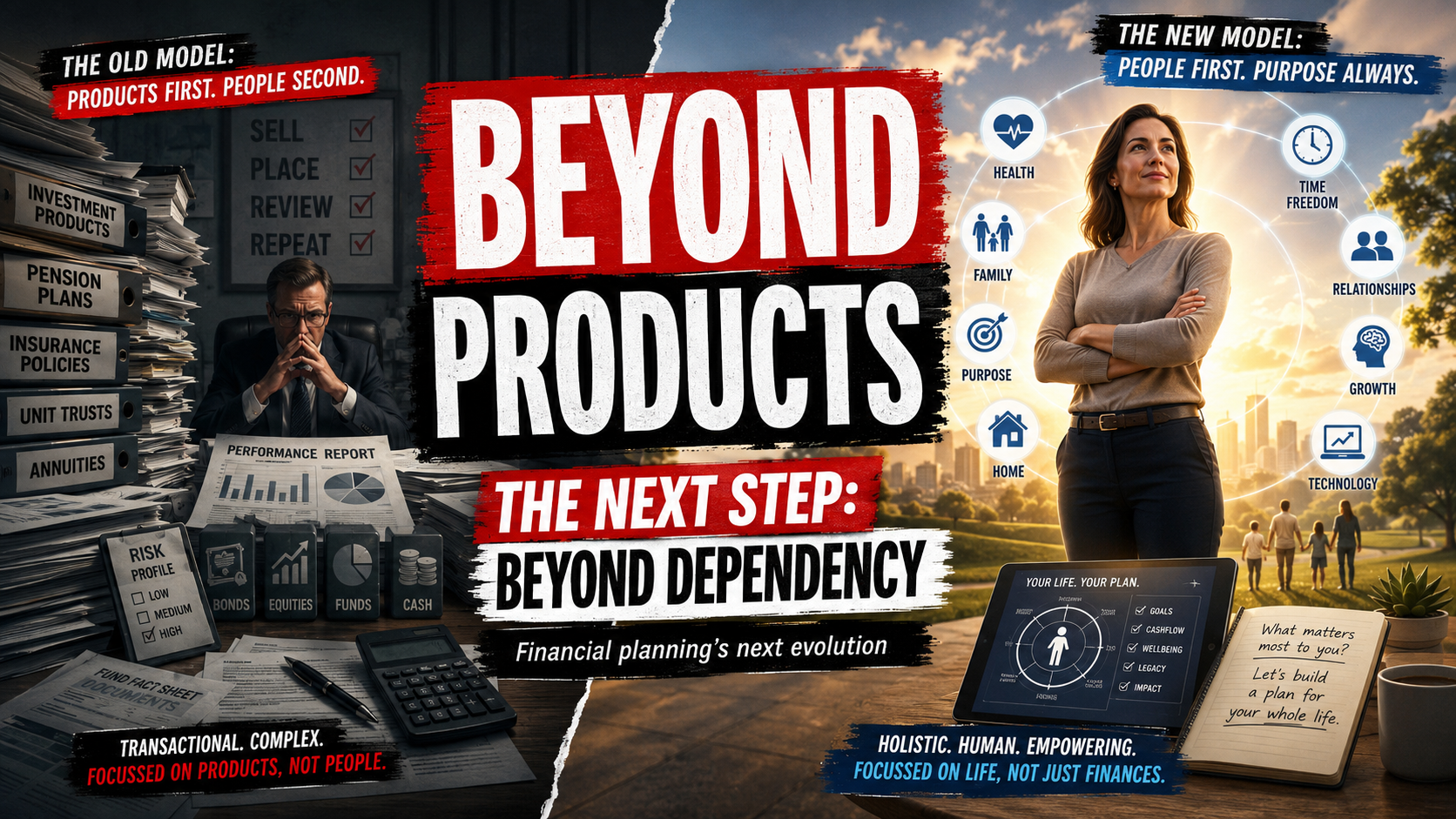
Financial planning is moving beyond products. The next step is to move beyond dependency.
Financial planning is moving beyond products.
That is good.
For too long, the public understanding of financial advice has been shaped by pensions, investments, tax wrappers, platforms, funds, protection products, and later-life lending. These things matter. They can be useful. They can form part of someone’s financial architecture.
But they are not the whole of financial planning.
A recent look at the PFS Financial Planning Conference agenda for the NEC Birmingham 18 – 19 November 2026 suggests the profession itself knows this. The language is shifting. The themes are no longer confined to technical expertise, investment propositions, tax efficiency, or product suitability. The agenda points toward something broader: AI, trust, accessibility, behavioural insight, professional standards, ethical judgement, adviser resilience, client vulnerability, social media, life transitions, and the changing expectations of clients.
That is a meaningful development.
It shows a profession in transition.
It knows the old model is under pressure. It knows clients are changing. It knows technology is changing. It knows trust cannot simply be assumed. It knows vulnerability is not a niche issue. It knows life events shape financial decisions. It knows that AI will affect advice, distribution, client engagement, and professional judgement.
But the missing question is still the central one:
Are we building a better advice industry, or are we restoring human agency?
That distinction matters.
Better advice still leaves the adviser as the centre of gravity.
Restored agency moves the centre of gravity back to the individual.
The risk of new language around an old model
The profession is beginning to talk about AI, trust, accessibility, behavioural insight, and life transitions.
The next step is to ask whether these developments make clients more dependent on advisers, or more capable of navigating complexity for themselves.
This is not a small distinction. It is the line between modernisation and transformation.
An advice firm can use AI to improve efficiency while leaving the client in the same dependent position.
It can talk about trust while still expecting the client to defer.
It can talk about wellbeing while still keeping money at the centre.
It can talk about accessibility while still designing systems around professional control.
It can talk about purpose while still using purpose as a pathway into product distribution.
It can talk about behavioural insight while using that insight to improve adviser influence, rather than client capability.
This is the risk.
Financial planning may move beyond products in language, yet still wrap the old dependency model in warmer, more progressive terminology: AI, trust, wellbeing, accessibility, purpose, vulnerability, and life transitions.
Those words matter. But they only become transformative when they change where authority sits.
If the professional remains the person who interprets, decides, frames, filters, and directs, then the client may receive a better service, but not necessarily greater agency.
What we hope the presentations will explore
The PFS agenda includes several themes that could open the door to a deeper conversation about the future of financial planning.
The sessions on AI, for example, could be extremely important. The obvious question is how advisers use AI to improve productivity, note-taking, compliance, reporting, marketing, client communication, and business growth. These are legitimate questions.
But the more important question is this: how can AI help clients think more clearly for themselves?
AI should not only be understood as something firms use internally. Nor should it only be framed as a distribution, compliance, or advice-efficiency tool. There is a public-interest use case for consumer-side AI: helping individuals understand documents, spot pressure, organise evidence, ask better questions, compare options, and regain confidence when faced with complexity.
If AI simply increases the power of firms and professionals, it risks widening the capability gap between institutions and individuals. If used well, it could narrow that gap.
The sessions on trust also matter. Trust is essential in financial planning. But trust should not mean passive deference. The healthiest form of trust is not “I don’t need to understand because my adviser knows best.” It is “I feel supported enough to understand, question, decide, and act.”
That is a very different kind of professional relationship.
The sessions on accessibility and assistive technology are equally significant. Accessibility should not be limited to digital design or regulatory compliance. It should include cognitive accessibility, emotional accessibility, procedural accessibility, and financial literacy under stress.
Many people do not struggle because they are incapable. They struggle because systems are complex, language is opaque, decisions are high-stakes, and the emotional load is heavy. Good design should reduce dependency, not reinforce it.
The behavioural insight sessions also raise an important opportunity. Behavioural finance has often focused on correcting client biases or helping clients follow advice. But human behaviour is not merely an obstacle to financial planning. It is the setting in which financial planning happens.
People make decisions while grieving, divorcing, caring, ageing, changing career, recovering from harm, managing illness, supporting children, facing retirement, or trying to hold a family system together. Behavioural insight should help people become more self-aware, more capable, and less easily pressured.
The sessions on life transitions may be among the most important of all. Life transitions are rarely just financial events. They are identity events. They change someone’s sense of security, purpose, belonging, responsibility, and future.
A retirement decision is not just a pension decision.
A bereavement is not just an estate administration issue.
A divorce is not just a settlement.
A care decision is not just a funding problem.
A business exit is not just a tax planning opportunity.
Each is a moment where a person may need structure, perspective, and restored agency before they need a product recommendation.
From financial advice to Total Wealth Planning
This is where Total Wealth Planning becomes the next developmental step.
Total Wealth Planning starts from a different premise. It does not ask only: “What financial recommendation is suitable?”
It asks: “What does this person need in order to become more capable, clear, safe, and self-directed in their own life?”
That shift changes everything.
It recognises that people hold many forms of wealth: financial capital, human capital, housing capital, social capital, family capital, health, time, knowledge, reputation, creativity, purpose, and spiritual or meaning-based capital.
Financial capital matters. But it is usually the store of wealth already created. Human capital is often the source of wealth creation. Social capital provides support, opportunity, belonging, and resilience. Health capital determines capacity. Time capital shapes possibility. Purpose gives direction. Family dynamics influence both risk and resource.
When planning starts only with money, it sees only part of the person.
When planning starts with the whole person, money becomes one resource among many.
This does not diminish technical financial planning. It gives it its proper place. Technical expertise remains valuable, but it should sit inside a wider human context. The adviser’s role is not to become more central to the client’s life. It is to help the client become more capable within their own life.
That is the developmental leap.
The adviser as centre, or the person as centre?
The old model of advice was built around the adviser as expert.
The improved model makes the adviser more professional, more ethical, more client-centred, more technologically enabled, and more emotionally intelligent.
That is progress.
But Total Wealth Planning asks for something deeper. It asks whether the professional relationship should be designed to reduce dependency over time.
A Total Wealth Planner is not simply a better adviser. Nor is the role to become a coach, therapist, mentor, caseworker, or guru.
The role is to help people stabilise, structure, and surface options so they can recover authority in their own lives.
Stabilise means helping people slow down, regain composure, and reduce the noise around a decision.
Structure means helping them organise the facts, choices, risks, resources, trade-offs, and next steps.
Surface options means helping them see what may be possible without directing them toward a predetermined outcome.
This is not about abandoning advice where advice is needed. It is about recognising that advice is not always the first need. Sometimes the first need is clarity. Sometimes it is confidence. Sometimes it is safety. Sometimes it is space. Sometimes it is the ability to ask a better question.
The future profession must choose its centre of gravity
The PFS agenda suggests the profession is asking many of the right questions.
How should advisers use AI?
How can planners build trust?
How do firms support clients through life transitions?
How do professionals perform under pressure?
How can ethical decision-making be protected?
How can financial planning become more accessible?
How can advisers communicate with younger generations?
How does the profession adapt to change?
These are all important.
But beneath them sits a larger question:
Who is financial planning ultimately designed to empower?
If the answer is the adviser, the firm, the platform, the profession, or the distribution system, then the old model will survive in new clothing.
If the answer is the individual, then financial planning has the opportunity to become something far more important than a better advice process.
It can become a discipline of restored human agency.
That is the promise of Total Wealth Planning.
Not product distribution with softer language.
Not adviser dependence with better technology.
Not wellbeing as a marketing wrapper.
Not purpose as a discovery technique.
But a practical, ethical, whole-person approach that helps people understand their resources, recover their confidence, and act under their own energy.
Financial planning is moving beyond products.
The next step is to move beyond dependency.
That is where the future of the profession begins.

