
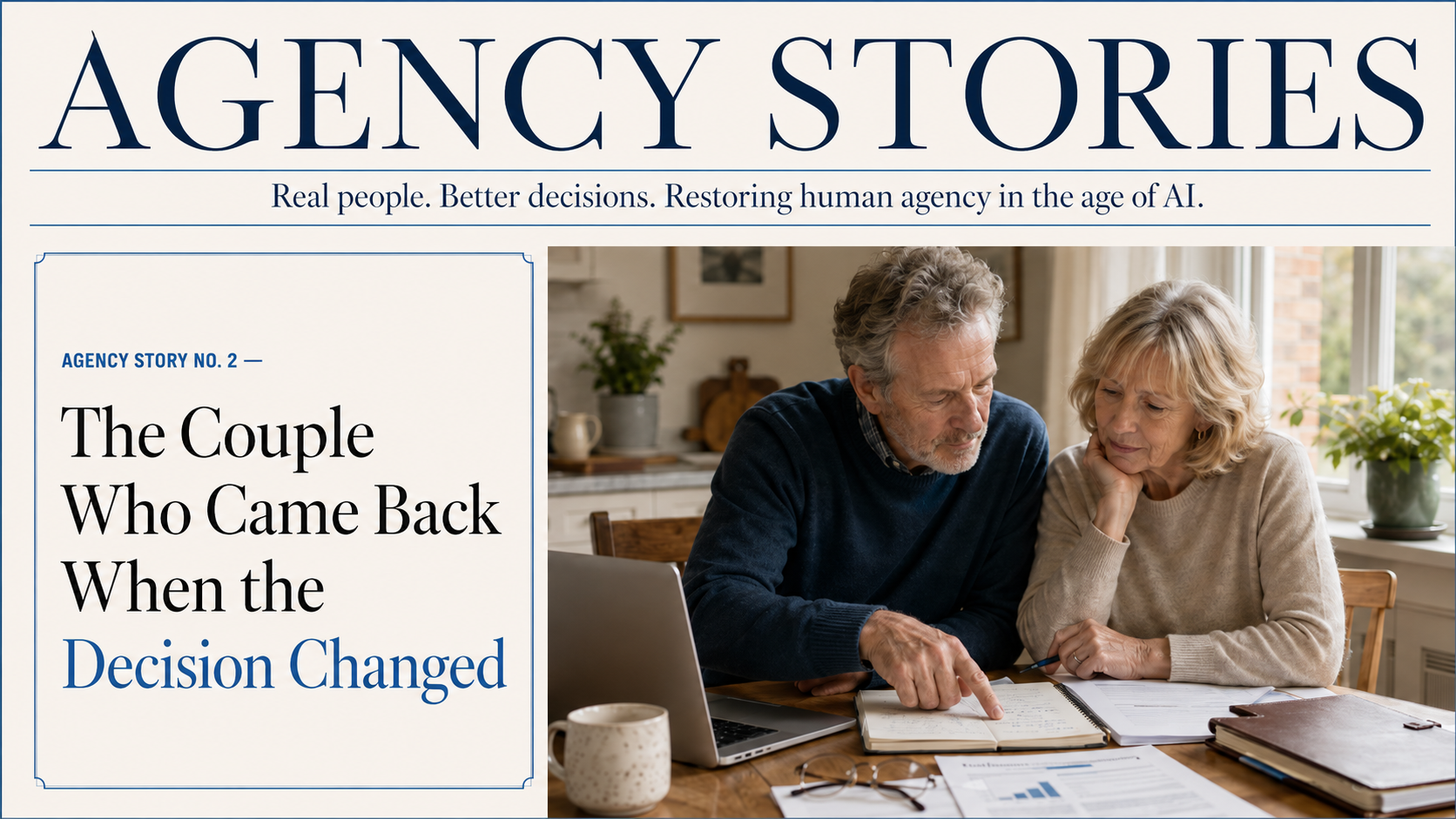
Rachel and David did not need someone permanently managing their financial lives. They needed a way to explore retirement for themselves, followed by focused human support when the remaining decisions became more complex.
Names and certain identifying details have been changed to protect client confidentiality. The underlying circumstances, planning process and client quotations remain faithful to the original case.
Rachel had been using the Total Wealth Plan almost continuously.
She had tested different retirement dates, changed assumptions and asked repeated “What if?” questions about pensions, savings, working patterns and future spending.
She had also created her own spreadsheets showing estimated household outgoings, when different pensions might begin and how accessible savings could support the years between stopping work and receiving later pension income.
Then she wrote:
“I have to admit I have been using the Total Wealth Plan pretty much non-stop to help me understand my pensions and running lots of ‘What if?’ scenarios. Such a useful tool!”
She was no longer looking at retirement as a single distant date.
She was beginning to see it as a sequence.
David was waiting for an important occupational pension calculation. Some of the figures remained provisional. Different pensions would become accessible at different ages. Rachel wanted to retire as soon as she reasonably could, but she did not yet know exactly when that would be possible.
She had information.
She had options.
What she wanted now was to confirm whether her thinking held together.
That distinction matters.
She was not asking someone else to create their future.
She was asking for help testing the future she had begun to create herself.
Six years earlier
I had last reviewed Rachel and David’s financial position around six years earlier.
At that time, the process looked more like a traditional financial fact-find. Their income, expenditure, home, savings and pension arrangements were gathered into a detailed record. They had several different pension schemes with different rules, values and retirement ages.
The fact-find created a snapshot of their financial position.
But snapshots age.
Salaries change. Mortgages end. Pensions accumulate. Priorities move closer. A distant idea called retirement becomes a decision about the next few years.
There had been no need for Rachel and David to remain in a permanent advisory relationship throughout the intervening period.
They continued with their lives.
Then the decision changed.
That was the point at which support became useful again.
Re-entering through the Total Wealth Plan
Rachel was invited to try the Total Wealth Plan as a done-by-you planning process.
The purpose was to help her bring together the different parts of life and money, explore possible futures and identify where further thought or professional support might add value.
Rachel immediately understood how she wanted to use it.
She did not follow the process passively or feel obliged to approach it in a prescribed order.
She wrote:
“I wasn’t really into the touchy-feely bits and wanted to get straight to the financial aspects, so I just told it that and it jumped ahead, which was pleasing.”
That response is revealing.
Agency does not mean forcing everyone through the same version of life planning.
It means allowing the person to direct the process.
Some people begin with values, identity and purpose.
Others begin with pensions, projections and numbers.
The tool should adapt to the person rather than require the person to adapt to the tool.
Rachel found the process straightforward and engaging. She could pause, return later, add more information and continue where she had left off.
Most importantly, she could change assumptions and observe the effect.
She wrote:
“I was also very impressed with the future modelling capabilities and how easy it was to adjust the factors and assumptions, with everything achieved through short, two-way conversations.”
That is where the planning relationship began to change.
The old model had gathered information for a professional.
The new model helped Rachel interrogate the information herself.
The apparent problem: can we afford to retire?
The first question was straightforward.
Could David retire soon?
And how quickly could Rachel follow?
The early Total Wealth Plan model explored a scenario in which David stopped work first while Rachel continued earning. It brought together salaries, expected pensions, savings, expenditure and possible retirement dates.
The initial projection suggested that their overall position was promising, while also identifying several areas requiring further investigation: pension figures needed updating, one important calculation remained outstanding, and accessible assets would be needed to bridge periods before later pension income became available.
But the real value was not the verdict produced by the model.
It was the ability to test alternatives.
Rachel could compare continuing full-time work with reducing her hours. She could explore how income, pension contributions, accessible savings and eventual retirement wealth might change.
The complete plan included a comparison of different working and saving scenarios, allowing her to examine the trade-off between accumulating more money and gaining more time.
The question was beginning to evolve.
It was no longer only:
Can we afford to retire?
It was becoming:
Which combination of time, work, saving and retirement feels sufficient for us?
A plan that reflected the people
The Total Wealth Plan also explored the values underlying the decision.
Rachel identified being capable and self-sufficient as especially important. David placed particular importance on independence and having a clear head.
Those preferences were not incidental to the financial question.
They explained how the couple wanted to approach retirement.
They were not chasing extravagance.
They wanted enough income, greater freedom and confidence that the plan would hold together.
Rachel’s desire to understand the details was not simply an appetite for numbers.
It reflected a deeper need to remain capable.
That makes her later review especially significant.
The outcome she valued was not that somebody had taken responsibility away from her.
It was that the process allowed her to retain it.
From exploration to a more precise question
After using the Total Wealth Plan, Rachel did not immediately ask for an ongoing adviser.
She continued investigating.
She saved the reports. She created her own spreadsheets. She tracked projected expenditure, pension-access dates and available savings.
Over time, the question became more specific.
She wrote:
“I’d like to have a chat to confirm my thinking.”
That may be the most important sentence in the early correspondence.
She was not asking:
“What should I do?”
She was asking:
“Does my reasoning make sense?”
This is the movement from advice-seeking to decision support.
The individual does not arrive as an empty vessel.
They arrive with information, assumptions, possible answers and questions worth examining.
The professional conversation becomes more valuable because the person has already completed meaningful work.
A new retirement possibility
The first projections had assumed that Rachel would continue working for several more years.
But using the tool changed her sense of what might be possible.
She began considering whether she could retire earlier.
That did not mean the app had proved that she could.
It meant the modelling had opened a question that previously felt closed.
This is an important function of planning technology.
A poor tool produces false certainty.
A better tool expands the field of choices while making clear what still needs to be tested.
Rachel could see that the issue was not only the total value of their pensions.
It was access.
Some pension funds could not be used immediately. Some benefits began later. One important pension calculation remained uncertain. Cash and other accessible assets would therefore play a central role if they wanted to stop work sooner.
The problem was becoming visible.
But it had not yet been resolved.
Moving from Total Wealth Plan to Navigator
Rachel then moved from broad exploration into more detailed retirement modelling.
She used Ask My Pension™ to identify questions about the different schemes. She entered updated information into Navigator™, including income, expenditure and pension commencement dates.
The tools performed different jobs.
Total Wealth Plan helped Rachel consider the whole life transition and explore possible futures.
Ask My Pension helped her identify pension questions requiring investigation.
Navigator helped her model the financial sequence in greater detail.
This was not three disconnected products.
It was a progression from orientation to understanding to decision support.
As the question became more precise, the tool became more precise.
And when the remaining trade-offs required human judgement, a Second Brain Session became appropriate.
That is Proportional Planning™ in practice.
The hidden problem was timing
Once the Navigator model had been updated, the apparent shortfalls in the early retirement years became easier to interpret.
They did not necessarily mean Rachel and David lacked sufficient wealth.
They meant that the model had not yet assigned the right assets to the right years.
Their emerging aim was to retire together within the next few years.
Rachel would stop working before some of her pension benefits became available. Her defined contribution pensions could be accessed first, with defined benefit and State Pension income beginning later.
The real problem was therefore not:
Do we have enough?
It was:
How do we bridge the years between stopping work and later pension income beginning?
The meeting notes concluded that the timetable appeared potentially achievable, provided the initial years were funded carefully. Existing savings, ISAs, Premium Bonds and maturing accounts were among the resources considered for that bridge.
This was not simply an insufficiency problem.
It was a sequencing problem.
An unexplained shortfall feels like evidence that retirement cannot happen.
A planned bridge is a design choice.
The Second Brain Session
By the time we spoke, Rachel had already prepared the ground.
She had gathered the information.
She had used the apps.
She had tested scenarios.
She had identified uncertainties.
The human conversation could therefore concentrate on the questions where interpretation mattered.
We discussed the period before pension access, how expenditure might change after work, how withdrawals could vary over time and which pension arrangements might provide suitable flexibility.
We also considered the difference between money likely to be needed soon and money intended for later life.
The aim was not to issue a single instruction.
It was to help Rachel understand the logic of the choices.
A Second Brain Session should not become a substitute brain.
It should help the person test assumptions, notice what may have been overlooked and leave with stronger reasoning than they brought in.
The moment the shift became visible
After the session, Rachel updated Navigator herself.
She amended the start and end dates for different expenses and saw the model become more accurate.
She wrote:
“I found our sessions incredibly useful, and I really feel that I’ve built the confidence to make these important decisions about our future.”
That statement did not emerge from one meeting alone.
It followed a progression.
She tried the Total Wealth Plan.
She explored “What if?” scenarios.
She created her own spreadsheets.
She used Ask My Pension.
She built a more detailed Navigator model.
She brought her thinking to a human conversation.
Then she returned to the model and improved it herself.
Agency was not delivered to her.
It developed through use.
“Without taking the decisions away from us”
Rachel later left five-star reviews on both Google and Trustpilot.
Her Trustpilot headline was:
“A game changer for our retirement planning!”
She explained that Navigator had allowed them to explore different scenarios and understand the potential effect of their choices.
But the strongest sentence was this:
“Steve’s guidance helped us feel confident in our decision making without feeling pressured or taking the decisions away from us.”
That is the central test of agency-restoring support.
Did the person receive help?
Yes.
Did the person retain authority?
Also yes.
The two should not be treated as opposites.
Professional support becomes problematic when help quietly turns into substitution—when the expert not only contributes knowledge but assumes ownership of the decision.
Rachel’s experience followed a different pattern.
The tools increased her ability to explore.
The conversation increased her confidence in interpreting what she found.
The final decision remained hers and David’s.
Support that expands and contracts
Some information was still outstanding.
There were pension figures to update and eventual implementation decisions that might require regulated financial advice.
But Rachel and David did not need to remain in a continuous advice process while waiting.
They had enough understanding to continue preparing.
They could build accessible savings.
They could refine their expected expenditure.
They could update pension values.
They could revisit Navigator when new information arrived.
And when the outstanding pension calculation changed the decision, they could return for another focused conversation.
That is not discontinuity.
It is proportionality.
The support expands when the decision becomes complex.
It contracts when the person can proceed independently.
It becomes available again when circumstances change.
What Proportional Planning™ looks like
Rachel’s story shows four different levels of support.
First came the self-directed Total Wealth Plan, allowing her to explore the whole situation and imagine different futures.
Then came specialist tools, helping her investigate pensions and create a more detailed model.
Next came a focused human conversation, used to test assumptions and understand the sequencing problem.
Finally came independent action: updating the model, building accessible savings and waiting for the information required for the next decision.
This is neither “do everything yourself” nor “delegate everything to an adviser.”
It is a third model:
Do independently what you can.
Seek support where it adds value.
Keep the decision yours.
A different measure of success
Conventional advice businesses often measure success through permanence.
How long did the relationship continue?
How much money remained under management?
How much recurring revenue did the client generate?
Proportional Planning™ suggests different questions.
What can the person now understand?
What scenarios can they test?
What assumptions can they challenge?
What can they do without waiting for a professional?
And do they know when a decision has become complex enough to justify further help?
Rachel first used the Total Wealth Plan independently.
She then sought more focused support.
She left with greater clarity and returned to working on the plan herself.
The successful outcome was not an indefinite relationship.
It was an intelligent relationship with changing intensity.
The future of planning
AI does not remove the need for professional judgement.
It changes where that judgement belongs.
Consumer-facing tools can increasingly help people organise information, explain unfamiliar concepts and explore possible futures.
Professionals can then concentrate on ambiguity, consequences, competing priorities and decisions that are difficult to reverse.
The tool can help a person see the landscape.
The professional can help them examine the difficult terrain.
But the person should remain the one choosing the destination.
That is what Rachel’s story reveals.
The Total Wealth Plan did not replace the planner.
It changed when the planner became useful.
The Second Brain Session did not replace Rachel’s judgement.
It strengthened it.
And the relationship did not require permanent dependence to remain valuable.
That is the essence of Proportional Planning™:
The right support at the right time.
What would financial planning look like if people could move freely between self-directed tools, focused human support and independent action—without being captured by any one of them?
Start with your own plan
You do not need to begin by handing your decisions to someone else.
Academy OS includes free, done-by-you apps designed to help you organise your information, explore your options and identify the questions that matter before deciding whether further support would be useful.
Use them at your own pace. Test different possibilities. Build your understanding. Then seek human or regulated professional support where the complexity of the decision genuinely requires it.
Explore the free Academy OS planning apps:
Start your done-by-you plan
Do independently what you can. Seek support where it adds value. Keep the decision yours.
Addendum: Not Everyone Begins with an App
Rachel’s story shows one route into Proportional Planning™.
She was curious, digitally confident and willing to explore. She used the Total Wealth Plan extensively, created her own spreadsheets, tested scenarios and arrived at the human conversation with increasingly precise questions.
But that will not be true for everyone.
Some people struggle to sign in.
Some feel overwhelmed by financial language before they begin.
Some do not yet recognise “planning” as something they can participate in. They associate financial services with a familiar shop: a place where someone sells a pension, investment or insurance product.
A proposition built around understanding, capability and self-direction may be better for them, but less immediately recognisable.
That creates an important boundary condition for Agency Story No. 2:
Agency-restoring tools only restore agency when the person is sufficiently activated to use them.
The problem is not always access to better tools.
Sometimes it is activation.
The client must first recognise the question
Many people are not looking for a Total Wealth Planner.
They may not be curious about modelling software or retirement projections. They may not believe they have enough money to justify professional help. They may assume that other clients are wealthier, more sophisticated or more deserving of attention.
But they may understand a different set of questions:
- Can someone explain this without trying to sell me something?
- Can I get a second opinion before I decide?
- Am I missing anything important?
- Is this suitable for someone with an ordinary amount of money?
- How ready am I to make this decision for myself?
- Must I continue trusting other people to make financial decisions for me?
These questions may provide a more familiar and psychologically safer front door.
The “shop” is not necessarily a place where people come to buy an investment.
It may be:
A place to bring financial decisions before you make them.
The role of the Financial Activation Measure™
Before inviting someone to use Academy OS, it may be useful to understand their current level of financial activation.
The Financial Activation Measure™ asks a different question from a conventional fact-find.
It does not begin with wealth, assets or product complexity.
It asks:
How ready is this person to understand, choose and act in their own financial life?
Someone who is confident, organised and curious may be ready to begin with the apps, as Rachel did.
Someone who is aware but struggling may need encouragement, explanation or help taking the first step.
Someone who is overwhelmed or disengaged may need a human conversation before a digital tool becomes useful.
The sequence should therefore not be rigid.
For one person it may be:
Academy OS → focused human support → independent action
For another it may be:
Human reassurance → Financial Activation Measure™ → supported use of Academy OS → growing independence
Both are examples of Proportional Planning™.
The right entry point depends not only on the complexity of the finances, but also on the readiness of the person.
Three possible front doors
Agency-restoring planning may therefore need more than one way in.
The activation door
How ready am I to make financial decisions for myself?
The Financial Activation Measure™ helps the person understand their current confidence, capability and dependency.
The second-opinion door
Can someone help me understand this before I act?
A focused conversation provides clarity without requiring an immediate commitment to a full advice process.
The done-by-you door
What can I explore and organise for myself?
Academy OS gives the person structured tools for understanding, modelling and preparing better questions.
These routes can converge.
The aim is not to force every person through the same process.
It is to meet them where they are and help them take the next proportionate step.
A wider lesson from Rachel’s story
Rachel’s experience should not be interpreted as evidence that every client will immediately embrace AI-assisted planning.
It shows what becomes possible when the tools, the person and the decision are well matched.
The wider lesson is therefore not simply:
Give people an app and they will become capable.
It is:
Understand their activation, offer a recognisable entry point, and use technology and human support in the proportion they need.
Some people will begin independently.
Some will need someone beside them.
Some may need help simply believing that financial planning is for people like them.
Restored agency does not mean abandoning people to self-service.
It means building enough capability that they can participate meaningfully in the decisions shaping their lives.
That is the deeper promise of Proportional Planning™:
Not the same process for everyone.
The right starting point for this person.
Find Your Financial Activation Score
Before deciding which tools, conversations or professional support you need, start by understanding your current level of financial activation.
The Financial Activation Measure™ looks beyond wealth and product complexity. It considers your present ability to understand, choose and act in your own financial life.
Are you feeling overwhelmed and dependent on others?
Are you aware of what needs attention but struggling to act?
Are you beginning to build confidence and better habits?
Or are you already making informed decisions and acting as your own advocate?
Your score can help identify the most appropriate next step.
Take the Financial Activation Scorecard and find your score for free:
Try the Financial Activation Measure™
Before you optimise your finances, understand how ready you are to own the decisions.


One thought on “Agency Story No. 2: The Couple Who Came Back When the Decision Changed”