
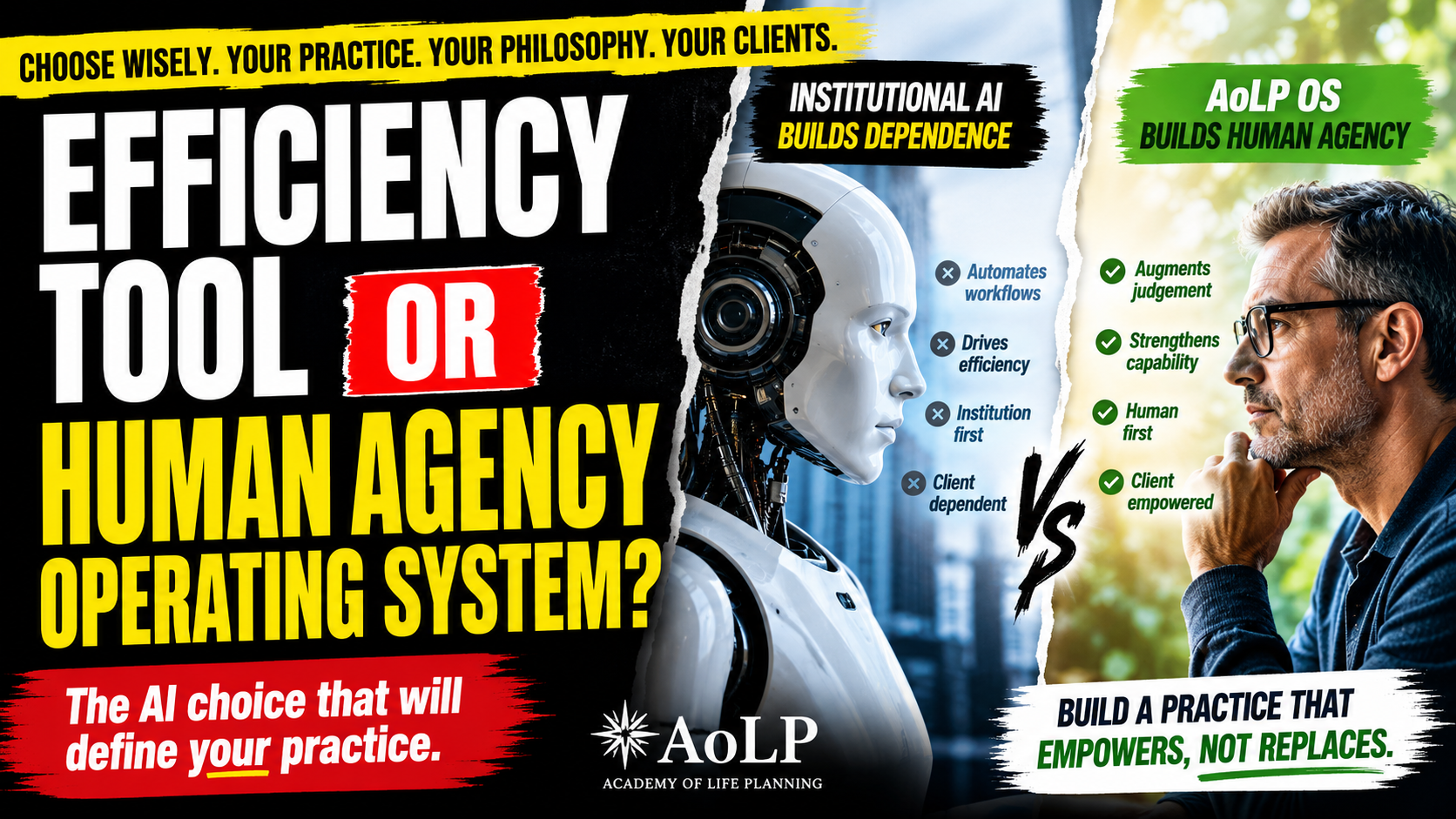
A new McKinsey study on AI competitive advantage raises important questions for financial planners choosing the next generation of technology platforms.
The study makes a simple but profound point:
When everyone has access to the same AI models, the real competitive advantage no longer comes from the AI itself. It comes from the operating system built around it.
That matters enormously for financial planners.
Because many firms are currently choosing AI systems based almost entirely on:
- speed
- workflow automation
- report writing
- compliance efficiencies
- scale
- operational convenience
Those things matter.
But they are not neutral design choices.
Every AI system embeds a philosophy.
And increasingly, planners are making a much bigger decision than they realise:
Are you adopting a tool that strengthens human agency — or one that quietly centralises control, dependency, and institutional thinking?
The danger of becoming operationally efficient but philosophically hollow
The current adviser AI market is rapidly filling with:
- centralised data ecosystems
- vertically integrated workflows
- institutional recommendation engines
- automated nudging systems
- platform-led client engagement layers
- adviser-side copilots
Most are marketed around productivity.
But productivity alone is not a planning philosophy.
A planner can become faster while becoming less differentiated.
This is one of the most important insights hidden inside the McKinsey paper. The authors argue that AI itself is becoming “table stakes.” The advantage comes from the surrounding architecture: trust, embeddedness, workflows, data design, and customer relationships.
That should make planners pause.
Because if every firm uses broadly similar AI systems, then what exactly remains unique about the planner?
The uncomfortable question facing financial planning
Many adviser AI systems are not designed primarily to restore human capability.
They are designed to:
- reduce friction
- increase throughput
- standardise delivery
- lower servicing costs
- improve consistency
- protect institutional processes
Again, none of this is inherently wrong.
But there is a subtle philosophical shift taking place.
The planner risks slowly becoming:
- workflow supervisor
- compliance operator
- distribution interface
- behavioural manager
- AI-enhanced intermediary
…rather than a trusted human thinking partner.
At the Academy of Life Planning, we believe this distinction matters enormously.
Because the future value of financial planning may not lie in having more information.
AI is rapidly commoditising information.
The future premium may instead lie in:
- judgement
- context
- meaning
- trust
- behavioural understanding
- life navigation
- helping people think clearly under uncertainty
In other words:
Human agency.
The real risk is not AI. It is invisible philosophy
The financial planning profession is currently standing at a fork in the road.
One path leads toward increasingly institutionalised AI ecosystems where:
- clients become data streams
- planning becomes workflow management
- recommendations become system-generated
- value becomes operational efficiency
- firms compete on scale
The other path leads toward AI systems designed to strengthen the client’s own capability, clarity, and participation in decision-making.
These are not the same thing.
One optimises the institution.
The other strengthens the individual.
This is where the Academy of Life Planning’s Operating System philosophy differs from much of the current market.
From “advice technology” to a Human Agency Operating System
The AoLP OS was not designed simply to automate advice processes.
It was designed around a different foundational question:
“How can technology help restore human agency in a complex world?”
That changes everything.
It changes:
- the data philosophy
- the role of AI
- the role of the planner
- the relationship with the client
- the architecture of trust
- the ownership of decision-making
Rather than treating clients as passive recipients of expertise, the OS treats people as active participants in their own planning process.
That is why the ecosystem focuses on:
- reflective thinking
- values clarification
- life-first planning
- behavioural understanding
- second-brain support
- longitudinal thinking
- local-first privacy principles
- client capability development
This is not anti-technology.
In many ways, it is more technologically aligned with the future than traditional adviser infrastructure.
Because as AI becomes abundant, the scarce resource becomes:
- trust
- coherence
- discernment
- emotional safety
- human interpretation
- meaning-making
The hidden strategic risk of institutional AI stacks
McKinsey warns that deeply embedded AI systems can become difficult to escape because they reshape workflows, behaviours, and dependency structures over time.
Financial planners should think carefully about that.
Because once a practice becomes fully dependent on:
- proprietary AI workflows
- centralised recommendation engines
- closed data architectures
- vertically integrated ecosystems
…it may gradually lose strategic freedom.
The planner can become embedded inside somebody else’s operating philosophy.
That has implications not just commercially, but ethically.
Especially in a profession supposedly built around acting in the client’s best interests.
The future planner may look very different
The planners who thrive in the AI era may not be those with the biggest automation stack.
They may be the planners who best help human beings:
- navigate uncertainty
- think clearly
- organise complexity
- align decisions with values
- resist manipulation
- build resilience
- regain confidence
- participate actively in their own lives
That is a fundamentally different proposition from industrialised financial advice.
It is also much harder to commoditise.
A strategic question worth asking now
Before adopting the next AI platform, planners may want to ask:
“What philosophy of human behaviour is embedded inside this system?”
Does it:
- increase dependency?
- centralise control?
- optimise product distribution?
- prioritise institutional efficiency?
- reduce the client’s participation in thinking?
Or does it:
- strengthen clarity?
- increase capability?
- support reflection?
- improve understanding?
- restore human agency?
Because increasingly, the technology stack is the planning philosophy.
And in the age of AI, the firms that endure may not be those with the cleverest models.
They may be the ones that remember the purpose of planning in the first place.
The Academy of Life Planning believes the future belongs to planners who use AI not simply to scale advice — but to strengthen the human being sitting in front of them.
I’d be interested in your perspective.

