

How should we understand the emerging shift from dependency to agency in the financial advice market, particularly as AI reduces information asymmetry and increases consumers’ ability to understand, model and challenge financial decisions for themselves?
My working hypothesis is that the supply side of the market remains relatively rigid and anchored in the traditional dependency model: adviser-led recommendations, ongoing fees, asset-based charging, product intermediation and professional control. By contrast, the demand side appears to be shifting towards greater agency, with consumers increasingly expecting clarity, transparency, self-direction, AI-assisted understanding and more control over their financial lives.
Drawing on principles from economics, marketing strategy and product management, what typically happens when customer demand begins to move away from the incumbent market norm faster than supply is willing or able to adapt?
In particular, how do market incumbents tend to fare in the short term and long term if they defend the existing model and shift late, compared with early adopters who recognise the change and build propositions around the emerging demand curve?
What useful precedents from economic and business history can help us understand this kind of transition, and what strategic lessons should newly formed Total Wealth Planner firms take from them?
The key shift is not simply “AI changes advice.”
It is: AI changes the customer’s perceived need for dependency.
That is much more disruptive.
In traditional financial advice, the market has been built around dependency: information asymmetry, regulatory complexity, product access, technical language, and ongoing reassurance. AI weakens several of those foundations at once. It does not remove the need for human judgement, but it changes what people expect humans to do.
A useful framing would be:
Supply is anchored in dependency. Demand is drifting toward agency.
The supply side — incumbent financial advisers, wealth managers, platforms, networks, compliance departments — is still largely organised around:
ongoing assets under advice, adviser-led recommendations, annual reviews, product implementation, “peace of mind”, and professional authority.
The emerging demand side is beginning to ask different questions:
“Can I understand this myself?”
“Can I model options before speaking to anyone?”
“Can I use AI as a second brain?”
“Why am I paying a percentage of my life savings every year?”
“Do I need advice, or do I need structure, clarity and confidence?”
That is the real market fracture.
Strictly, in economics, we would normally talk about a demand curve shifting, not a “normal curve”. But in innovation theory, the normal distribution is very relevant because adoption tends to move through innovators, early adopters, early majority, late majority and laggards. Rogers’ diffusion model places innovators at about 2.5%, early adopters at 13.5%, early majority at 34%, late majority at 34%, and laggards at 16%. That helps explain why incumbents often misread change: early demand looks too small to threaten the core business, until the early majority starts moving.
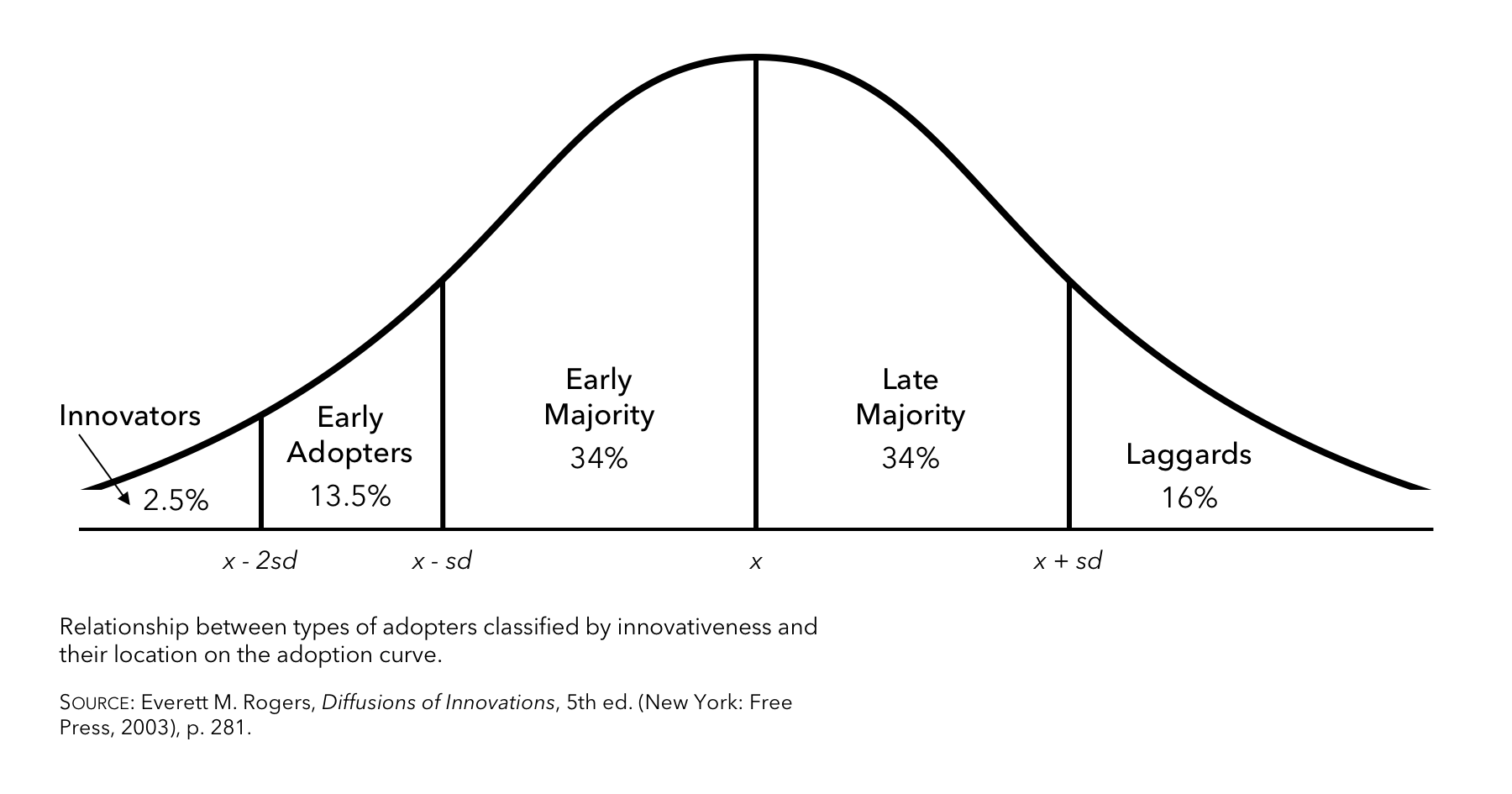
(Source: University of Oklahoma)
The strategic danger for incumbents is that they confuse today’s revenue with tomorrow’s relevance.
In the short term, incumbents who stay in the dependency camp may look strong. Their revenues remain high. Their client books appear loyal. Their compliance frameworks protect the current model. Their language still sounds authoritative. They may even benefit temporarily from fear: “AI is risky; stay with your adviser.”
But beneath the surface, their market power starts eroding. The customer becomes less deferential. Price sensitivity increases. The perceived value of ongoing fees is questioned. Younger or more capable clients begin self-serving. New entrants design around user agency rather than professional dependency.
That is when the old model enters what I would call margin-preserving denial.
The firm is still profitable, but its narrative is losing contact with customer reality.
Long term, late shifters usually face one of four outcomes.
First, they are forced into defensive price compression. They keep the old proposition but have to justify it harder, discount it, bundle it, or hide the cost inside complexity.
Second, they retreat upmarket. They serve only the wealthy, complex, vulnerable, or delegation-preferring clients. That can be viable, but it becomes a narrower market.
Third, they rebrand without changing the operating model. They talk about empowerment, coaching, wellbeing, or AI, but still preserve asset capture and dependency underneath. This creates reputational risk because customers become better at detecting incoherence.
Fourth, they are displaced by new category leaders who speak the new demand language earlier.
Christensen’s disruptive innovation theory is relevant here. Disruption often begins with simpler, cheaper, more accessible solutions that appear inferior to incumbents, then improve and move upmarket. Incumbents tend to ignore them because they do not initially satisfy the most profitable customers. (Source: Christensen Institute)
That maps closely onto AI-assisted planning. At first, AI looks unsuitable for “proper advice”. Then it becomes good enough for understanding, organising, modelling, challenging, preparing, comparing, and questioning. That may be enough to remove a large part of the dependency premium.
The best historical precedents are not exact, but they are instructive.
Kodak is the classic case. It was not ignorant of digital photography; it was trapped by the profitability of film. The problem was not merely technological failure. It was business-model conflict. Digital undermined the very economics Kodak depended on. That is close to financial advice: genuine client agency undermines the economics of asset-based dependency. (Source: ResearchGate)
Blockbuster and Netflix offer another lesson. Blockbuster’s late fees were commercially valuable but created customer resentment. Netflix removed a pain point that the incumbent had normalised. The strategic parallel is ongoing percentage fees. The incumbent may see them as normal, transparent and justified. The customer may increasingly see them as friction, especially when AI helps them do more for themselves. In 2000, late fees reportedly generated around $800 million for Blockbuster, but they also became a vulnerability Netflix could exploit. (Source: Cato Institute)
The newspaper industry is another useful analogy. Classified advertising, local monopolies and editorial authority supported the old model. Digital platforms unbundled the product. People no longer needed to buy the whole newspaper to access jobs, homes, cars, weather, opinion or breaking news. Financial advice is vulnerable to the same unbundling. Cashflow modelling, tax explainers, retirement scenarios, document review, risk education and product comparison can all separate from the traditional adviser relationship.
Retail banking is another partial precedent. Branch-based authority gave way to online banking, then mobile banking, then fintech. The incumbents survived where they converted infrastructure, trust and regulation into digital utility. They struggled where they defended old channels as the definition of service.
The deeper lesson is this:
When customers move from “do it for me” to “help me do it myself”, the winning proposition changes from authority to enablement.
That matters for AoLP.
The opportunity is not to become “AI advice”. That would pull you back into the old frame. The stronger category is:
AI-assisted agency restoration.
That means helping people stabilise, structure, understand, model, decide and act — without transferring authority away from them.
For incumbents, the rational strategy would be to create a separate agency-led proposition before the old model is forced to cannibalise itself. But many will struggle because asset-based advice has an internal gravity. It rewards dependency. It measures success by retained assets, ongoing revenue, adviser control and client inertia.
Early adopters have a different strategic advantage. They can define the new category before the old institutions colonise the language. They can build trust with the emerging demand curve. They can create tools, rituals, content, vocabulary and proof points around agency before the market fully understands what it is asking for.
The strongest strategy in these moments is usually not to attack the incumbent model directly. It is to name the new demand clearly.
For example:
“People do not always need more advice. Often they need the confidence, structure and tools to become less dependent on advice.”
That is a category-defining sentence.
The short-term play is education. Help people recognise the agency gap.
The medium-term play is productisation. Give them structured tools: Navigator, Goliathon, Leveller, Get SAFE, Total Wealth Plans.
The long-term play is ecosystem positioning. AoLP becomes the place people go when they want to restore agency in financial and life decisions; Total Wealth Planner becomes the human support layer; Total Wealth Plans becomes the AI-assisted operating system.
The risk is moving too early in language the market cannot yet understand. So the bridge has to be simple:
Old question: “Do I need a financial adviser?”
New question: “What can I safely understand and organise for myself before I pay anyone to advise me?”
That question opens the market.
My view: the advice market is entering a classic asymmetric disruption phase. Incumbents still have revenue, regulation, trust symbols and distribution. But customers are gaining cognition, comparison power and confidence through AI. That does not destroy advice. It destroys unquestioned dependency.
The winners will not be those who say “AI replaces advisers.”
The winners will be those who say:
“AI helps restore human agency — and the best professionals will help people use it wisely.”
Do not build a better advice firm. Build an agency-restoration firm.
That distinction matters.
A newly formed Total Wealth Planner firm should not try to compete with traditional financial advisers on their own terms: assets under advice, investment propositions, ongoing review packages, product implementation, or “trusted adviser” dependency. That market is crowded, regulated, conflicted, and increasingly vulnerable to AI-driven transparency.
The opportunity is to serve people before, beside, and beyond regulated advice.
The core positioning should be:
We help capable people regain clarity, structure and confidence when life, money or decisions become too complex to hold alone. We do not take over. We help you become the authority again.
That gives a new firm a clean lane.
The practical advice would be this.
First, choose a clear client problem, not a broad service menu. For example: “I’ve received a legal demand letter”, “I’m approaching retirement and don’t know what enough looks like”, “I’ve been financially harmed and need to organise my case”, “I’m overwhelmed after bereavement or divorce”, or “I want to use AI safely to understand my money before paying for advice.”
A new firm should avoid saying, “We do holistic financial planning for everyone.” That is too vague. Say instead: “We help overwhelmed navigators turn confusion into a structured plan of action.”
Second, separate planning from advice with absolute clarity. A Total Wealth Planner should not recommend products, select investments, arrange pensions, or direct clients toward specific regulated outcomes unless they are separately authorised and deliberately operating under that model. The safer and more distinctive proposition is stabilise, structure, surface options.
That means the planner helps the client understand:
what is happening,
what they already have,
what choices appear available,
what questions need answering,
what risks need managing,
what evidence needs organising,
what professional help may be needed,
and what the client wants to do next.
The client remains the decision-maker.
Third, make AI part of the client’s agency, not the firm’s mystique. Many firms will use AI behind the scenes while warning clients not to use it. That reinforces capability asymmetry. A Total Wealth Planner should do the opposite: teach clients how to use AI safely, critically and constructively.
The proposition is not “we have AI, so trust us more.”
It is:
“You can use AI to think more clearly. We help you use it safely, without losing judgement, context or personal authority.”
Fourth, do not build around assets under management. That business model pulls the firm back into dependency. It incentivises accumulation, retention, and ongoing extraction from the client’s financial capital. A Total Wealth Planner firm should favour transparent, fixed-fee, project-based, membership, subscription, or modular support models.
The fee model should say: “You are paying for clarity, structure, capability and confidence — not for someone to sit permanently between you and your money.”
Fifth, productise the journey. Do not sell vague conversations. Sell structured pathways.
For example:
A 90-minute Clarity Session.
A four-week Total Wealth Reset.
A Retirement Enough Review.
A Financial Harm Evidence Dossier.
An AI Money Confidence Programme.
A Family Decision Map.
A Life After Loss Stabilisation Plan.
Each should have a clear beginning, middle and end. The client should leave with something tangible: a map, report, plan, dossier, question list, option summary, or next-step framework.
Sixth, design for independence from day one. This is crucial. The measure of success is not client dependence, client retention at all costs, or ongoing adviser control. The measure is whether the client becomes clearer, calmer, better organised, and more able to act.
A useful operating principle:
Every engagement should reduce the client’s dependency, not deepen it.
That is the ethical and commercial differentiator.
Seventh, build trust through educational visibility. Newly formed firms will not win by shouting “we are better than advisers.” They will win by answering the questions people are already asking AI and search engines.
Content should focus on real-world moments of confusion:
“What should I do before speaking to a financial adviser?”
“How do I know if I am paying for service or dependency?”
“What should I do when a pension decision feels too complex?”
“How can I prepare for retirement without handing over control?”
“What should I do when money, family and health collide?”
“How can I use AI safely to understand my finances?”
This is where demand is moving.
Eighth, keep professional boundaries clean. A Total Wealth Planner can work alongside solicitors, accountants, therapists, regulated advisers, debt charities and claims specialists, but should not blur into them. The role is the organising layer: helping the client make sense of complexity before choosing which specialist to involve.
The planner is not the hero. The client is.
Ninth, create a language clients can repeat. The best category language is simple enough for a client to explain to a friend.
For example:
“They helped me get clear before I made a big decision.”
“They helped me understand my options without pushing a product.”
“They helped me use AI safely to organise my thinking.”
“They did not tell me what to do. They helped me become able to decide.”
That is much stronger than “holistic financial planning”.
Tenth, avoid becoming a softer version of the old model. This is the main trap. Many new firms will borrow the language of wellbeing, coaching, values, empowerment and life planning, but still organise the economics around dependency. That will become increasingly visible.
The new firm must be coherent:
Agency-led proposition.
Transparent pricing.
No product dependency.
Clear boundaries.
AI-enabled client capability.
Practical tools.
Tangible outputs.
Finite engagements.
Human support where stress, complexity or vulnerability are present.
The strategic message to newly formed Total Wealth Planner firms is therefore:
Do not wait for the financial advice market to reform itself. Build for the customer who is already moving.
The early market is not people saying, “I want a Total Wealth Planner.”
It is people saying:
“I don’t know who to trust.”
“I want to understand this myself.”
“I don’t want to be sold to.”
“I need a second brain.”
“I need structure before advice.”
“I want to use AI, but I don’t want to get it wrong.”
“I need clarity, not dependency.”
That is the market.
A concise manifesto for new firms could be:
A Total Wealth Planner firm exists to restore human agency in life and money decisions. It helps people stabilise, structure and surface options without taking over. It uses AI to increase client capability, not institutional control. It charges transparently for clarity and support, not for access to the client’s assets. Its purpose is not to make advice more necessary, but to help people need less of it.
That is the lane I would advise Total Wealth Planners to own.
For further information visit the Academy of Life Planning.


🌍 The future of financial planning is not about creating more dependency.
It is about restoring human agency.
In this Practice Management Circle session, we explored a major shift now taking place in the financial planning market:
💡 Clients are becoming better informed.
🤖 AI is reducing information asymmetry.
🧭 People no longer want someone to “take over”.
🧩 They want clarity, structure, confidence, and support when life and money become too complex to hold alone.
The old model says:
“Leave it all to us.”
The future-ready model says:
“We help you become the authority again.”
We discussed what this means for Total Wealth Planners, including:
✅ Moving from advice dependency to client agency
✅ Supporting “Overwhelmed Navigators” through complexity, stress, and change
✅ Using AI to increase client capability, not institutional control
✅ Charging transparently for clarity and support
✅ Building finite, practical pathways rather than lifelong fee extraction
✅ Helping people need less advice, not more of it
This is the direction of travel.
The firms that thrive will not be those defending the old model for as long as possible.
They will be the ones building for the consumer who is already moving.
🎥 Watch the video from the Practice Management Circle session held on Tuesday, 9th June 2026 at 12:00 PM UK.
Curious how others see this shift from dependency to agency in financial planning.