
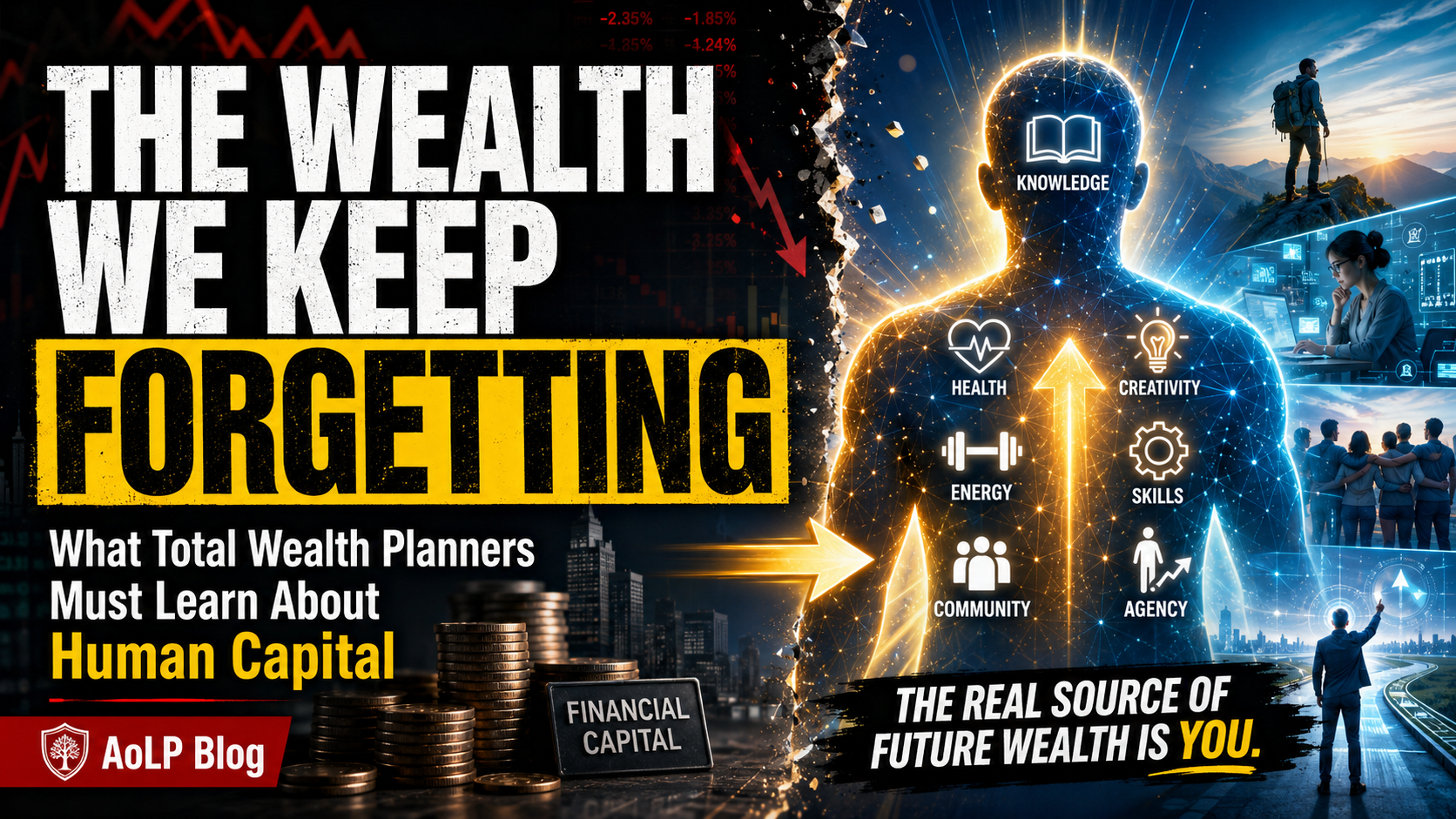
For decades, financial planning has been built around a narrow idea of wealth.
Money. Assets. Investments. Pensions. Portfolios. Tax wrappers.
These things matter. But they are not the whole story. In many cases, they are not even the starting point.
The deeper question is this:
What enables a person to live well, adapt, contribute, recover, choose, and remain self-directed through change?
That question takes us beyond financial capital and into human capital.
Human capital means the abilities, knowledge, skills, health, confidence, creativity, time, energy and judgement that a person can use to shape their life. It is not just employability. It is personal capacity. It is the living asset inside the person.
For Total Wealth Planners, this is not an abstract economic concept. It is central to the work.
[Source: The Importance of Human Capital Development in Ensuring Sustainable Economic Growth.]
1. Financial capital is not enough
Traditional financial services often treats money as the primary store of security.
The assumption is simple: accumulate enough financial capital and life will become safer.
But life does not usually work that neatly.
People experience illness, bereavement, divorce, career disruption, caring responsibilities, family conflict, burnout, exploitation, redundancy, retirement anxiety and loss of confidence. In these moments, the person does not only need a financial product or a technically accurate calculation.
They need clarity.
They need capacity.
They need structure.
They need options.
They need enough confidence to act.
This is where Total Wealth Planning begins. Not with the product market, but with the human being.
A pension can provide income. But it cannot restore confidence.
An investment portfolio can grow. But it cannot clarify purpose.
A cashflow model can show sustainability. But it cannot, by itself, rebuild agency.
The lesson is clear: financial capital supports life, but human capital enables life.
2. Human capital is a form of wealth
The uploaded paper argues that modern economic development increasingly depends on knowledge, education, creativity, health, innovation and intellectual capability. In other words, wealth is no longer created only by land, machinery, money or natural resources. It is created by people.
That matters profoundly for personal planning.
A person’s ability to learn, adapt, solve problems, make decisions, build relationships, generate income, manage stress, use technology, ask better questions and navigate uncertainty may be more important to their future wellbeing than the size of their investment portfolio.
This is especially true in later life and during transition.
A capable person with modest financial resources may still have many choices available.
A overwhelmed person with substantial assets may feel trapped, dependent, frightened or unable to act.
Total Wealth Planners therefore need to help people see themselves as active participants in their own future, not passive holders of financial products.
The work is not to make people dependent on expertise.
The work is to help them recover their own.
3. Sustainable planning needs all forms of capital
The paper identifies different forms of capital that contribute to sustainable development: financial, natural, productive, social and human.
This maps closely onto the Total Wealth Planning philosophy.
Financial capital is money and assets.
Human capital is capability, health, knowledge, time, energy and skill.
Social capital is trust, relationships, community, reputation and mutual support.
Natural capital is the environment and living systems that make life possible.
Productive capital is the tools, systems, infrastructure and technology that help people create value.
A life plan that ignores these wider forms of wealth is incomplete.
A client may be financially secure but socially isolated.
They may be asset-rich but exhausted.
They may have pension wealth but no sense of purpose.
They may have income but no autonomy.
They may have a technically sound plan that quietly destroys their health, relationships or meaning.
That is not total wealth.
It is partial wealth wearing the costume of success.
4. Planning should develop capacity, not merely allocate assets
One of the strongest lessons for Total Wealth Planners is that planning should not only distribute existing money. It should help develop the person’s future capacity.
This changes the planning conversation.
Instead of asking only, “How much do you have?” we also ask:
What can you do?
What do you know?
What gives you energy?
What drains you?
Who supports you?
What skills could be strengthened?
What decisions are you avoiding?
What tools would make life easier?
What would make you less dependent on others?
What would help you feel safer, clearer and more capable?
This is not coaching in disguise. Nor is it regulated financial advice. It is agency-restoration planning.
It helps people recognise what is already present, then organise it into useful form.
For some people, the key asset is professional experience.
For others, it is a trusted relationship.
For others, it is health, time, creativity, local knowledge, lived experience, digital confidence, emotional resilience, or the ability to turn adversity into contribution.
A Total Wealth Planner helps people see these assets before they are lost, ignored or undervalued.
5. Education is not just preparation for work
The paper places strong emphasis on education as a driver of human capital and economic wellbeing. That is important. But in Total Wealth Planning, education has a broader meaning.
Education is not only about qualifications.
It is about procedural literacy: understanding how systems work.
It is about financial literacy: understanding money without being captured by product sales.
It is about digital literacy: using technology safely and confidently.
It is about emotional literacy: recognising fear, pressure, manipulation and overwhelm.
It is about decision literacy: knowing how to pause, compare options and avoid being rushed into poor choices.
This is why AI matters so much.
Used badly, AI can deepen dependency and widen power gaps.
Used well, AI can give ordinary people structured thinking support before they ever need a professional. It can help them organise facts, ask better questions, understand documents, explore trade-offs and recover confidence.
For AoLP, this is not about replacing human judgement.
It is about restoring it.
6. The planner’s role must change
If human capital is central to wealth, the planner cannot remain merely a financial technician.
Nor should the planner become another authority figure telling the client what to do.
The future planner is a facilitator of agency.
A Total Wealth Planner helps people stabilise, structure and surface options.
They do not take over.
They do not make the client dependent.
They do not measure success by obedience to professional recommendations.
They measure success by whether the person becomes clearer, safer, more capable and more self-directed.
This is a profound shift.
The traditional advice model often asks, “What recommendation should we give?”
The Total Wealth Planning model asks, “What capacity needs to be restored so this person can make a better decision?”
That is a different profession.
7. Human capital must not become another extraction opportunity
There is a danger here.
Once human capital becomes fashionable, the financial services industry may try to package it, brand it, monetise it and sell it back to people as another advisory dependency.
That would miss the point.
Human capital development should not become a new product funnel.
It should not be used to create more sophisticated forms of control.
It should not be captured by institutions that claim to empower people while quietly keeping authority in professional hands.
The purpose is not to make people better clients of the advice industry.
The purpose is to make people less dependent on advice where they do not need it.
That is the line AoLP must hold.
Advice out. Agency in.
8. Total Wealth Planning begins with what is already present
The most practical lesson is also the simplest.
All planning begins with what is already present.
Before we ask what someone lacks, we help them see what they already have.
Their knowledge.
Their experience.
Their relationships.
Their strengths.
Their tools.
Their options.
Their values.
Their energy.
Their story.
Their unfinished possibilities.
This does not romanticise hardship. Many people are genuinely under pressure. Some have been harmed, exploited or left unsupported by structurally untrustworthy systems.
But even then, the first planning act is not to impose an answer.
It is to help the person recover orientation.
Where am I?
What is true?
What matters now?
What choices remain?
What support is safe?
What can I do next?
This is the human capital conversation in its most practical form.
The lesson for Total Wealth Planners
The central lesson is this:
A person’s greatest wealth may not be what they own. It may be what they can still become capable of doing, choosing, creating, understanding and recovering.
Financial planning that ignores this will remain incomplete.
Sustainable life planning must develop the whole person, not merely manage the portfolio.
That is why Total Wealth Planning matters.
It brings financial capital back into proportion. It places money in service of life. It recognises human, social, natural and productive capital as part of the planning landscape. And most importantly, it helps people reclaim their own authority.
The future of planning is not more dependency.
It is restored agency.
And that begins by recognising the wealth we keep forgetting: the person themselves.

