
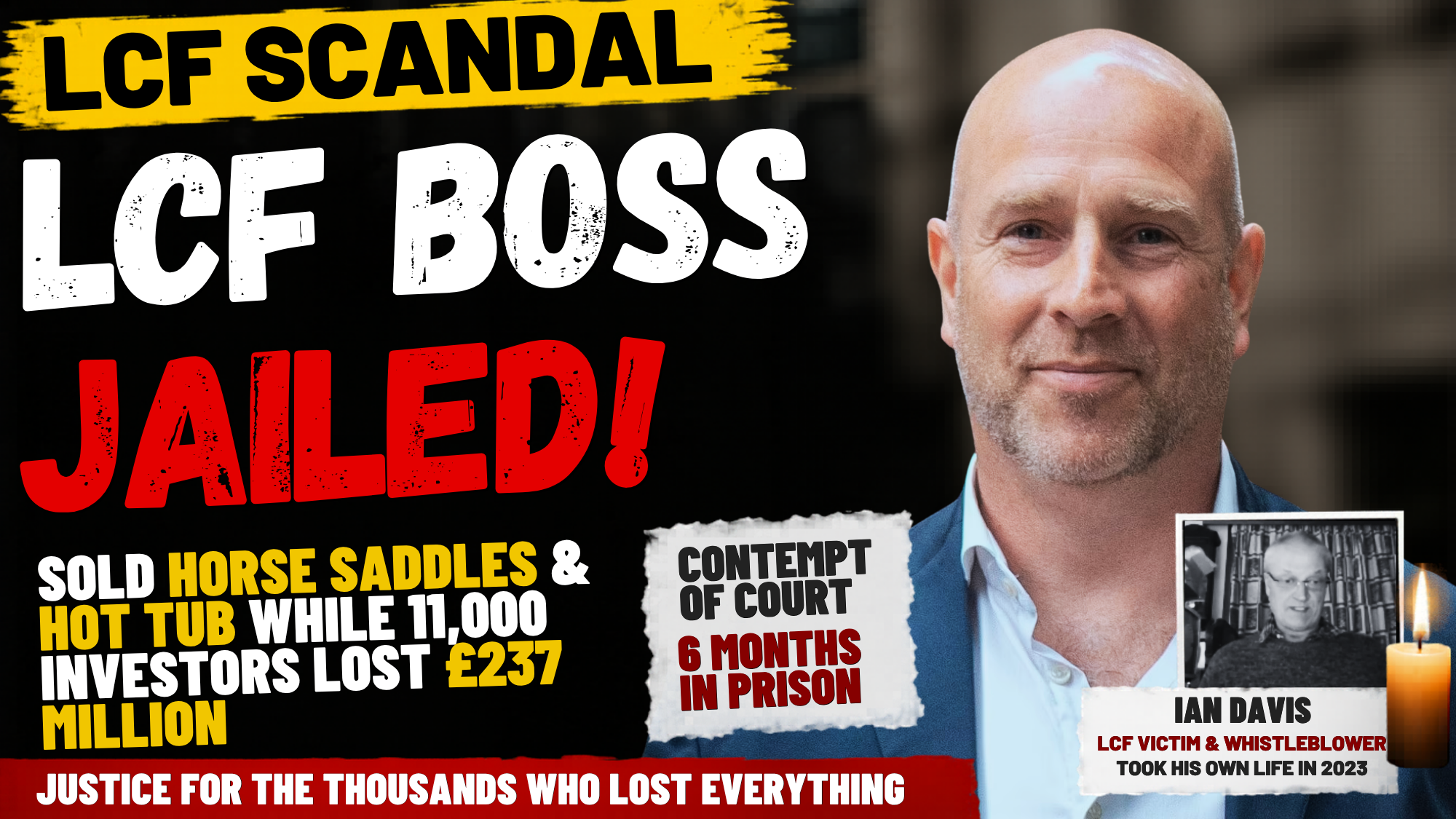
In May 2026, former London Capital & Finance (LCF) CEO Michael Thomson was jailed for contempt of court after breaching Serious Fraud Office restraint orders designed to preserve assets linked to the collapse of the mini-bond firm. His wife received a suspended sentence for related breaches. The offences involved the sale of luxury items, including horse saddles and a hot tub, while the Serious Fraud Office continues its investigation into one of the UK’s most devastating retail investment scandals.
For some, this news will feel like accountability finally catching up.
For others, it will feel painfully inadequate.
Because for many victims of LCF, the damage was never only financial.
It was psychological.
Relational.
Existential.
And for some, the consequences became irreversible.
One of those people was Ian Davis.
Ian lost over £618,000 in the collapse of London Capital & Finance — his life savings. But what followed became an even greater tragedy. Rather than retreat, Ian devoted himself to uncovering what had happened. He built a database of over 70,000 documents, tracing networks of companies, individuals, and regulatory failures connected to the scandal.
He did what society often says it wants citizens to do.
He gathered evidence.
He documented patterns.
He submitted findings.
He cooperated with authorities.
He approached the Financial Conduct Authority, the Serious Fraud Office, Action Fraud, the National Crime Agency, the Insolvency Service, and others.
Again and again.
And yet, from Ian’s perspective, meaningful action never seemed to arrive.
By March 2023, exhausted and overwhelmed, Ian took his own life.
That reality changes how we should understand stories like today’s sentencing.
Because this is not merely a legal story about contempt of court.
It is part of a much larger story about trust, institutional response, and what happens to ordinary people when systems fail repeatedly over long periods of time.
The LCF scandal exposed far more than a failed mini-bond company.
It exposed a dangerous psychological assumption embedded within modern financial systems:
That ordinary people can absorb catastrophic losses, navigate opaque complaint systems, conduct forensic investigations, withstand years of uncertainty, and still remain emotionally intact.
Many cannot.
And increasingly, they are left trying to do this alone.
At the Academy of Life Planning, we have observed something important emerging from cases like LCF, Blackmore Bond, British Steel Pension transfers, QROPS failures, and countless other financial harm stories.
The secondary trauma often becomes greater than the original event.
The endless paperwork.
The unanswered correspondence.
The contradictory explanations.
The procedural complexity.
The isolation.
The erosion of identity and safety.
Financial exploitation is rarely experienced as “just money.”
Money represents time.
Security.
Future possibility.
Freedom.
Dignity.
Safety.
When those foundations collapse, people do not simply lose capital.
They can lose coherence.
That is why the future of consumer protection cannot only be about enforcement after harm.
It must also be about restoring human agency during harm.
This is one of the reasons initiatives like Get SAFE were created within the broader Academy of Life Planning ecosystem — not to replace lawyers, regulators, or investigators, but to help stabilise people psychologically and structurally while they navigate overwhelming systems.
Sometimes the first priority is not “winning.”
Sometimes the first priority is helping someone breathe again.
Sleep again.
Think clearly again.
Organise reality again.
Because without that, justice processes themselves can become part of the harm.
Today’s sentencing demonstrates that accountability mechanisms do eventually move.
But for many victims, the clock moves differently.
Some wait years.
Some lose relationships.
Some lose homes.
Some lose health.
And some, like Ian, lose hope before the system ever catches up.
That should concern all of us.
Not only regulators.
Not only politicians.
Not only investigators.
All of us.
Because trust is not rebuilt merely through prosecutions after collapse.
Trust is rebuilt when people believe they will not be abandoned in the first place.
Ian Davis should still be alive today.
And perhaps the most important question his story leaves behind is this:
How many more people are currently sitting alone in silence, trying to carry unbearable complexity without support, while institutions move at institutional speed?
That question matters far beyond LCF.
It speaks to the future of financial services itself.
A system that cannot emotionally contain the human consequences of its failures will eventually lose legitimacy, no matter how sophisticated its regulation appears on paper.
Ian’s legacy asks something deeper of us now.
Not only:
“How do we punish wrongdoing?”
But also:
“How do we stop people being psychologically destroyed while waiting for justice?”
We are building a national support network so people facing financial exploitation, housing crisis, or institutional overwhelm are not left alone.
Not everyone can afford a solicitor. Not everyone has family support. And not everyone is strong enough to navigate complex systems while traumatised, ill, or afraid.
Your donation helps keep calm, human, practical support available for people who need it most.
Every contribution helps us:
- support vulnerable individuals,
- provide stabilisation and guidance,
- develop free tools and resources,
- and restore human agency when people feel powerless.
If you believe nobody should face these situations alone, please support the mission.

