
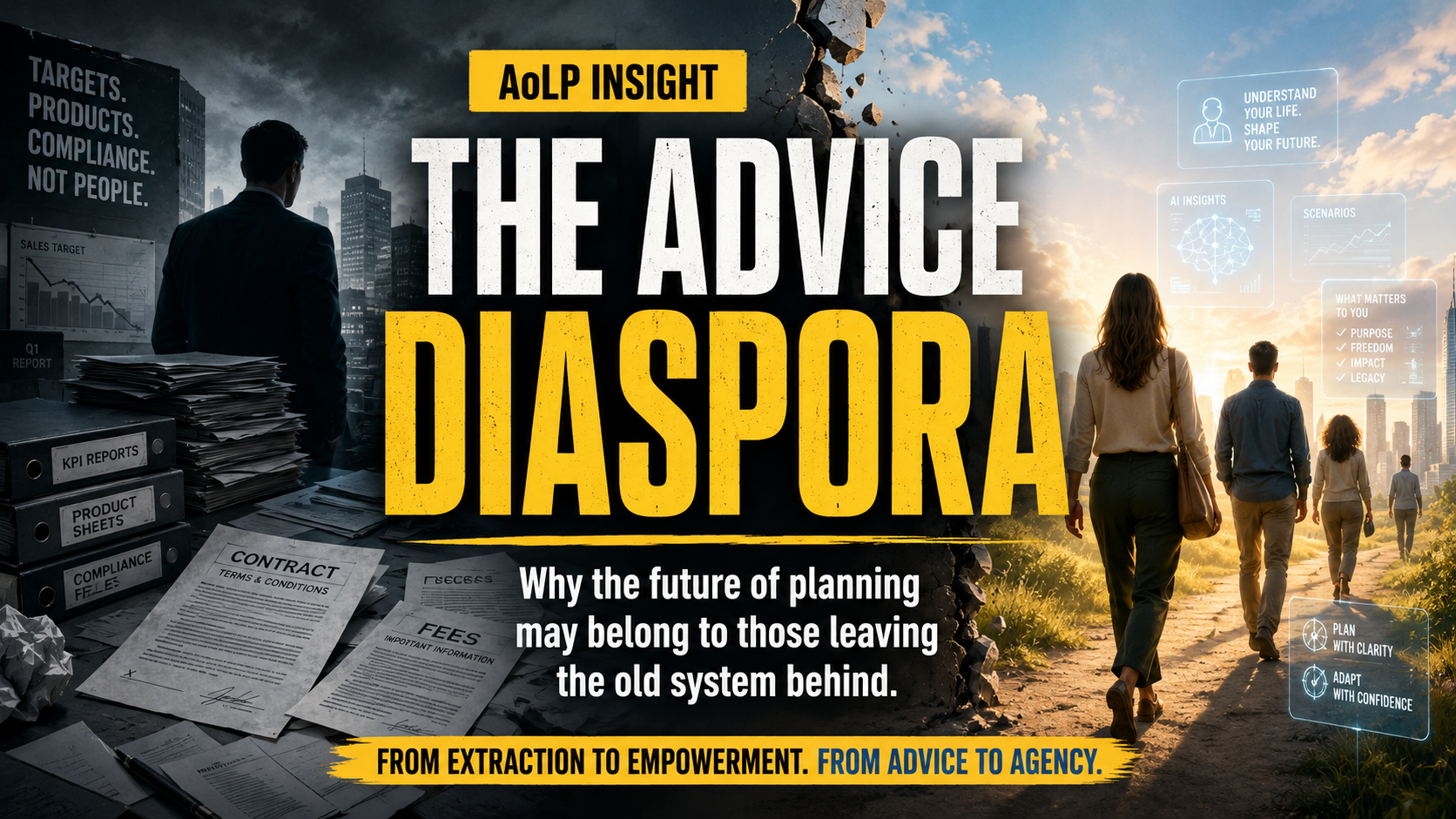
For years, the financial advice industry has told itself a comforting story.
That story says the public needs advice because money is complex, regulation is difficult, products are technical, and ordinary people cannot be expected to make good decisions without professional guidance.
There is some truth in that. Money decisions can be complex. Pensions, tax, care, inheritance, debt, investment risk and family dynamics are not simple matters. Good human judgement still matters.
But there is another truth, less often spoken.
Much of the traditional advice model has not been designed to restore human agency. It has been designed to preserve dependency.
That is why artificial intelligence now feels so disruptive. Not simply because it can automate paperwork, analyse documents, draft tax strategies or summarise financial information. Those things matter, but they are not the deepest shift.
The deeper shift is this:
AI gives ordinary people a way to begin understanding their own financial lives without first asking permission from the industry.
That changes everything.
The wrong risk is being priced
Recent debate around AI in financial advice has focused on whether machines will replace advisers.
This is understandable. When new AI tools can process client documents, identify planning opportunities and produce structured outputs in minutes, investors naturally ask what happens to the economics of advice firms whose margins have depended on administrative effort, technical preparation and complexity.
That is a legitimate question.
But it is not the only question.
The more important question is not whether AI will make traditional advice cheaper.
The more important question is whether people will continue to accept a model that keeps them structurally dependent on professionals, platforms, providers and opaque processes.
For many, the answer is already no.
People are not waiting for the advice industry to decide how AI should be used. They are already using general-purpose AI tools to ask questions about budgeting, pensions, retirement, debt, tax, investment choices and financial anxiety. Some answers will be helpful. Some will be incomplete. Some may be wrong. That risk is real.
But the behaviour itself tells us something important.
People are not only seeking answers.
They are seeking agency.
The problem is not advice. It is dependency.
The traditional advice system often presents itself as consumer protection.
In principle, that should mean helping people make better decisions, avoid harm, understand risk and act in their own interests.
In practice, too much of the system has become structurally untrustworthy.
That does not mean every adviser is untrustworthy. Many are decent people. Many care deeply. Many entered the profession because they wanted to help. Some still do excellent work.
But the structure matters.
When revenue is linked to assets under advice, dependency becomes commercially useful.
When complexity justifies ongoing fees, simplicity becomes commercially inconvenient.
When product intermediation is the economic centre of gravity, human life planning becomes secondary.
When regulatory files evidence process rather than lived client outcomes, compliance can become a substitute for care.
When clients are encouraged to outsource understanding rather than develop it, the adviser remains necessary for longer than they should.
This is the fundamental contradiction.
A profession that claims to protect consumers should be asking: “How do we help this person become more capable, more confident and less dependent over time?”
Too often, the industry has asked a different question: “How do we retain this client profitably?”
Those are not the same question.
The advice diaspora
There is now a growing group of people who no longer feel at home in the traditional advice system.
Some are former advisers who became uncomfortable with the economics of extraction.
Some are planners who wanted to focus on lives, not products.
Some are coaches, educators, mentors, financial wellbeing practitioners and paraplanners who saw the human need more clearly than the commercial machine around it.
Some are consumers who experienced poor advice, unsuitable products, excessive fees or indifference when things went wrong.
Some are younger professionals who look at the old model and cannot see a future for themselves inside it.
This is the advice diaspora.
They are not united by job title. They are united by a shared unease.
They know that something in the current system is misaligned.
They may not yet have the language for the alternative. They may still carry the habits of the old world. They may still wonder whether leaving the regulated advice path means losing status, credibility or commercial viability.
But many are beginning to sense the same thing:
The future of planning is not better extraction.
It is restored agency.
AI does not solve this by itself
It would be easy to replace one dependency with another.
That is the danger.
If people move from adviser dependency to chatbot dependency, we have not solved the problem. We have simply changed the authority figure.
A confident AI answer is not the same as wisdom. A fluent explanation is not the same as suitability. A personalised-looking output is not the same as accountability. A low-cost tool is not automatically a safe one.
AI can be wrong. It can miss context. It can overstate confidence. It can fail to understand vulnerability, trauma, family pressure, coercion, grief or fear. It can generate plausible nonsense. It can encourage action where reflection is needed.
But that does not mean people should be told not to use AI.
That response would simply preserve the old asymmetry.
Firms will use AI. Platforms will use AI. Providers will use AI. Institutions will use AI to reduce costs, improve productivity, target consumers and defend their margins.
If individuals are told not to use AI for themselves, the capability gap widens.
The real question is not whether people should use AI.
The real question is how they can use it safely, structurally and without surrendering their agency.
AI-assisted clarity, not AI advice
This is where a new planning discipline is emerging.
Not AI financial advice.
Not robo-advice rebadged.
Not a cheaper version of the old model.
Something different.
AI-assisted clarity.
That means helping people use AI to understand their situation, organise their information, explore trade-offs, prepare better questions and identify where human expertise may be needed.
It means helping people see the shape of their own lives before anyone starts talking about products.
It means distinguishing between:
education and recommendation;
structure and instruction;
options and advice;
clarity and control;
agency and dependency.
This distinction matters.
A person may need help understanding their pension position, but that does not mean they are ready to receive a product recommendation.
A widow may need help organising paperwork after bereavement, but that does not mean she needs to be sold an investment solution.
A family facing care costs may need help mapping decisions, emotions, responsibilities and risks before any regulated transaction is considered.
A person harmed by financial exploitation may need stabilisation, evidence structure and safe next steps before anyone talks about legal escalation or financial products.
In each case, the first human need is not advice.
It is agency.
The new planner is not an adviser in disguise
This creates space for a new kind of practitioner.
At the Academy of Life Planning, we call this role the Total Wealth Planner.
A Total Wealth Planner is not a traditional financial adviser, coach, therapist, case worker or product intermediary.
The role is to help people restore agency in financial and life decisions.
That means helping people stabilise when overwhelmed, structure what is already present, surface options, understand trade-offs and act from greater self-authority.
It does not mean taking over.
It does not mean recommending products.
It does not mean creating dependency.
It does not mean becoming the expert whose approval the client must seek before acting.
The purpose is almost the opposite.
The purpose is to help the person become progressively less dependent on external authority.
That is a radical shift.
Traditional advice asks, “What should this client do?”
Agency-restoration planning asks, “How can this person become clear enough to decide what is right for them?”
Traditional advice asks, “How do we manage the client relationship?”
Agency-restoration planning asks, “How do we reduce unnecessary dependency?”
Traditional advice often measures success by retention, assets and implementation.
Agency-restoration planning measures success by clarity, confidence, capability and self-direction.
This is not anti-adviser
It is important to be precise.
This is not an attack on individual advisers.
There will always be circumstances where regulated financial advice is needed. There will always be complex cases where technical expertise, regulated accountability and professional judgement matter. There will always be people who want and value a long-term adviser relationship.
But the old assumption that professional advice should be the centre of the consumer’s financial life is breaking down.
That assumption belonged to a world in which information was scarce, tools were expensive, technical knowledge was hard to access and institutions controlled the pathways.
That world is ending.
The new world will not be safe simply because AI exists. It may become more confusing, more fragmented and more dangerous if people are left alone with unstructured tools.
But it will not be possible to put people back into passive dependency and call that protection.
The task now is to build a better bridge.
A home for the diaspora
The advice diaspora needs a home.
Not a home built around product sales.
Not a home built around assets under advice.
Not a home built around the old status hierarchy of adviser, client and provider.
A home built around human agency.
That means a different philosophy, different economics and different practice standards.
It means planning begins with what is already present: the person’s life, values, skills, relationships, responsibilities, fears, opportunities, documents, resources and choices.
It means AI is used as a capability multiplier, not as a replacement authority.
It means the planner’s task is to support clearer thinking, not impose decisions.
It means trust is built through transparency, not mystique.
It means the client is not the product, the asset, the case file or the revenue stream.
They are the authority in their own life.
The future is not cheaper advice
The industry may spend the next few years arguing about whether AI makes advice cheaper, faster or more scalable.
That debate matters, but it is incomplete.
The future is not simply cheaper advice.
The future is less dependency.
People do not only need access to advice. They need access to their own capacity to understand, choose and act.
Some will still need regulated advice. Some will need technical specialists. Some will need legal, tax, counselling or safeguarding support. But before any of that, they need a way to recover orientation in their own lives.
This is the work now.
For those in the advice and planning diaspora, the invitation is clear.
You do not have to spend your life trying to make structurally untrustworthy systems look more caring.
You do not have to keep defending models that no longer feel coherent.
You do not have to choose between traditional advice and unstructured AI.
There is another path.
Advice out.
Agency in.

