
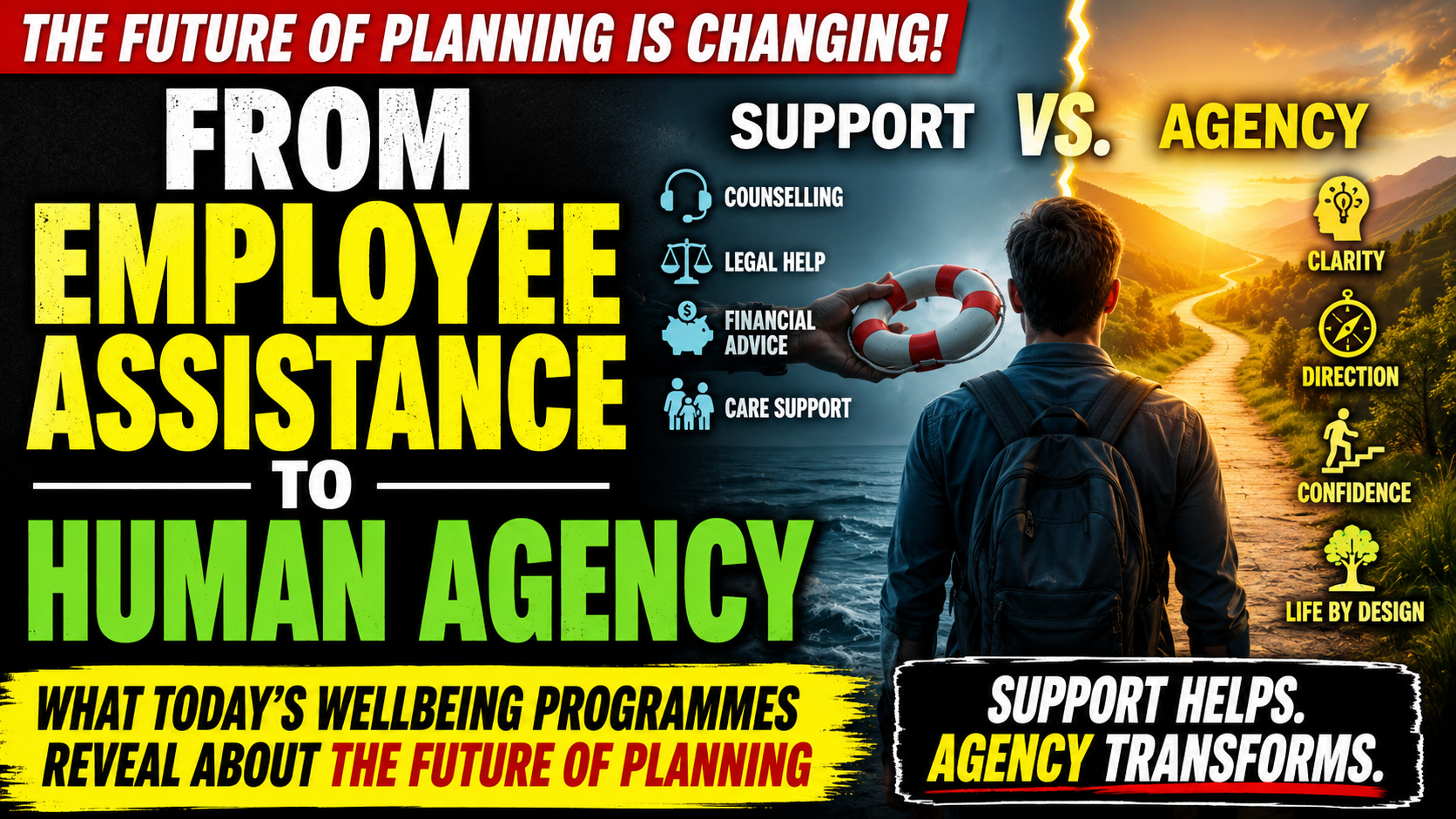
For decades, Employee Assistance Programmes (EAPs) have sat quietly in the background of organisational life.
Originally designed as counselling and crisis-support services, they were often associated with stress, addiction, bereavement, or workplace difficulties — a safety net for people under pressure.
But something is changing.
Modern EAPs are no longer simply mental health helplines. They are evolving into broad behavioural support ecosystems designed to help people navigate the growing complexity of modern life itself.
A recent EAP webinar hosted through a major employee benefits provider revealed just how far this evolution has gone. The programme now extends far beyond counselling into areas such as:
- Financial consultations
- Legal support
- Elder care
- Childcare navigation
- Identity theft protection
- Stress management
- Relationship support
- Crisis intervention
- Life transition guidance
- Wellness and lifestyle services
The underlying message was clear:
Modern life has become too complex for many people to navigate alone.
That observation matters.
Because it reveals something much larger happening beneath the surface of financial planning, wellbeing, and professional advice.
The future is no longer simply about financial products, investment returns, or retirement forecasts.
It is increasingly about helping human beings function effectively in a world of escalating complexity.
And that changes everything.
The Hidden Shift Beneath the Advice Industry
Traditional financial planning evolved during an era where information scarcity gave institutions power.
Consumers relied on professionals because:
- information was difficult to access,
- financial products were opaque,
- regulation was complex,
- and specialist expertise was concentrated inside institutions.
But AI is changing the economics of knowledge itself.
Today, information is abundant.
Analysis is increasingly automated.
Technical capability is becoming democratised.
The real challenge is no longer access to information.
The real challenge is:
- judgement,
- clarity,
- emotional regulation,
- discernment,
- and the ability to navigate complexity without becoming overwhelmed.
That is why wellbeing systems are expanding.
Employers increasingly understand that financial stress, emotional strain, caregiving pressure, burnout, uncertainty, and digital confusion all affect human performance. The old separation between “work problems” and “life problems” is collapsing.
The EAP webinar openly acknowledged this reality.
If people are overwhelmed at home, they struggle at work.
If they are emotionally exhausted, their decision-making deteriorates.
If they feel isolated, confused, or unsupported, productivity and wellbeing suffer.
In other words:
Human capability itself is becoming a strategic issue.
But There Is a Deeper Question
Most EAP systems are fundamentally designed around support and stabilisation.
Their role is often to:
- reduce distress,
- improve coping,
- provide referrals,
- restore functioning,
- and help people manage existing systems more effectively.
That is valuable.
But it also raises an important question:
Are we helping people cope inside increasingly complex systems…
or helping them become more capable of navigating complexity independently?
This is where the Academy of Life Planning takes a different path.
From Support Systems to Agency Systems
At the Academy of Life Planning, we believe the future of planning is not merely about outsourcing expertise.
It is about restoring human agency.
That means helping individuals:
- think more clearly,
- understand their own lives,
- navigate uncertainty,
- make values-aligned decisions,
- organise complexity,
- and build confidence in their own judgement.
This is a fundamentally different orientation.
Traditional support models often position the individual as a dependent consumer of expert services.
Human agency models position the individual as an active participant in their own life architecture.
That does not mean abandoning expertise.
It means changing the relationship between the person and the system.
The goal becomes:
not dependency,
but capability.
Not passive consumption,
but informed participation.
Not simply reducing anxiety,
but increasing coherence.
Why This Matters in the Age of AI
One section of the EAP webinar focused heavily on identity theft, voice cloning, fraud, and the growing risks associated with AI-generated deception.
That concern is entirely justified.
We are entering a world where:
- information can be fabricated instantly,
- synthetic media can mimic reality,
- institutional trust is weakening,
- and individuals are increasingly exposed to cognitive overload.
In this environment, technical knowledge alone is insufficient.
The defining human skill may increasingly become:
the ability to remain psychologically grounded while navigating uncertainty.
This is why the Academy’s philosophy of “planning life before money” matters more than ever.
Because financial decisions do not occur in isolation.
They emerge from:
- identity,
- relationships,
- emotional state,
- health,
- purpose,
- time,
- values,
- and the ability to think clearly under pressure.
The future planner is therefore unlikely to be merely a product intermediary.
The future planner becomes something closer to:
- a thinking partner,
- a complexity navigator,
- a behavioural guide,
- a systems translator,
- and a facilitator of human capability.
The Rise of the Total Wealth Planner
At the Academy of Life Planning, we describe this evolution through the concept of the Total Wealth Planner.
A Total Wealth Planner understands that wealth is not confined to financial capital alone.
Human wellbeing also depends upon:
- human capital,
- social capital,
- emotional resilience,
- environmental stability,
- meaning,
- and personal agency.
This broader understanding becomes increasingly important as AI reshapes both work and financial services.
The question is no longer simply:
“How do we optimise portfolios?”
The deeper question becomes:
“How do we help human beings remain capable, coherent, and empowered inside rapidly changing systems?”
That is a different profession.
And perhaps, increasingly, a necessary one.
The Future May Belong to Hybrid Models
The emergence of sophisticated EAP systems suggests something important.
Institutions themselves are beginning to recognise that people need more than transactional services.
They need:
- guidance,
- interpretation,
- emotional support,
- behavioural understanding,
- and trusted navigation frameworks.
In many ways, this validates the direction holistic planning has been moving toward for years.
But it also creates a fork in the road.
One path leads toward increasingly institutionalised support dependency.
The other leads toward distributed human capability supported by ethical technology, transparent systems, and restored personal agency.
At the Academy of Life Planning, we believe the future should move toward the latter.
Not because support is unimportant.
But because flourishing requires more than support alone.
It requires participation.
Understanding.
Judgement.
And the confidence to navigate life consciously.
Final Thought
The most revealing aspect of modern wellbeing programmes may not be the services themselves.
It may be what their existence quietly admits:
Modern systems have become cognitively exhausting for ordinary people to navigate alone.
That reality is reshaping:
- financial planning,
- wellbeing,
- leadership,
- technology,
- and the future role of trusted professionals.
The opportunity now is not simply to build better support systems.
It is to build better agency systems.
And that may become one of the defining challenges of the AI age.
Curious how others see this.
 Academy of Life Planning