
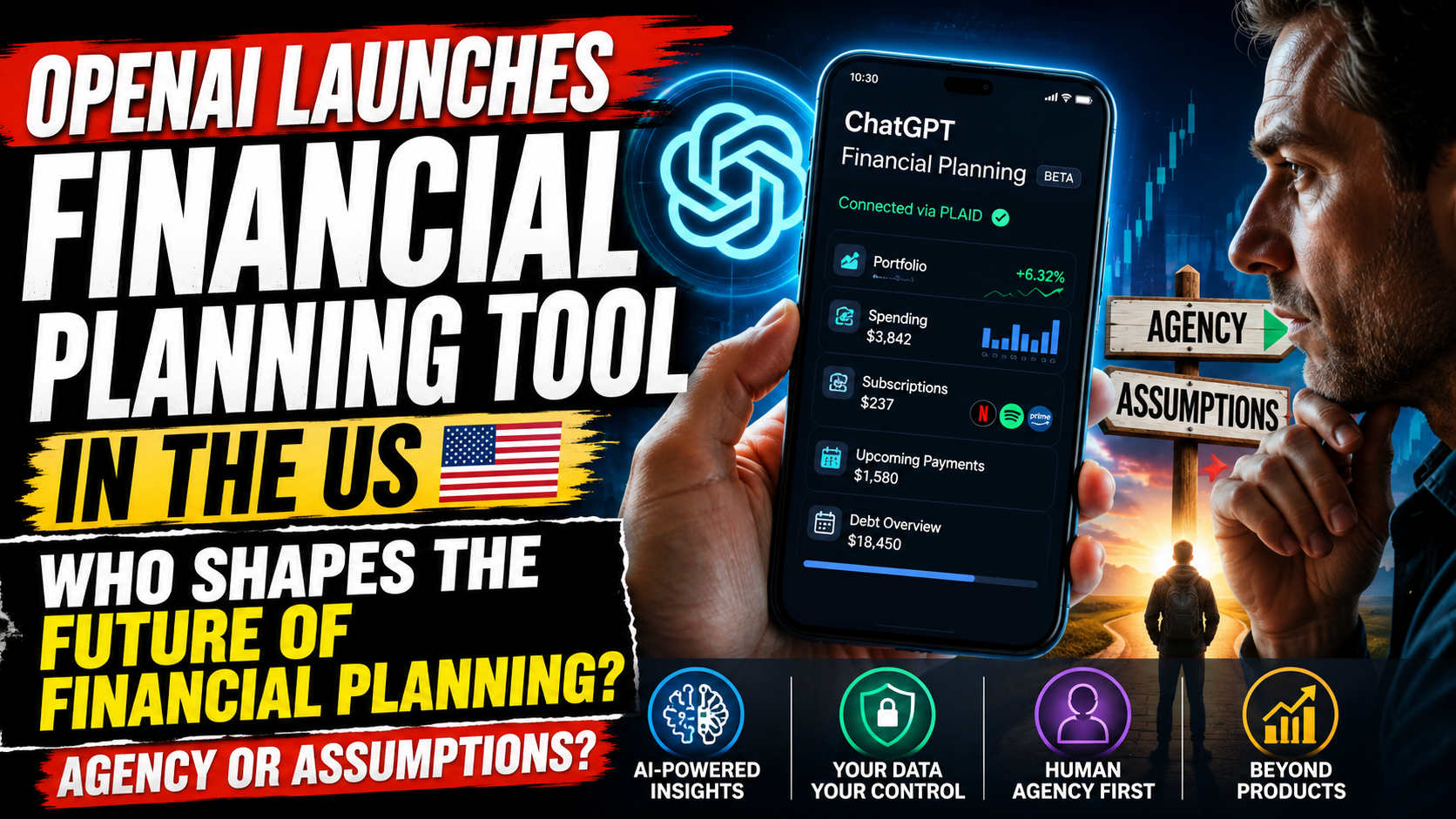
This week, OpenAI announced the launch of a new personal finance experience inside ChatGPT for US Pro users.
“People are already turning to ChatGPT for help: more than 200 million people come to ChatGPT every month for budgeting, questions about their investments, comparing different paths, planning for future goals, and more.”
The system allows users to connect financial accounts through Plaid and view:
- portfolio performance,
- spending patterns,
- subscriptions,
- debt,
- upcoming payments,
- and broader financial dashboards.
According to OpenAI, the tool is designed to help people explore financial decisions conversationally using GPT-5.5 reasoning capabilities. The company also states clearly that it is “not a replacement for professional financial advice.”
At one level, this may look like the latest evolution of budgeting apps and account aggregation tools.
But something much bigger is happening underneath.
For decades, financial planning has largely operated inside a world of information asymmetry.
Institutions held structural advantage because:
- financial data was fragmented,
- modelling tools were inaccessible,
- technical knowledge was gatekept,
- and meaningful financial analysis was expensive for ordinary people.
Artificial intelligence changes that equation dramatically.
A person can now ask:
- “Can I afford to reduce my working hours?”
- “What happens if I retrain later in life?”
- “Should I pay down debt or retain liquidity?”
- “How vulnerable am I to inflation?”
- “Could I generate future income from my skills instead of drawing pensions early?”
That is not merely budgeting.
That is exploratory financial thinking.
Historically, that level of modelling and scenario exploration sat almost exclusively inside professional advice environments.
The arrival of conversational AI into financial planning changes consumer expectations permanently.
People are beginning to expect:
- continuous exploration,
- real-time modelling,
- contextual explanations,
- and interactive financial reasoning.
That has profound implications for the future role of the financial planner.
But there is also a deeper and more important question emerging.
What philosophy sits underneath the machine?
Because AI systems do not emerge in isolation.
They learn from:
- dominant industry practice,
- existing financial literature,
- institutional frameworks,
- regulatory assumptions,
- and commercially successful models.
If AI financial planning systems are trained primarily on:
- traditional retirement planning,
- accumulation-focused advice,
- investment optimisation,
- institutional product ecosystems,
- and legacy financial planning frameworks,
then there is a real possibility that AI simply becomes a more efficient reproduction engine for incumbent assumptions.
In other words:
digitising the existing paradigm rather than transforming it.
That matters because most traditional financial planning models still define wealth primarily through financial capital.
The conversation typically revolves around:
- pensions,
- investments,
- tax wrappers,
- risk profiling,
- withdrawal strategies,
- and portfolio construction.
Important? Of course.
But increasingly incomplete.
In a world shaped by:
- AI disruption,
- economic uncertainty,
- career reinvention,
- longer lives,
- institutional mistrust,
- and rapid technological change,
planning cannot simply revolve around accumulated assets.
It must also include:
- human capital,
- adaptability,
- resilience,
- health,
- relationships,
- meaning,
- earning capability,
- and the ability to navigate complexity itself.
This is where Total Wealth Planning becomes highly differentiated.
At the Academy of Life Planning, we believe planning should begin with life first — not products first.
A person’s:
- goals,
- values,
- capabilities,
- desired lifestyle,
- and broader life architecture
should shape the financial structure around them.
Not the other way around.
Importantly, this is not an anti-AI argument.
Far from it.
The emergence of AI planning tools could become one of the greatest democratising forces financial planning has ever seen.
The ability for individuals to explore decisions, test scenarios, and improve understanding independently is potentially transformative.
We welcome all genuine efforts that help restore human agency.
Collaboration creates markets.
And markets evolve when more people gain access to capability.
But the direction of travel is not yet fixed.
The future is unlikely to be:
“AI replaces advisers.”
Nor is it likely to be:
“Institutions fully control AI-enabled planning.”
The more important question is:
Who helps human beings remain capable inside increasingly automated systems?
The future Total Wealth Planner is therefore evolving into something fundamentally different.
Less:
- gatekeeper,
- product intermediary,
- or spreadsheet operator.
More:
- thinking partner,
- contextual guide,
- behavioural stabiliser,
- complexity navigator,
- and interpreter of meaning in uncertain environments.
That may ultimately become the defining distinction of the next decade.
Not simply who builds the AI.
But what worldview the AI inherits.
Because if agency-centred thinkers do not participate, then incumbent assumptions become the default operating system.
And that question now matters to everyone.
If you believe the future of financial planning should focus on restoring human agency — not simply optimising financial products — the Academy of Life Planning is building a global community of future-ready Total Wealth Planners exploring exactly these questions.

