
For years, technology in financial services was largely discussed as a productivity tool.
Faster processing.
Better reporting.
Lower costs.
More automation.
But the conversation is now shifting.
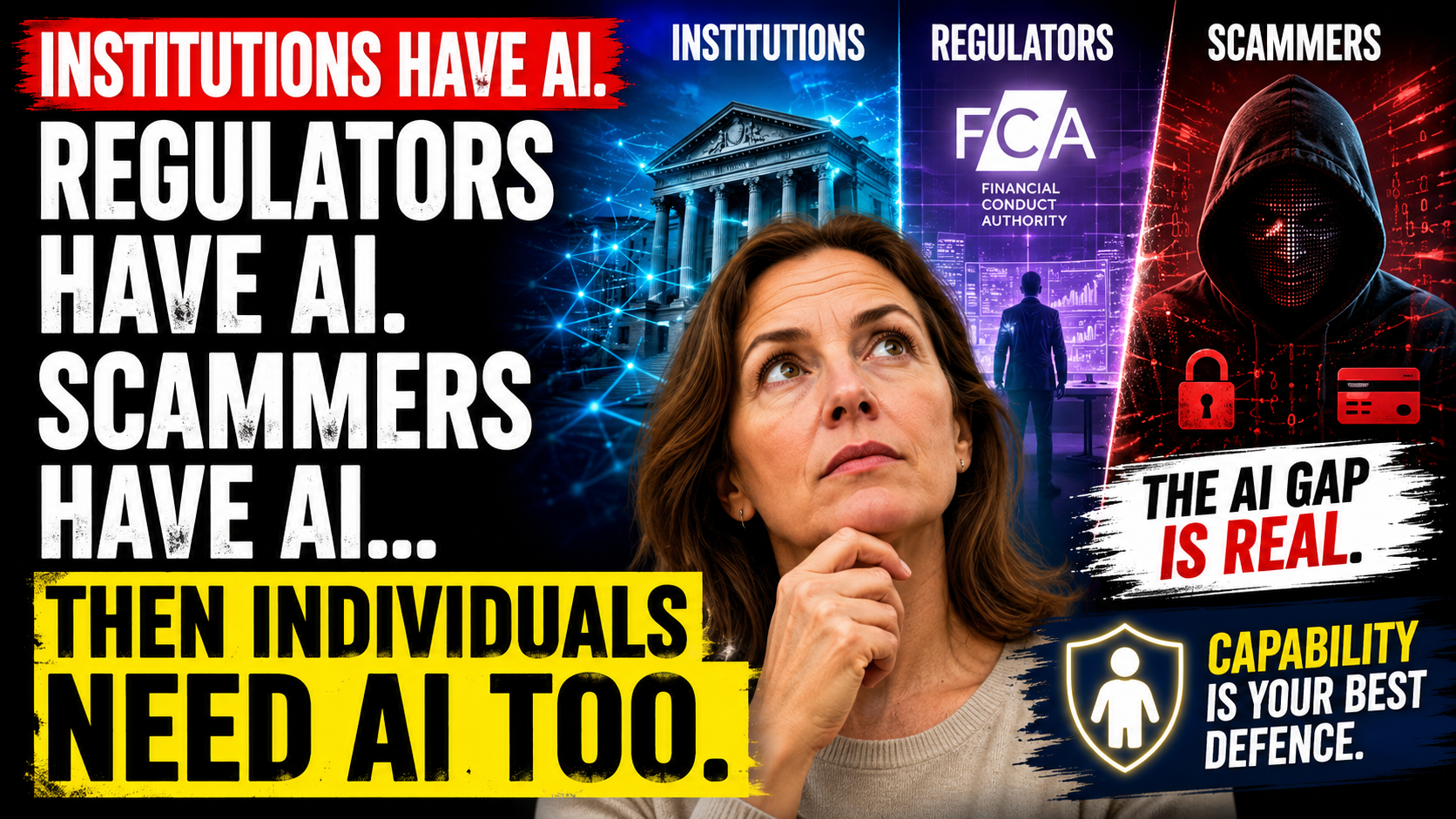
This week, the Financial Conduct Authority openly discussed the possibility of “robo-regulation” — a future where AI helps monitor firms, identify risks, detect misconduct, and supervise markets in real time.
At the same time:
- financial firms are embedding AI into advice and operations,
- fraudsters are using AI to scale scams and impersonation,
- and consumers are increasingly exposed to systems they do not fully understand.
This matters far beyond regulation.
Because it reveals something deeper:
We are entering a world where almost every major system around the individual is becoming AI-enhanced.
Institutions have AI.
Regulators have AI.
Scammers have AI.
The question is:
What does the individual have?
For many people, the answer today is:
very little.
That is the real risk emerging underneath the AI transition.
Not simply automation.
Capability asymmetry.
The New Information Imbalance
For decades, financial services operated through information asymmetry.
Institutions had:
- the data,
- the modelling tools,
- the technical expertise,
- the legal teams,
- the systems,
- and the processing power.
Ordinary people largely did not.
AI is beginning to change that.
For the first time in history, individuals can now access:
- sophisticated modelling tools,
- intelligent financial analysis,
- real-time explanation systems,
- document interpretation,
- forecasting,
- planning support,
- and structured exploration tools.
Often at little or no cost.
That is potentially transformative.
But there is also a danger.
Because access to AI is not the same as capability.
A person can now generate thousands of pages of information instantly — while becoming more confused, more overwhelmed, and more dependent at the same time.
That is why the future cannot simply be:
“more AI.”
The future must become:
better human capability within AI-rich systems.
Advice Alone Is No Longer Enough
Traditional financial advice evolved in a slower world.
A world where:
- information moved slowly,
- decisions were periodic,
- and complexity was manageable through occasional expert intervention.
That environment is disappearing.
Today, individuals are navigating:
- algorithmic systems,
- continuous financial change,
- digital fraud,
- pension complexity,
- behavioural manipulation,
- AI-generated misinformation,
- and increasingly opaque institutional processes.
In that environment, the role of the future financial professional changes fundamentally.
The most valuable person may no longer be:
the product intermediary.
Nor simply:
the technical expert.
But instead:
the capability guide.
Someone who helps human beings:
- think clearly,
- remain calm,
- structure decisions,
- interpret complexity,
- use AI safely,
- maintain judgement,
- and preserve agency.
That is much closer to the philosophy behind the Total Wealth Planner™ model.
Human Judgement Still Matters
One of the most important parts of the FCA discussion was the acknowledgement that regulation still depends upon human judgement.
Not everything can be reduced to algorithms.
Culture matters.
Intent matters.
Context matters.
Human vulnerability matters.
A machine may detect patterns.
But it cannot fully understand:
- grief,
- fear,
- coercion,
- shame,
- manipulation,
- exhaustion,
- or meaning.
Yet these are often the very conditions in which poor financial decisions occur.
This is why the future cannot be built entirely around automation.
Because when systems become too automated, people often become:
- passive,
- disempowered,
- detached from understanding,
- and overly dependent on external systems they cannot challenge.
The danger is not merely “bad AI.”
The danger is learned helplessness inside increasingly complex systems.
The Next Frontier Is Human Agency
At the Academy of Life Planning, we believe the next frontier is not simply artificial intelligence.
It is restored human agency.
That means helping people:
- understand before they commit,
- think before they delegate,
- question before they comply,
- and participate more actively in decisions affecting their lives.
It also means building tools and planning systems that strengthen the individual rather than replace them.
This is why the Academy’s direction increasingly focuses on:
- local-first systems,
- transparent frameworks,
- structured thinking,
- human-centred planning,
- and capability development alongside technology.
Not anti-AI.
But not blind dependence either.
The future belongs neither to:
“humans alone”
nor:
“machines alone.”
It belongs to people who learn how to think clearly and remain capable while using increasingly intelligent systems around them.
That may ultimately become the defining skill of the AI age.
And perhaps the defining role of the Total Wealth Planner™.
Curious how others see this.

