
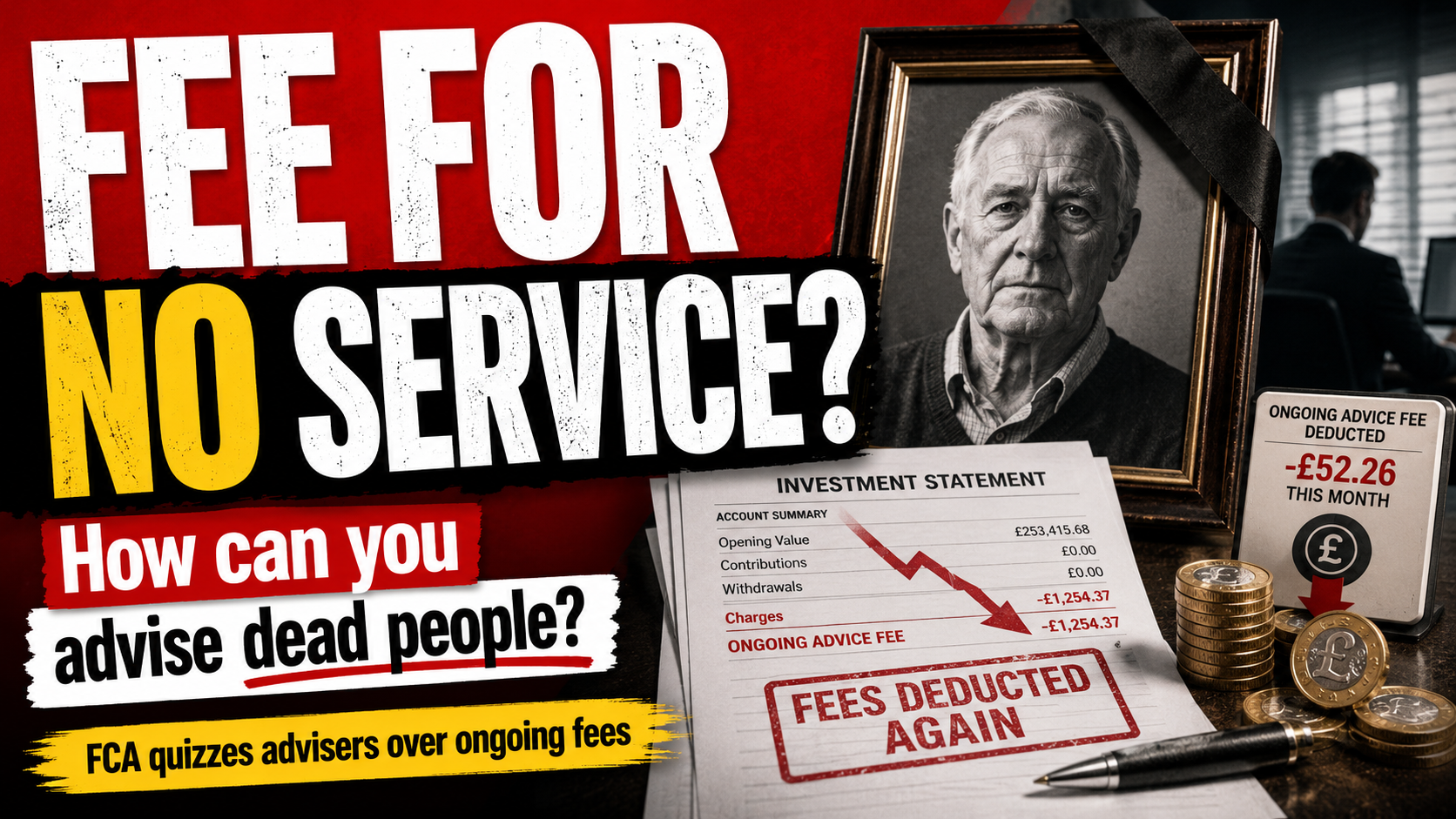
Following reports that the FCA has asked advice firms whether they continue to charge ongoing fees after a client has died, the central question is simple: what service is actually being provided, and to whom? Ongoing advice fees are only defensible where there is an ongoing service, such as suitability reviews or active support, and the FCA has already been scrutinising whether consumers receive the services they pay for.
Source: Citywire: 08 Jun, 2026 FCA asks advisers if they charge fees to deceased clients. Exclusive: The FCA has sent out a survey to advice firms asking whether they still charge deceased clients ongoing fees.
A deceased client cannot receive advice, update objectives, attend reviews, confirm suitability, or consent to continuing charges. So if deductions continue after death, this raises a sharper form of the “fee for no service” problem: is the adviser being paid for genuine work for the estate and executors, or is the charging machinery simply continuing because assets remain on the platform?
How can an adviser provide ongoing advice to someone who has died?
That cuts straight through the euphemism of “ongoing adviser charging”. If the client is deceased, there is no ongoing client relationship in the ordinary sense. There may be work to support executors, beneficiaries, estate administration, tax planning, or transfer of assets — but that is a different service, to different decision-makers, under a fresh authority.
The FCA has already said ongoing advice fees must relate to an ongoing service, and its 2025 review stated that around 80% of advice firm revenue comes from ongoing-service charges for about 4 million clients. That makes this more than an administrative issue. It is a structural question about whether the advice model has become too dependent on recurring deductions from client assets. (FCA)
The core problem is “fee for no service”. In ordinary language, that means:
money is taken because a system keeps charging, not because a person is actively being helped.
With deceased clients, the contradiction becomes impossible to ignore. A dead person cannot attend a review. They cannot confirm objectives. They cannot update circumstances. They cannot consent to continued advice. They cannot receive a suitability review. They cannot benefit from behavioural coaching, reassurance, tax planning, withdrawal strategy or portfolio discussion.
So what exactly is the fee for?
A fair distinction matters. Advisers may do valuable work after death: helping executors understand investments, liaising with platforms, clarifying tax wrappers, supporting bereaved families, or preparing information for probate. But that should be explicitly agreed with the executors or personal representatives. It should not simply continue as an inherited asset-based deduction because nobody has stopped the machinery.
This is why percentage-of-assets charging is so problematic. It can turn advice into a standing extraction mechanism. The client may disengage. The service may become thin. The adviser may not meet the client. The client may even die. Yet the fee can continue because the assets are still there.
That is not financial planning.
That is an automated toll booth attached to someone’s life savings.
Fee for no service was always a warning sign.
Charging dead people makes the warning impossible to ignore.
The FCA is reportedly asking advice firms whether they still charge deceased clients ongoing fees.
It is a simple question with uncomfortable implications.
Because how do you advise someone who has died?
A deceased client cannot attend an annual review.
They cannot update their objectives.
They cannot confirm their risk profile.
They cannot consent to continued service.
They cannot receive financial planning.
Of course, families and executors may need help after death. That can be valuable work. But it is a new service, for living decision-makers, under clear authority.
It is not the same as quietly continuing an ongoing adviser charge because assets remain on a platform.
This is the deeper issue.
When advice fees are deducted automatically from assets, the line between service and extraction can become dangerously blurred.
The industry calls it recurring revenue.
Clients experience it as money leaving their pot.
If the service is real, evidence it.
If the client is disengaged, address it.
If the client has died, stop and re-authorise properly.
The bigger question is not just whether firms charged deceased clients.
It is whether the whole ongoing-fee model has become too dependent on inertia.
Financial planning should restore agency.
It should not keep billing people after agency has literally ended.
Curious how others see this.


This is where the industry’s loose use of the word “advice” begins to fail.
Too often, “ongoing advice” is used to describe a bundle of very different things: investment administration, platform servicing, portfolio oversight, client relationship management, bereavement support, executor liaison, and sometimes actual personal advice.
That ambiguity becomes indefensible when the client has died.
A deceased person cannot receive advice. They cannot update objectives, confirm risk tolerance, approve suitability, consent to charges, or benefit from an annual review. So, by definition, advice fees should cease immediately on notification of death.
That does not mean no work may be needed. Executors, personal representatives, surviving spouses, trustees, or beneficiaries may require support. But that is a different service, for living decision-makers, under clear authority, with a separately agreed scope and price.
The policy should have been agreed in advance in the deceased client’s terms and conditions. Firms should already have made clear what happens on death, what stops automatically, what limited administration may continue, and what requires fresh authority.
The clean principle is simple:
Death should end the advice relationship with the deceased. Anything after that must be re-authorised, re-scoped, and re-priced with the person who now has legal authority.
That is not anti-adviser. It is pro-clarity, pro-consumer, and pro-agency.
The deeper problem is not bereavement administration. It is the way recurring asset-based charging can keep moving even when the advisory relationship has ended.
If the client has died, stop the advice fee. Then ask: who is the client now, what authority exists, what service is being provided, and what fee has actually been agreed?