
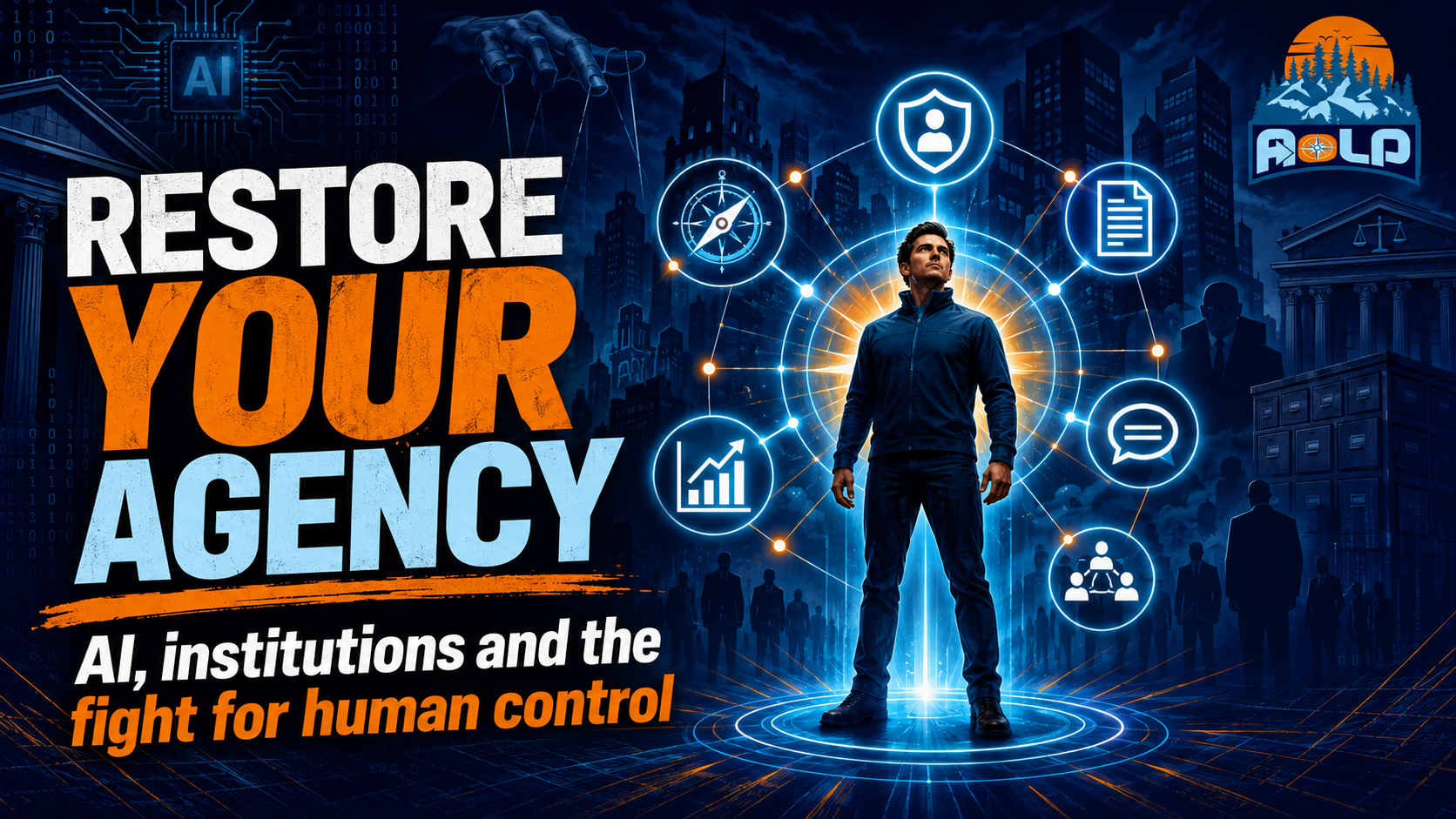
How do we restore human agency in the age of AI and institutional power asymmetry?
The defining question of the AI age may not be whether machines become more intelligent.
It may be whether human beings become less capable of acting for themselves.
For decades, individuals have lived with a growing power asymmetry between themselves and large institutions. Banks, pension providers, insurers, employers, technology firms, platforms, regulators and government agencies increasingly operate through systems that ordinary people cannot easily see, understand, challenge or navigate.
The result is not merely an advice gap.
It is an agency gap.
People are not simply short of information. They are often short of power, confidence, structure, time, language, evidence, procedural literacy and trusted support. They may be capable, intelligent and self-directed, but when life becomes complex — through bereavement, illness, retirement, divorce, financial harm, family pressure, debt, institutional dispute or career disruption — their ability to act can become compromised.
This is where the Academy of Life Planning is evolving.
AoLP is becoming an agency-restoration ecosystem.
Not a financial advice firm.
Not a product distribution channel.
Not a coaching brand.
Not a dependency machine.
An ecosystem designed to help people stabilise, structure their situation, surface their options, and recover authority over their own lives.
The problem: AI is widening the agency divide
AI is often presented as a productivity tool. For institutions, that is largely true.
Large organisations can use AI to automate decisions, analyse customer behaviour, improve compliance workflows, detect risk, reduce costs, manage claims, structure correspondence and defend institutional positions. They already have data, legal teams, internal systems, specialist knowledge and procedural advantage. AI strengthens that advantage.
For the individual, the picture is different.
Most people do not have a team. They do not have structured records. They do not have easy access to expertise. They may not know what questions to ask. They may be under stress. They may be facing a deadline, a legal demand, a complaint process, a pension decision, a mortgage dispute, a care decision, a bereavement administration problem or a life transition they have never faced before.
In that moment, AI can either restore agency or deepen dependency.
Used badly, AI can overwhelm people with plausible but ungrounded output. It can create overconfidence, confusion or unsafe escalation. It can make people feel they have “done the work” when they have only generated words.
Used well, AI can help people think clearly, organise evidence, ask better questions, understand trade-offs, and decide their next safe step.
The difference lies in architecture.
Why AoLP is not building isolated apps
The Academy’s technology direction is not about launching a collection of disconnected tools.
A single app can be useful. But an ecosystem is different.
An ecosystem connects tools, people, data, processes, principles and safeguards so that each part strengthens the others. The value does not sit only inside one application. It sits in the relationships between the parts.
This matters because human agency is rarely restored through one isolated intervention.
A person may need to understand their life goals. They may need to organise their finances. They may need to examine a contract. They may need to build a case history. They may need to stabilise emotionally. They may need to communicate more clearly. They may need to understand what is theirs to decide, what requires professional input, and what should not be rushed.
That requires more than software.
It requires an agency-restoration ecosystem.
What is an agency-restoration ecosystem?
An agency-restoration ecosystem is a connected system designed to help people become more capable, not more dependent.
Its purpose is not to tell people what to do.
Its purpose is to help them recover the conditions under which they can make sound decisions for themselves.
Those conditions include clarity, confidence, evidence, structure, language, perspective, emotional steadiness, practical tools and safe boundaries.
In the AoLP model, the ecosystem has several layers.
The Academy of Life Planning provides the movement, philosophy and learning community.
Total Wealth Plans provides the AI-assisted operating system.
Total Wealth Planner provides the human support layer.
Get SAFE provides trauma-informed stabilisation and structure for people harmed by financial exploitation or institutional behaviour.
The individual applications provide specific capabilities: planning, evidence organisation, contract review, income security, cashflow modelling, decision support and communication support.
Together, these parts form a practical answer to a simple but urgent question:
How does a person regain agency when the world has become too complex to hold alone?
The first step: stabilise before deciding
Human agency cannot be restored while a person is in panic.
When people receive a legal demand letter, face institutional pressure, deal with financial loss or feel trapped by complexity, the instinct is often to react immediately. They may write too much, say too much, disclose too much, accuse too strongly, or rush into decisions before they understand the terrain.
The first task is not action.
The first task is stabilisation.
That means slowing the situation down enough to think. It means identifying immediate risks, deadlines and pressures. It means separating facts from fears. It means understanding what is urgent, what is important, and what can wait.
This is especially important after financial harm or institutional conflict. A distressed person may be highly intelligent and still unable to process complexity safely. Stress narrows attention. It affects memory, sequencing, judgement and communication.
An agency-restoration ecosystem must therefore be trauma-informed. It must reassure before it explains. It must reduce cognitive load. It must help people move from panic to structure.
The aim is not to take over.
The aim is to help the person become steady enough to act.
The second step: structure what is already present
One of AoLP’s core principles is this:
All planning begins with what is already present.
This is true whether someone is planning their life, rebuilding after harm, reviewing their financial position, examining a contract, or considering a major transition.
Most people already have more assets than they realise. Not only financial assets, but human assets: skills, relationships, knowledge, experience, health, values, reputation, creativity, time, attention and lived wisdom.
They may also already have the evidence they need, but not in a usable form.
Emails, letters, screenshots, bank statements, pension records, medical notes, agreements, timelines and recollections may be scattered across devices, folders and memory. The problem is not always absence. Often, it is disorder.
Structure restores agency because it turns overwhelm into something visible.
A timeline gives shape to confusion.
A summary gives language to complexity.
A document review gives focus to concern.
A cashflow plan gives proportion to anxiety.
A human capital review gives possibility to stuckness.
This is why tools such as Goliathon, The Leveller, Navigator and Get Secure matter. Each serves a different function, but the deeper purpose is the same: to help the individual see clearly enough to act.
The third step: surface options, not instructions
Traditional advice models often revolve around recommendation.
The adviser diagnoses, recommends and implements. The client receives, agrees and pays.
That model may be suitable for regulated product advice, but it is not the model AoLP is building.
An agency-restoration approach is different.
It does not begin with “Here is what you should do.”
It begins with “Here is what appears to be happening. Here are the options you may wish to consider. Here are the risks, trade-offs and questions. Here is where specialist advice may be needed. Here is what remains yours to decide.”
This distinction matters.
A person does not recover agency by outsourcing judgement indefinitely. They recover agency by rebuilding their own capacity to understand, weigh and choose.
That does not mean people must do everything alone. It means support should make them stronger, not smaller.
The best support reduces dependency over time.
The fourth step: use AI as a second brain, not a substitute self
AI should not become the new authority.
This is one of the central ethical lines for AoLP.
If AI simply replaces the adviser, caseworker, institution or expert as the thing the individual must obey, then the agency gap has not been closed. It has merely been automated.
AI should function as a second brain: a thinking aid, organiser, explainer, challenger, summariser and pattern detector.
It can help a person ask:
What do I know?
What do I not yet know?
What evidence supports this?
What assumptions am I making?
What are the possible interpretations?
What are my options?
What could go wrong?
What should I not do yet?
What question should I ask next?
This is a very different use of AI from asking it to make decisions on someone’s behalf.
The purpose is not artificial authority.
The purpose is augmented agency.
The fifth step: build safeguards into the ecosystem
Agency without safeguards can become reckless.
That is why governance matters.
An agency-restoration ecosystem must be clear about what it does and does not do. It must distinguish between information, education, planning support, emotional stabilisation, evidence organisation and regulated advice. It must avoid outcome promises. It must not encourage unsafe escalation. It must not pretend that AI output is truth.
This is especially important in financial harm cases.
People who have been mistreated by institutions often need validation. But they also need accuracy. They need support that honours their experience without turning every grievance into a crusade. They need help distinguishing what is evidenced from what is inferred, what is relevant from what is noise, and what is safe from what may cause further harm.
Good governance is not bureaucracy.
It is protection.
It protects the individual, the supporter, the integrity of the process, and the credibility of the wider movement.
The sixth step: restore the person as the decision-maker
The final measure of success is not whether someone follows a recommendation.
It is whether they regain authorship.
Can they explain their situation clearly?
Can they identify the key issues?
Can they distinguish facts from assumptions?
Can they communicate with brevity and precision?
Can they see their options?
Can they decide what support they need?
Can they avoid being bounced into unsafe decisions?
Can they act from clarity rather than panic?
This is what restored agency looks like.
It is not dominance. It is not certainty. It is not self-reliance taken to an extreme.
It is the recovered ability to participate consciously in one’s own life.
Why this matters now
The age of AI will not automatically empower individuals.
Without intentional design, AI may strengthen existing power concentrations. Institutions will use it to become faster, more automated and more difficult to challenge. Professional services may use it to preserve authority while reducing cost. Platforms may use it to capture attention, behaviour and dependency.
That is why AoLP’s mission matters.
The future should not be “better advice for more people” if better advice still leaves people dependent.
The better future is restored human agency.
People should be helped to become more capable of understanding their own lives, navigating their own choices, using technology wisely, and knowing when specialist help is genuinely required.
This is the shift:
Advice out. Agency in.
The AoLP answer
AoLP exists to restore human agency in financial and life decisions.
That means helping people move from overwhelm to structure, from dependency to capability, from confusion to clarity, from institutional asymmetry to informed participation.
The ecosystem being built around AoLP is designed for that purpose.
Not to replace professionals.
Not to replace judgement.
Not to replace human care.
But to give individuals the tools, language, structure and support to stand more firmly in their own lives.
In the age of AI, the question is no longer simply:
“Where can I get advice?”
The better question is:
“How do I restore my capacity to decide?”
That is the work.
That is the ecosystem.
That is the future AoLP is building.

