
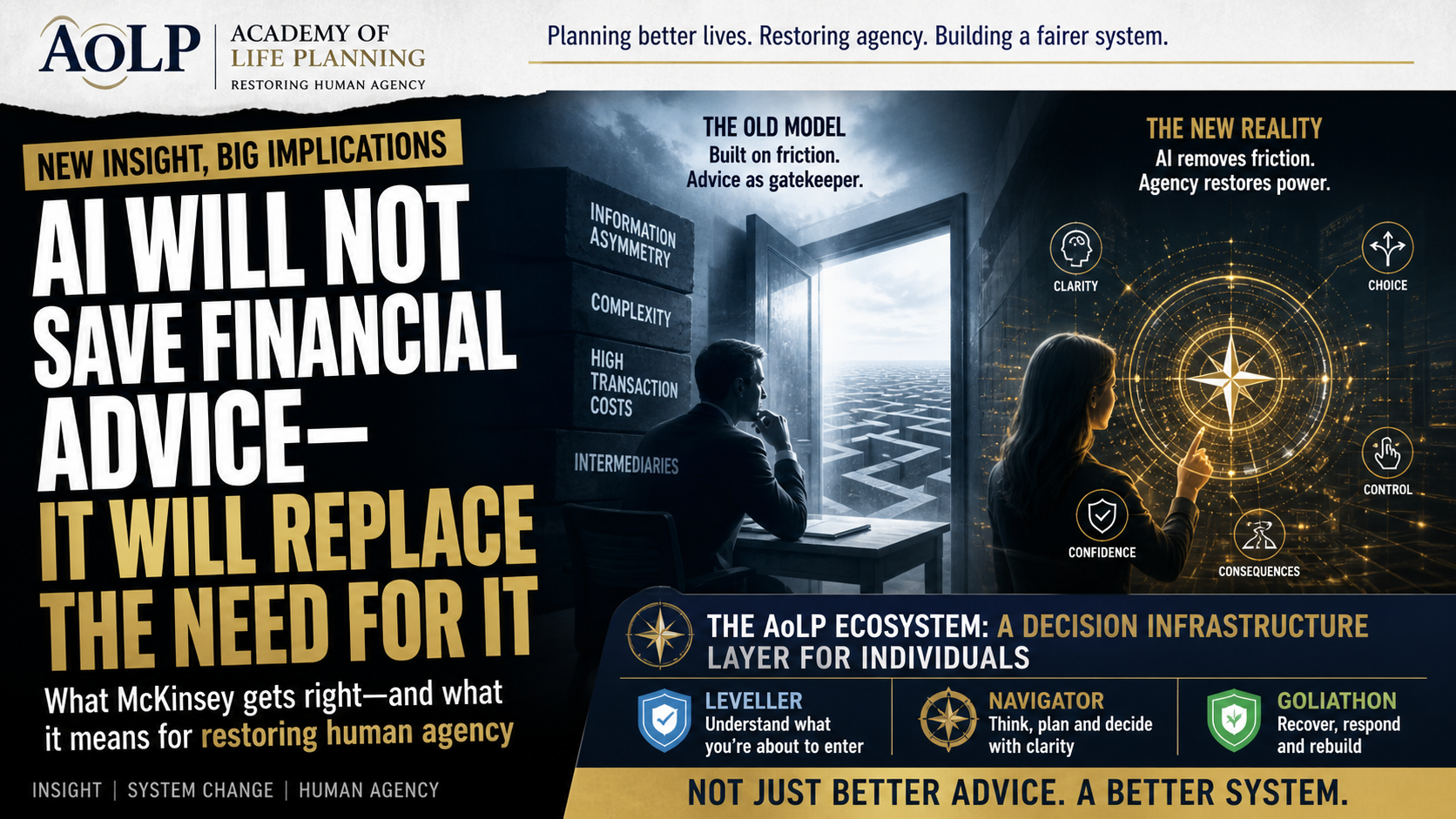
What McKinsey gets right—and what it means for restoring human agency
A recent McKinsey & Company Quarterly article makes a quietly radical point.
Despite near-universal adoption of AI across business functions, most organisations are not seeing meaningful value. The reason is not technological. It is strategic.
Companies are focusing on productivity.
And productivity, history shows, is not where lasting advantage is found.
This insight matters more than it might first appear—particularly in financial services, where the dominant model remains built on a set of assumptions that AI is now beginning to unwind.
The Productivity Illusion
For the past two years, the industry has raced to deploy AI:
- automating administration
- accelerating report writing
- improving compliance workflows
These are useful developments. But they do not change the structure of the system.
As McKinsey observes, productivity gains rarely expand profit pools. They are competed away. What begins as advantage quickly becomes expectation.
In practice, this means:
- faster advice becomes normal advice
- cheaper delivery becomes baseline pricing
- efficiency becomes table stakes
The system improves its speed, but not its direction.
This is the first illusion.
AI is not transforming financial advice.
It is simply making the existing model more efficient.
Where Value Actually Moves
If productivity is not the source of advantage, where does value go?
McKinsey identifies three deeper shifts:
- Differentiation through new offerings and models
- Reinvention of business economics
- Reduction of transaction costs across markets
It is the third that carries the greatest consequence.
AI reduces friction:
- information becomes instantly accessible
- comparison becomes continuous
- switching becomes effortless
The economic foundation of many industries—including financial advice—has historically depended on that friction.
Clients did not act because:
- they lacked information
- they lacked time
- they lacked confidence
Intermediaries existed to bridge that gap.
But what happens when the gap disappears?
From Advice to Agency
The traditional advice model was built in an era of information scarcity.
Paper files. Specialist knowledge. Slow communication.
In that world, it made sense to delegate decisions to an expert.
Today, AI changes that equation.
Information is no longer scarce.
Analysis is no longer slow.
Access to expertise is no longer restricted.
What remains scarce is something else entirely:
the ability to think clearly, decide well, and act with confidence.
This is the shift from advice to agency.
Not:
- “What should I do?”
But:
- “How do I decide what matters, and move forward with clarity?”
The difference is subtle. The implications are profound.
The Collapse of Transaction Costs
McKinsey describes a future in which AI agents:
- search continuously on behalf of individuals
- compare options in real time
- switch providers automatically
In banking, this could mean deposits flowing instantly to the best rates.
In energy, tariffs optimised without human effort.
In retail, purchasing decisions mediated entirely by intelligent systems.
In such a world, the traditional sources of advantage begin to erode:
- brand visibility
- distribution reach
- client inertia
Value shifts instead to new control points:
- the interface where decisions are made
- the data that informs those decisions
- the systems that orchestrate outcomes
This is not a marginal adjustment.
It is a reconfiguration of the economic landscape.
The Missing Layer in Financial Services
Financial services, as currently structured, does not yet fully account for this shift.
The dominant model still assumes:
- the client as recipient
- the adviser as decision-maker
- the product as the outcome
But as transaction costs fall, that structure becomes increasingly unstable.
Because the client no longer needs:
- a gatekeeper to access information
- an intermediary to execute transactions
What they need is something else:
a decision environment that supports agency.
AoLP and the Emergence of Decision Infrastructure
This is where the Academy of Life Planning sits.
Not as an alternative advice firm.
Not as a more efficient delivery model.
But as something structurally different:
a decision infrastructure layer for individuals.
The Academy’s ecosystem has evolved around a simple premise:
All planning begins with what is already present.
From that premise, a system emerges:
- Leveller — helping individuals understand what they are about to enter
- Navigator — supporting real-time thinking, planning, and decision-making
- Goliathon — enabling structured recovery and response when things go wrong
This is not a collection of tools.
It is a continuity of agency:
- before engagement
- during life
- after disruption
In McKinsey’s terms, it occupies the emerging control point:
the interface where decisions happen.
Why This Matters Now
The article makes one further point that deserves attention.
Advantage in an AI-driven economy compounds early.
Organisations that move quickly:
- learn faster
- gather better data
- improve more rapidly
- attract more usage
Over time, these advantages reinforce themselves.
Those that focus only on efficiency risk a familiar fate:
- optimising existing models
- while others redefine them
Financial services now sits at that junction.
It can:
- improve advice
Or:
- reimagine the role of the individual within the system
A Different Question
This shift reframes the question entirely.
Not:
How do we make advice more efficient?
But:
What does a system look like when individuals are supported to think, decide, and act for themselves?
And perhaps more importantly:
Where should the infrastructure of that system sit?
Closing Reflection
AI is often described as a technological revolution.
In practice, it is something more structural.
It reduces friction.
It redistributes power.
It changes who makes decisions.
The system is becoming more efficient for institutions.
But the real leverage sits elsewhere:
in restoring agency before the system engages.
The Academy of Life Planning is not responding to this shift.
It is positioning within it.
The question is not whether this transition will happen.
It is how quickly—and who is ready when it does.

