
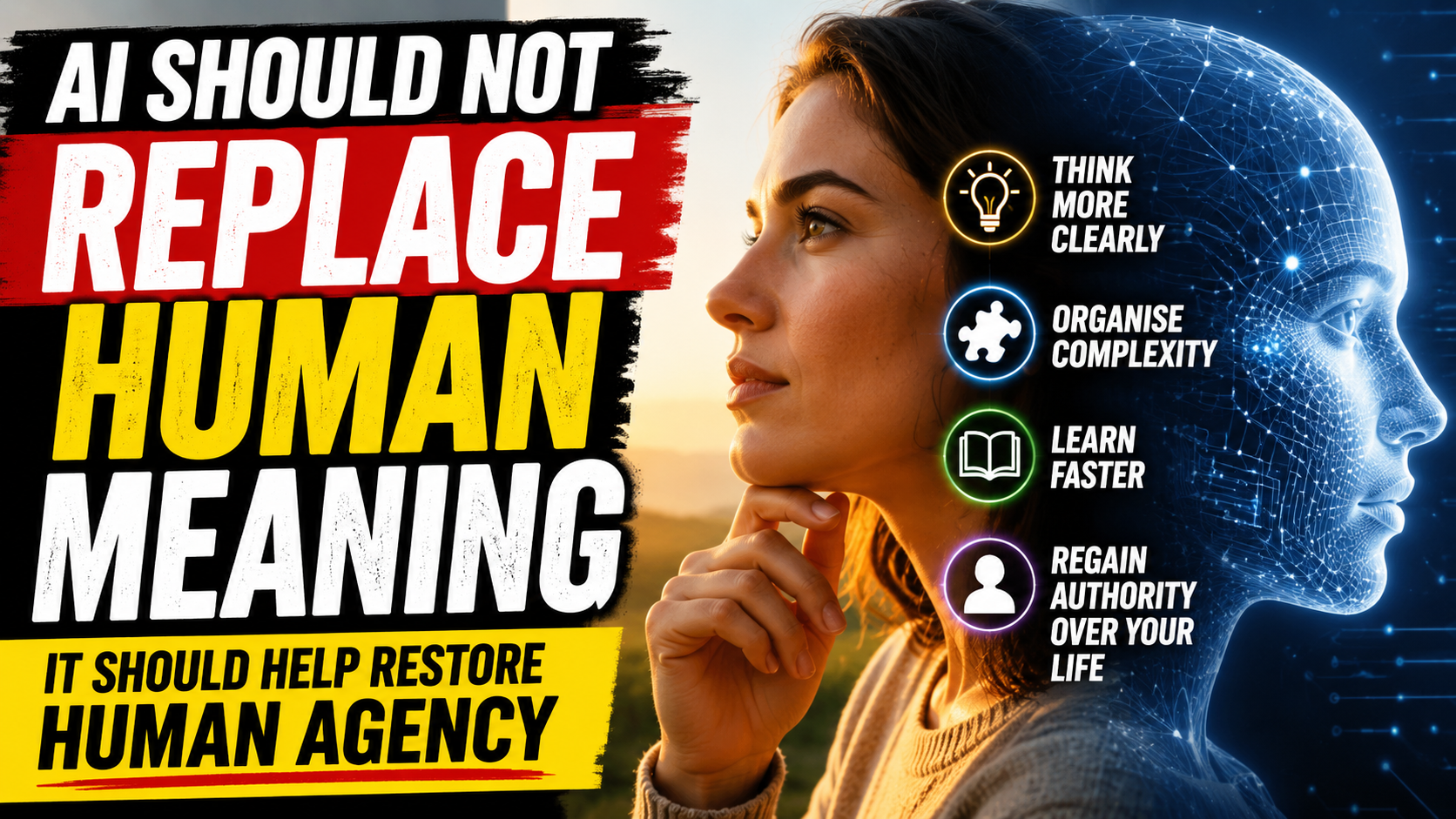
For much of the public conversation, artificial intelligence is being framed in extremes.
Either:
- AI will save humanity
or - AI will destroy it.
In reality, the more important question may be much simpler:
What role should AI actually play in human life?
At the Academy of Life Planning, we believe the answer matters enormously because the technology itself is not the central issue.
The deeper issue is human agency.
The Real Risk Is Not AI. It Is Human Displacement.
Many current debates around AI focus on:
- job loss
- misinformation
- surveillance
- institutional disruption
- automation
These are legitimate concerns.
But there is another, quieter risk emerging beneath the surface:
the gradual displacement of human judgement, meaning, conscience, and authorship.
In other words, people may begin outsourcing not only tasks, but parts of themselves.
This is where the conversation becomes more nuanced.
AI should not become:
- a substitute for wisdom
- a replacement for human relationships
- an authority over conscience
- a surrogate for spirituality or meaning
- or a mechanism for emotional dependency
Those are deeply human domains.
And they matter because societies do not flourish through efficiency alone.
They flourish through purpose, belonging, discernment, contribution, and human connection.
But Rejecting AI Entirely Misses Something Important
At the same time, dismissing AI as inherently dangerous or “anti-human” may also miss what is emerging.
Used wisely, AI can become something quite different.
Not a replacement for human agency.
But an amplifier of it.
For many individuals, AI already helps:
- organise overwhelming complexity
- clarify thinking
- accelerate learning
- structure ideas
- improve communication
- reduce cognitive friction
- increase confidence
- and create greater personal capability
For some, this may represent the first time they have felt able to navigate systems that previously overwhelmed them.
That matters.
Because throughout history, access to knowledge, structure, planning, and strategic thinking has often been concentrated inside institutions and professions.
AI is beginning to redistribute parts of that capability back toward individuals.
The Shift From Dependency to Capability
This is where the conversation becomes especially relevant for the future of financial planning, education, healthcare, governance, and community life.
For decades, many systems have unintentionally trained people into dependency:
- dependency on experts
- dependency on institutions
- dependency on platforms
- dependency on opaque systems they do not fully understand
AI introduces the possibility of something different.
Not the elimination of professionals.
But the restoration of more capable, informed, self-directing individuals.
That is a very different future.
The question is not whether humans will continue to need guidance, wisdom, teachers, mentors, or communities.
Of course they will.
The question is whether people become more conscious participants in their own lives — or increasingly passive consumers of automated outputs.
Discernment May Become One of the Most Important Human Skills
The benefits of AI do not arrive automatically.
Like any powerful tool, outcomes depend heavily on:
- intention
- judgement
- emotional maturity
- incentives
- context
- and discernment
This may explain why some individuals experience AI as empowering while others experience confusion, dependency, or distortion.
AI tends to amplify existing patterns.
Used consciously, it can support reflection, learning, and agency.
Used unconsciously, it can reinforce fear, bias, avoidance, emotional substitution, or manipulation.
This is why the future conversation cannot simply be about technology.
It must also be about:
- human development
- ethics
- education
- self-awareness
- and the cultivation of judgement
A Different Vision for AI
At AoLP, we believe AI should be positioned as:
- a thinking partner, not a master
- a tool for clarity, not control
- a support for human development, not a replacement for it
- a mechanism for restoring agency, not extracting it
The goal should not be to create more dependent humans attached to more intelligent systems.
The goal should be to help people become:
- more thoughtful
- more capable
- more informed
- more creative
- more intentional
- and more connected to what actually matters
In that sense, the most important AI question may not be technological at all.
It may be profoundly human.
Will these systems reduce human agency — or help restore it?
That choice is still ours.
The Academy of Life Planning
Replacing Extraction with Empowerment.
Restoring Human Agency in the Age of AI.

