
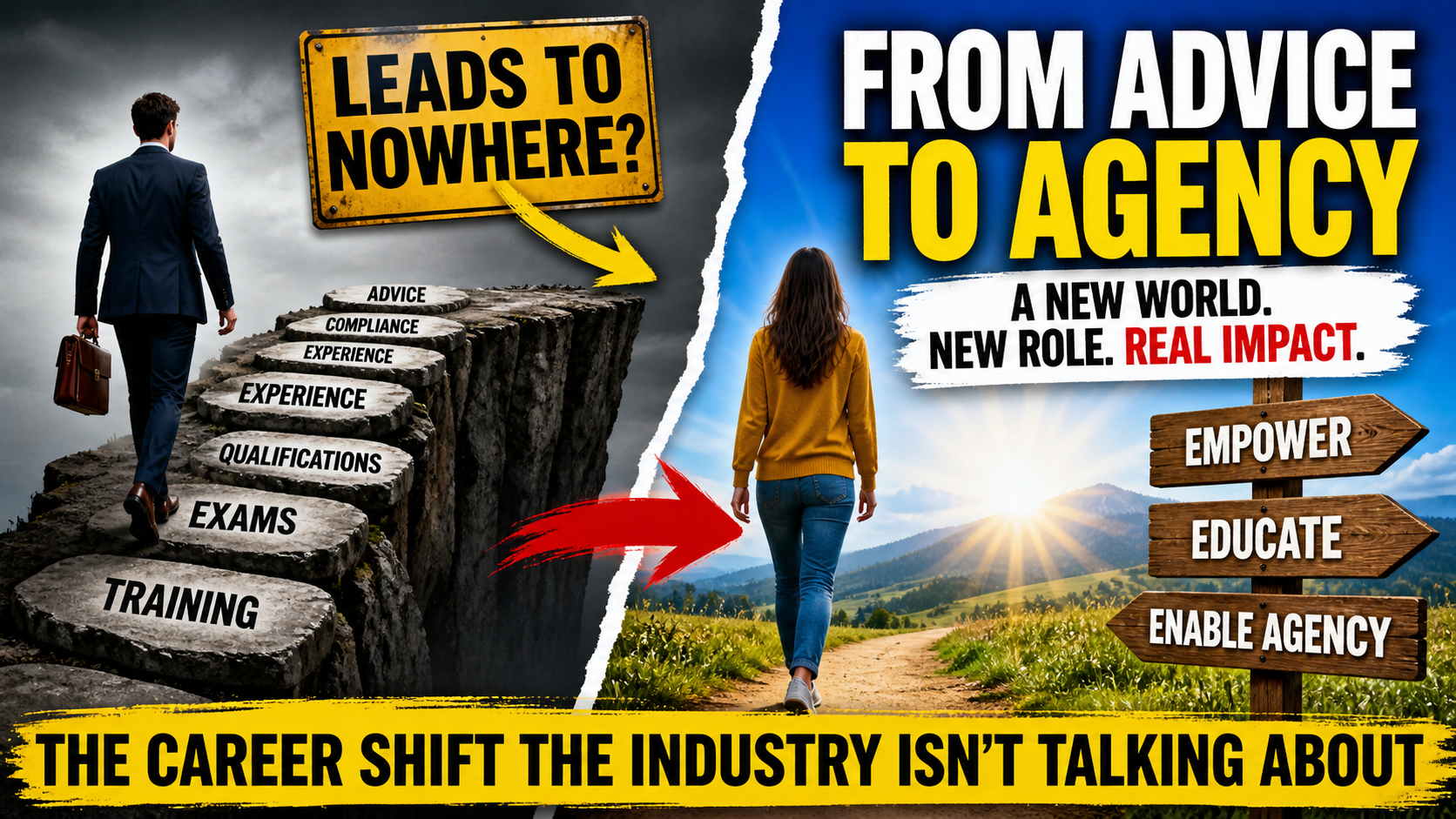
Most careers in financial services begin the same way.
You learn the system.
You build experience.
You move closer to “advice.”
Each step feels like progress.
And for a long time, it was.
But what if the path hasn’t changed… and the world has?
The traditional model was built on a simple assumption:
Clients need experts to make decisions for them.
Information was scarce.
Access was limited.
Trust sat with institutions.
So we trained professionals to:
- analyse
- recommend
- and implement
A classic “done-for-you” model.
That model made sense—then
It produced careers.
It built firms.
It created an entire profession.
But it also created something else:
dependency.
Clients relied on:
- access they didn’t have
- knowledge they couldn’t verify
- decisions they didn’t fully own
And for decades, that dependency held.
Now something is shifting
Not loudly.
But fundamentally.
We’re moving into a world where:
- information is accessible
- tools are widely available
- AI can analyse faster than any individual
Which raises an uncomfortable question:
If clients can access insight… what is the adviser’s role?
From “done-for-you” to “done-by-you”
This is where the tension begins.
Because many careers are still built on mastering:
- recommendations
- product knowledge
- implementation pathways
But the emerging need is different.
People don’t just need answers.
They need:
- clarity
- confidence
- and the ability to think things through
In other words:
agency.
So what happens to the stepping stones?
They don’t disappear.
But their direction becomes less certain.
If each step trains you to:
- take control
- provide answers
- manage outcomes
Then you may be climbing a ladder that:
- fewer people need
- and fewer people trust
Not because the intention is wrong—
but because the context has changed.
A different entry point
What if we started somewhere else?
Not with:
- “How do I become an adviser?”
But with:
- “How do I help people make better decisions?”
That question leads to a different kind of professional.
One who:
- doesn’t remove responsibility from the client
- but strengthens it
- doesn’t replace thinking
- but improves it
The emergence of agency-led planning
In this world, the role evolves.
From:
- expert → partner
- answer-giver → thinking guide
- controller → enabler
The work shifts from:
- telling people what to do
To:
- helping them understand what matters
- structuring decisions
- navigating complexity
And the uncomfortable truth…
Some of what we’ve trained for becomes less relevant.
Not useless.
But no longer central.
Because when clients gain agency:
- they don’t need to be managed
- they don’t need decisions outsourced
- they don’t need dependency
They need support.
So are the stepping stones leading nowhere?
Not exactly.
They still build:
- experience
- judgement
- human understanding
But if they’re only pointing toward a “done-for-you” destination…
Then yes—there’s a risk they lead somewhere fewer people want to go.
A quieter, more important question
For those entering the profession now:
You’re not just choosing a career.
You’re choosing a model.
- One built on control
- Or one built on agency
- One where value comes from answers
- Or one where value comes from better thinking
Because the future may not need more advisers
It may need something else entirely.
People who can:
- hold complexity without simplifying too early
- create clarity without removing ownership
- and support decisions without taking them away
A different kind of professional.
For a different kind of client.
Curious how this lands with you.
Does this feel like a shift already underway…
or one we’re only just beginning to notice?

