
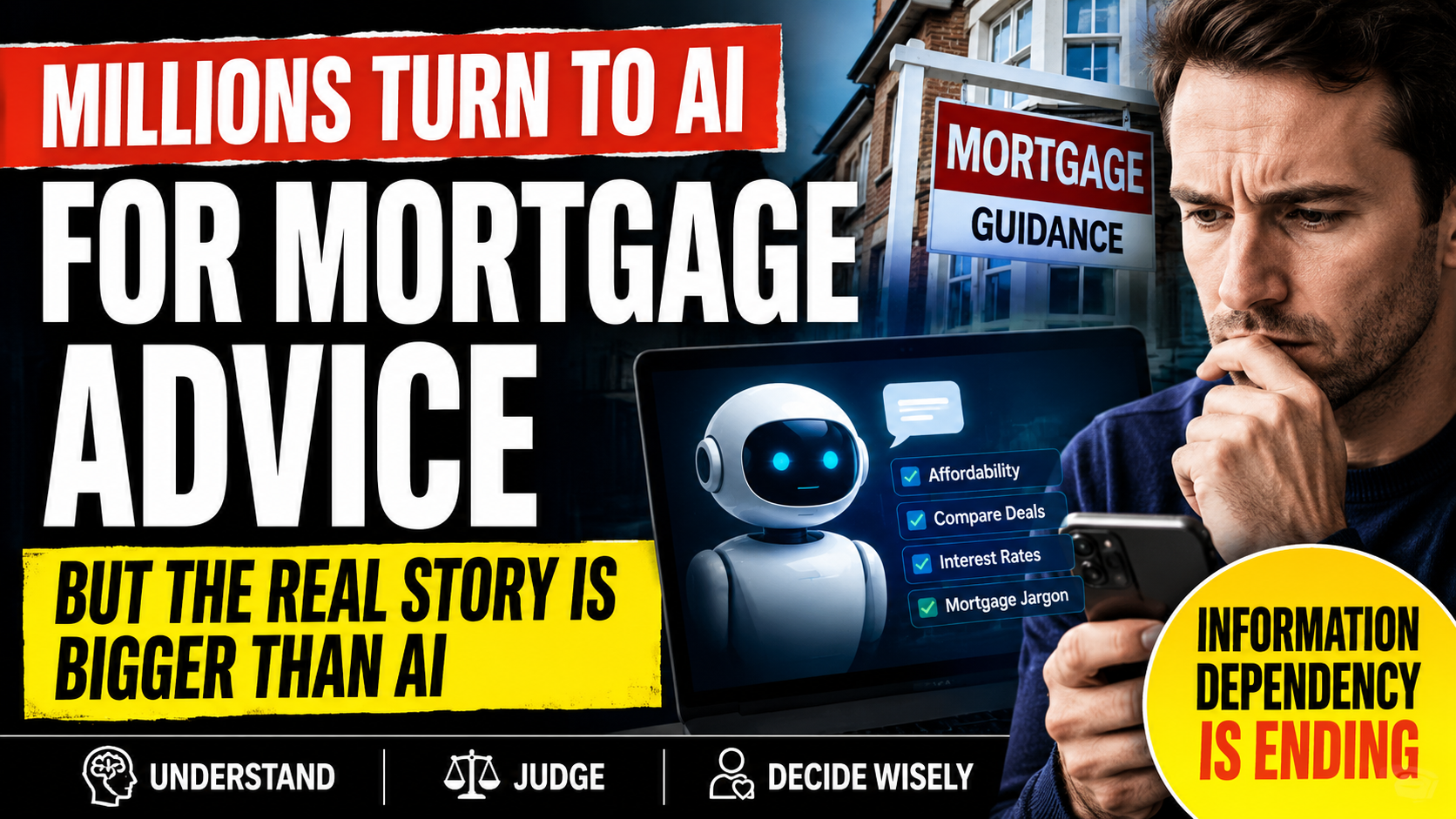
A recent news story [Millions turn to AI for mortgage advice despite concerns, Money Marketing 11th May 2026] reported that almost a quarter of Britons have already used artificial intelligence tools such as ChatGPT, Microsoft Copilot and Grok for mortgage guidance. Consumers are increasingly using AI to understand jargon, assess affordability, compare mortgage products, and interpret changing interest rates.
The article framed this primarily as a cautionary tale. Different AI models can produce different mortgage recommendations from the same information. Confidence in the outputs remains low. Industry representatives warned that affordability calculations are complex, lender criteria vary, and AI should not replace professional advice.
Those concerns are legitimate. Current AI systems can hallucinate, misinterpret nuance, rely on outdated assumptions, or produce overconfident answers. Blind delegation to AI carries real risk.
But beneath the surface, the article points to something much larger than mortgage guidance.
It reveals the beginning of a structural shift in the relationship between individuals, expertise, and institutions.
People are no longer waiting passively for financial institutions or professionals to interpret complexity on their behalf. Millions are already experimenting with self-navigation tools because they want understanding before engagement. They want to explore scenarios privately. They want clarity without pressure. They want to make sense of systems that often feel opaque, expensive, and difficult to trust.
This is not simply a story about AI adoption.
It is a story about the restoration of human agency.
For decades, much of financial intermediation has depended upon information asymmetry. The industry held the expertise, the systems, the product knowledge, and the technical language. Consumers relied upon intermediaries not only because decisions were important, but because the architecture of finance itself was difficult to navigate independently.
Artificial intelligence changes that equation.
The technical layer of financial planning is increasingly becoming compressible:
- document interpretation,
- jargon translation,
- scenario modelling,
- affordability calculations,
- product comparison,
- information synthesis,
- report generation.
These are precisely the kinds of structured cognitive tasks AI systems are rapidly improving at.
The significance of this cannot be overstated.
If consumers can access increasingly capable analytical support directly, then the traditional value proposition of financial intermediation begins to shift. The future role of professionals becomes less about controlling access to information and more about helping human beings navigate judgement, uncertainty, behaviour, and meaning.
That distinction matters enormously.
The future value of financial professionals may increasingly lie in:
- helping clients think clearly during periods of stress and transition,
- supporting behavioural resilience,
- framing difficult trade-offs,
- understanding family dynamics and life priorities,
- interpreting complexity within the context of a human life,
- exercising wisdom where certainty does not exist.
In other words, the future belongs less to information gatekeepers and more to capability partners.
This is where the Academy of Life Planning sees a major transition emerging within financial services.
The question is no longer:
“Will AI replace advisers?”
The more important question is:
“What work remains uniquely human when information becomes widely accessible?”
At AoLP, we believe the answer lies in restoring human capability rather than reinforcing dependency.
The planner of the future may look less like a product intermediary and more like:
- a strategic thinking partner,
- a behavioural guide,
- a trusted educator,
- a complexity navigator,
- a facilitator of better judgement.
This does not remove the need for expertise. Far from it.
But expertise itself changes form.
The professionals who thrive in the age of AI are unlikely to be those who merely possess information. Increasingly, information is abundant. What becomes scarce is discernment, context, emotional intelligence, ethical judgement, and the ability to help another human being remain calm and coherent inside uncertainty.
At the same time, this transition also creates new responsibilities.
Consumers must learn not to replace institutional dependency with technological dependency. AI systems should not become unquestioned authorities. Human beings still need critical thinking, self-awareness, and the ability to challenge outputs rather than simply consume them.
That is why AoLP continues to emphasise capability-first planning.
The objective is not to eliminate human support. Nor is it to hand decision-making over to machines.
The objective is to help individuals become more informed, more capable, more self-directed, and more resilient within increasingly complex systems.
The deeper warning for institutions may therefore be this:
The age of asymmetric information is ending.
Consumers now have tools that can help them interrogate systems, compare narratives, test assumptions, and access forms of capability that previously required institutional gatekeepers.
That shift cannot be reversed.
The organisations that adapt successfully will likely be those that move from protecting dependency toward strengthening human agency.
Because in a world overflowing with information, the greatest value may no longer come from controlling knowledge — but from helping people think clearly enough to use it wisely.
Curious how others in financial services see this transition evolving over the next few years.

