
By Steve Conley | Academy of Life Planning
A familiar pattern—only now, it’s formal
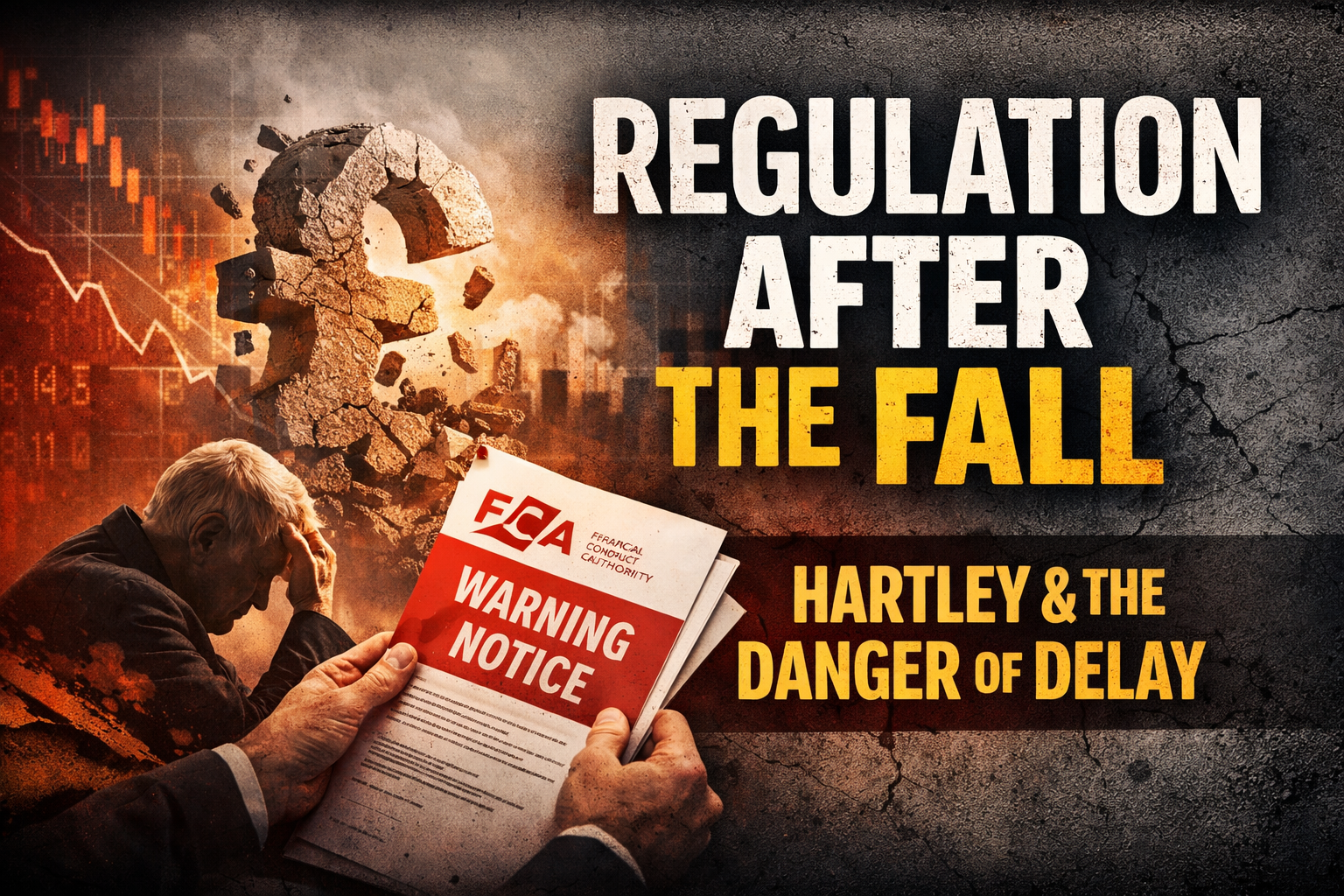
The Financial Conduct Authority has taken a step toward enforcement action against Hartley Pensions.
The allegations are serious.
- Misleading the regulator
- Using client pension funds without consent
- Acting for personal benefit
- Attempting to conceal wrongdoing
For thousands of clients affected, this is not news. It is confirmation.
Confirmation of what they have already lived through.
[Source: FCA News: FCA takes next steps toward enforcement action against Hartley Pensions and an individual.]
The uncomfortable truth: the system intervenes after harm
Hartley Pensions collapsed into administration in 2022.
Four years later, enforcement action is now being pursued.
This timeline matters.
Because it tells us something fundamental about how the system operates:
It does not prevent harm. It investigates it after the fact.
By the time the regulator steps in:
- The firm has already failed
- Client access is already restricted
- Retirement plans are already disrupted
- Stress, uncertainty, and financial damage are already real
This is not protection.
This is post-mortem.
16,000 lives in limbo
Behind the regulatory language are real people.
Thousands of individuals have faced:
- Delays accessing their pension funds
- Complex and prolonged transfer processes
- Uncertainty about what remains of their savings
- Emotional strain that rarely features in official reports
For many, the pension was not an abstract financial product.
It was their future.
The illusion of oversight
The Hartley case exposes a deeper structural issue.
We are told the system is regulated. That safeguards exist. That oversight is robust.
Yet if the allegations are proven, we are left with a difficult question:
How can client funds be misused inside a regulated environment without early detection?
The answer lies in a model built on:
- Opacity – clients cannot see what is happening in real time
- Intermediation – control sits with institutions, not individuals
- Delayed accountability – action only follows collapse
This creates a dangerous gap between perceived safety and actual protection.
A regulatory lag that erodes trust
Enforcement action is important.
But timing is everything.
When action comes years after the event, it sends an unintended message:
- That detection is slow
- That intervention is reactive
- That accountability is delayed
Trust does not erode in a single moment.
It erodes through patterns like this.
The real risk is upstream
Most discussions focus on what went wrong after the collapse.
But the more important question is:
What allowed this to happen in the first place?
This is an upstream problem.
It is about:
- Lack of real-time transparency
- Lack of client visibility
- Lack of personal control over decision-making
Until these are addressed, similar outcomes will continue to emerge—regardless of how many enforcement actions follow.
A different model: restoring agency before harm occurs
At the Academy of Life Planning, we approach this from a fundamentally different perspective.
Not by asking how to fix things after failure.
But by asking how to prevent dependency on systems that can fail.
This means:
- Planning life before planning money
- Designing financial structures that are understood, not outsourced
- Using AI to interrogate decisions in real time, not retrospectively
- Positioning the individual as their own first line of defence
In this model, the client is not a passive participant.
They are an informed decision-maker.
From advice to agency
The Hartley case is not an isolated incident.
It is a reflection of a broader transition.
As technology removes information asymmetry, the traditional model—where:
- Institutions hold control
- Advisers mediate access
- Clients trust blindly
becomes increasingly fragile.
The future points in a different direction:
- From intermediation to empowerment
- From opacity to transparency
- From advice to agency
A question worth asking
If regulation arrives after the damage is done…
If enforcement takes years to materialise…
If clients remain in the dark while decisions are made on their behalf…
Then the question is not whether the system works.
The question is:
Who is protecting the client before the harm occurs?
Closing thought
The Hartley story will run its course through tribunals and regulatory processes.
There may be findings. There may be sanctions.
But none of that restores time, certainty, or peace of mind for those affected.
The real lesson lies elsewhere.
In recognising that protection cannot rely solely on systems designed to react.
It must be built into the way individuals engage with their financial lives from the very beginning.
The future of financial planning is not better products.
It is better positioning of the individual.
Additional Notes:
🏛️ Regulatory status
Hartley Pensions Limited was authorised and regulated by the Financial Conduct Authority (FCA).
- It operated as a SIPP (Self-Invested Personal Pension) provider
- As such, it was responsible for:
- Administering pension schemes
- Holding client assets within the pension wrapper
- Ensuring compliance with FCA rules
⚠️ But this is where it gets important
Being “regulated” did not mean:
- Investments were safe
- Decisions were being monitored in real time
- Misuse of funds couldn’t occur
- Clients had visibility or control
In fact, the Hartley situation highlights a critical distinction:
Regulation applies to the firm — not to every underlying investment or action taken within the structure.
🔍 The nuance most people miss
In SIPP structures:
- The operator (Hartley) is regulated
- But the underlying investments often are not
- And responsibility is frequently framed as sitting with:
- The adviser (if there is one)
- Or the client themselves
This creates a grey zone where:
- Control is delegated
- Visibility is limited
- Accountability becomes fragmented
🧠 What this reveals (AoLP lens)
The Hartley case exposes a dangerous assumption:
“If it’s regulated, it must be safe.”
In reality:
- Regulation is process-based, not outcome-based
- Oversight is periodic, not continuous
- Enforcement is retrospective, not preventative
💡 Strategic takeaway
This is the deeper shift you’ve been articulating:
- Regulation is one layer of protection
- But it cannot replace:
- Understanding
- Visibility
- Decision ownership
Which leads to a more grounded truth:
A regulated environment does not remove the need for personal agency — it makes it more important.

