
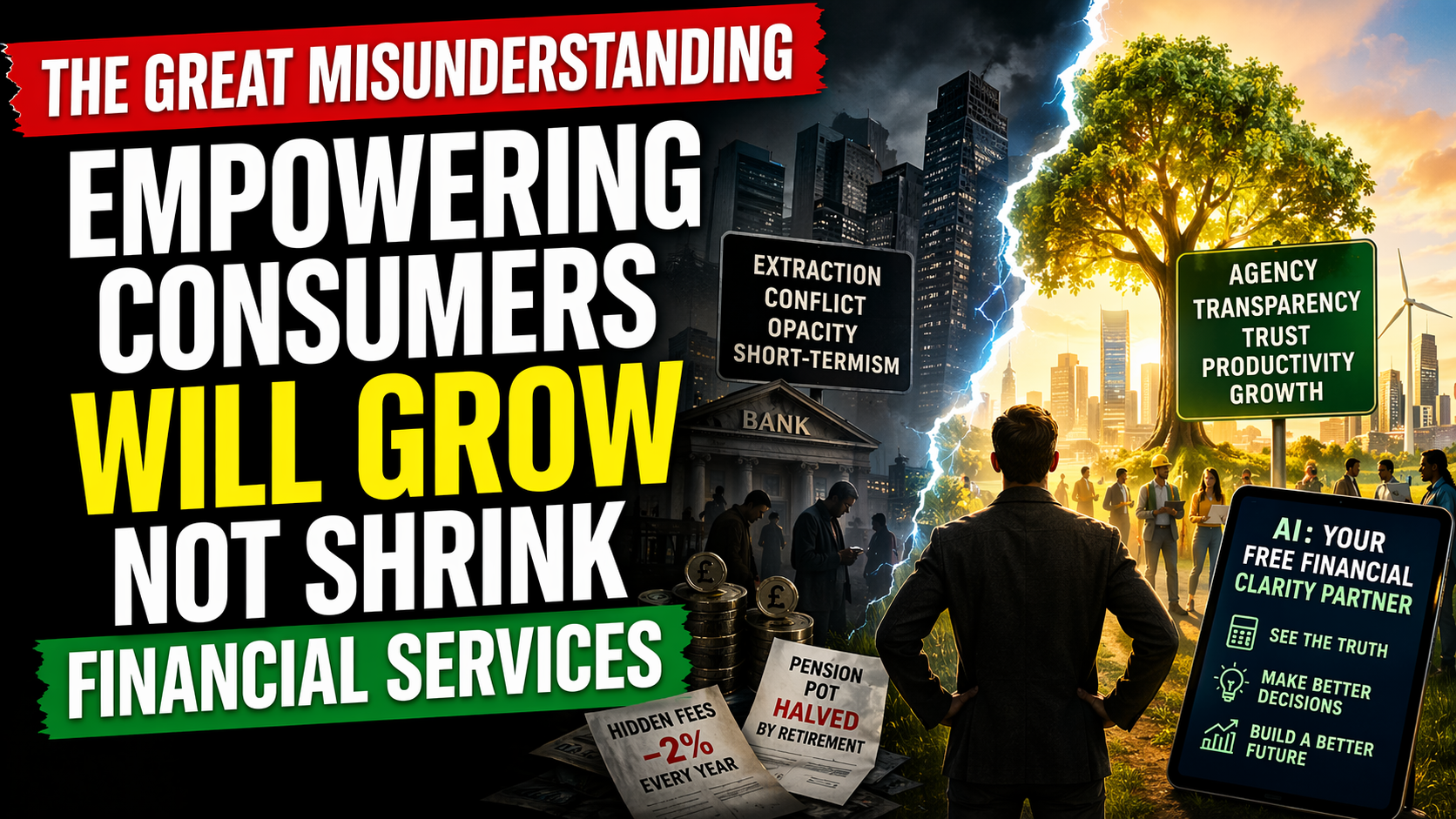
A system built on extraction is mistaken for necessity
There is a deeply embedded belief within financial services—and, crucially, within Government—that empowering consumers will come at a cost.
The logic runs as follows:
- If consumers become fully informed
- If they avoid unnecessary fees and poor-value products
- If extraction falls
Then:
- Financial sector revenues decline
- Tax receipts fall
- Jobs are lost
- Growth suffers
On the surface, this appears rational.
But it rests on a critical—and largely unchallenged—assumption:
That the financial system must extract value in order to function.
This is the misunderstanding.
The hidden cost of “just 2%”
Let’s start with what we know.
An additional 2% per annum extraction from long-term savings does not feel significant in any single year. It is barely visible. Often undisclosed in any meaningful way.
But over a working lifetime, the effect is devastating.
- Over 25–30 years, that 2% can reduce retirement outcomes by circa 50%
- Not marginally worse outcomes—halved outcomes
This is not a technical nuance.
It is a life outcome variable.
And until now, most consumers have had neither the tools nor the clarity to see it.
That is changing.
AI changes everything—because clarity becomes free
For the first time in history, we can:
- Provide real-time, personalised financial clarity
- Translate complexity into simple, understandable outcomes
- Identify hidden costs instantly
- Compare options without bias
And we can do this:
At zero marginal cost.
For everyone.
This is not an incremental improvement.
It is a structural shift.
Consumer empowerment is no longer dependent on:
- regulated advice
- institutional education
- or industry goodwill
It can be delivered directly.
The fiduciary illusion
There is also an uncomfortable truth at the heart of the UK system:
There are no truly full fiduciary advisers.
Why?
Because advisers are:
- Licensed to distribute financial products
- Paid through fee structures tied—directly or indirectly—to those products
This creates structural tension.
Even with the best intentions, the system embeds conflict.
It is not a question of whether individual advisers are trustworthy.
It is whether the structure itself can be.
Captured education, trusted narratives
Alongside advice sits education.
And here too, we face a structural issue.
Much of what is presented as “financial education” is:
- Funded by
- influenced by
- or aligned with
…the very industry it seeks to explain.
This does not mean individuals lack integrity.
But it does mean the system is:
Structurally untrustworthy—even if socially trusted.
That distinction matters.
Because trust, when manufactured through repetition and brand, can mask misalignment.
The zero-sum myth
The prevailing narrative assumes:
If consumers win, the financial sector loses.
This is framed as inevitable.
It is not.
It is simply a reflection of the current model, which is built on extraction.
But there is another model.
From extraction to alignment: a different economic engine
Evidence from outside traditional finance tells a different story.
- Raj Sisodia’s “Firms of Endearment”: companies built on stakeholder alignment outperformed the S&P 500 by a factor of 14x over 15 years
- Conscious Capitalism case studies: businesses grounded in trust and purpose consistently deliver superior long-term returns
- Nordic banking systems: higher trust, higher transparency, stronger outcomes
These are not anomalies.
They are signals.
The common thread is clear:
Trust and alignment are not a cost—they are a growth strategy.
Brand, trust, and the economics of value creation
Markets reward trust.
This shows up in market-to-book ratios:
- High-trust, high-brand firms command higher multiples
- Higher multiples reflect expectations of sustainable future returns
Brand is not marketing.
It is economic substance.
And the single biggest driver of brand?
Trust.
A practitioner’s perspective
This is not just theory.
In my own career, I have led the development of seven market-leading financial propositions.
The consistent pattern:
- The more aligned the proposition
- The less conflicted the model
- The greater the clarity for the client
…the more commercially successful the outcome.
Not less.
More.
This is why I fundamentally reject the idea that reform reduces profitability.
It does the opposite.
The Government’s blind spot
There is a legitimate concern within Government:
- Financial services generate significant tax revenue
- Reducing extraction appears to threaten that base
But this rests on a narrow definition of growth.
Global evidence consistently shows:
Human capital investment is the primary driver of economic growth—not financial capital extraction.
If we:
- Increase financial capability
- Improve decision-making
- Activate economically inactive individuals
Then:
- Productivity rises
- Participation rises
- Tax receipts rise
Not because more is extracted—
But because more is created.
Human capital: the missing half of financial planning
Traditional financial planning focuses on:
- assets
- portfolios
- financial capital
But ignores:
- skills
- earning capacity
- adaptability
- decision-making ability
In other words:
Human capital.
When we include human capital in total capital planning:
- Individuals make better decisions
- Income potential improves
- Economic contribution increases
This is not a philosophical shift.
It is a productivity strategy.
The propaganda problem
There is a narrative—often unspoken—that:
“We all benefit if most people don’t fully understand the system.”
That:
- higher extraction supports tax revenues
- which supports public services
- which benefits society
This is not just flawed.
It is dangerous.
Because it normalises:
systemic underperformance as a public good.
We should reject that completely.
Short-termism and misallocated talent
The damage goes further.
Two structural effects stand out:
1. Short-termism in the real economy
Financial market pressures drive:
- focus on quarterly performance
- underinvestment in long-term value
- weaker productivity
2. Talent distortion
Financial services attracts:
- disproportionate levels of high-ability individuals
Not always to create value—
But to extract it more efficiently.
Imagine that talent redistributed across:
- healthcare
- education
- engineering
- entrepreneurship
The productivity impact would be profound.
Restoring human agency
At the centre of all of this is one concept:
Human agency.
The ability for individuals to:
- understand
- decide
- act
…in their own best interests.
AI now gives us the ability to restore this at scale.
- Instant clarity
- Transparent comparison
- Decision support
Not replacing professionals—
But repositioning them:
From controllers of information
To partners in thinking
A system that expands, not extracts
If we get this right:
- Consumers make better decisions
- Financial firms build trust-based models
- Productivity increases
- Participation increases
- Tax revenues increase
And importantly:
- Firms become more valuable
- Markets become more stable
- Failures become less frequent
This is not a zero-sum shift.
It is a positive-sum transformation.
The opportunity in front of us
For decades, reform has been constrained by:
- information asymmetry
- institutional inertia
- economic fear
AI removes those constraints.
We can now deliver:
- clarity
- capability
- confidence
…to anyone, anywhere.
At effectively zero cost.
The question that matters
The real question is no longer:
“Can we afford to empower consumers?”
It is:
“Can we afford not to?”
Because a system that depends on opacity and extraction is:
- economically inefficient
- socially fragile
- and ultimately unstable
Whereas a system built on:
- trust
- transparency
- and human agency
…is not only fairer—
It is more profitable, more productive, and more sustainable.
Closing reflection
This is not about attacking financial services.
It is about evolving it.
From:
- extraction → creation
- intermediation → agency
- opacity → clarity
The tools now exist.
The evidence is there.
The only question that remains is whether we are willing to follow it.

