
A quiet gap in the system—and why it matters now
There is a pattern emerging in the stories we see.
Different people.
Different advisers.
Different jurisdictions.
But the structure is remarkably consistent.
A pension leaves the UK system.
Multiple parties are paid along the way.
And when things go wrong—no one appears to own the outcome.
This isn’t a claim.
It’s an observation.
And it raises a simple question:
What exactly is being regulated?
The journey most people never see
At a surface level, pension transfers—particularly historic QROPS transfers—followed a defined process.
In many cases, the checks were limited to two core questions:
- Was the receiving scheme on the relevant list?
- Had the member signed the required documentation?
If both conditions were satisfied, the transfer could proceed.
What often wasn’t assessed in any integrated way:
- The quality and nature of the advice
- The fee structures embedded within the destination
- The long-term suitability of the arrangement
- The cumulative risk created across multiple parties
Once the transfer was complete, the system effectively reset.
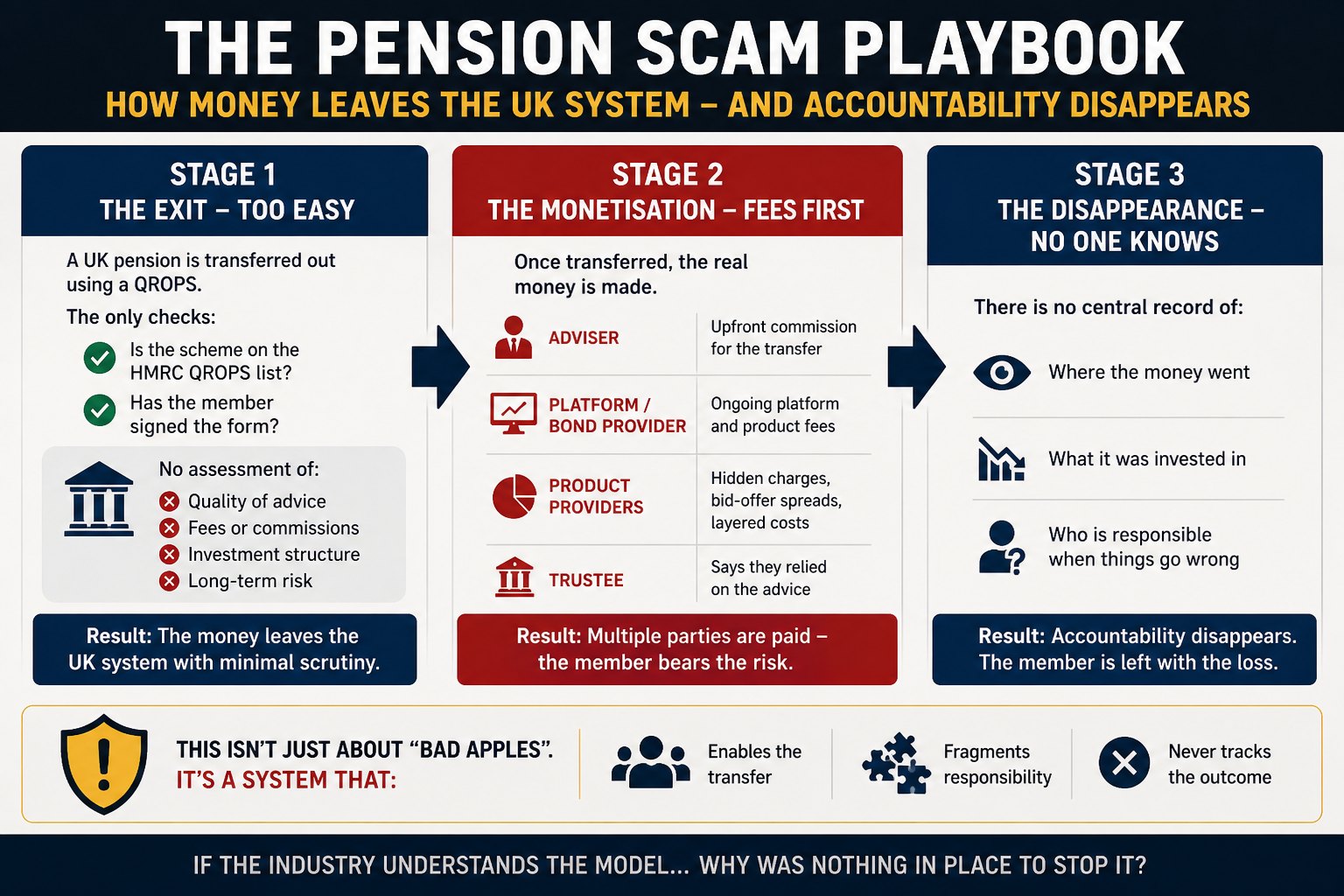
A three-stage pattern
Looking across multiple cases, a simple pattern becomes visible:
Stage 1 — The Exit
The pension leaves the UK system with minimal friction once formal conditions are met.
Stage 2 — The Monetisation
Value is extracted across the chain:
- Advisers (often upfront)
- Platforms and bond providers (ongoing)
- Product layers (fees, spreads, structures)
- Trustees (reliance on advice)
Each participant operates within their own remit.
Stage 3 — The Disappearance
When performance deteriorates or value is lost:
- There is no central record of where the money ultimately went
- No single party owns the full lifecycle
- Responsibility fragments across jurisdictions and roles
The member carries the outcome.
The structural gap
Individually, each component can sit within a regulatory framework.
Collectively, something is missing.
There is no consistent mechanism that:
- Tracks outcomes across the lifecycle
- Connects responsibility from origin to endpoint
- Assesses whether the system, as a whole, produced a good result
In simple terms:
Transfers are recorded.
Outcomes are not.
Why this matters now
It’s often said that rules have improved.
In many areas, that is true.
But two realities sit alongside that progress:
- A large number of transfers occurred under earlier frameworks
The outcomes of those decisions still sit with individuals today. - The model hasn’t disappeared—it has evolved
From transfer-based extraction
To ongoing fee-based structures
To increasingly complex investment pathways
Which leads to a more reflective question:
If the system now works better, what happens to those who went through it before it did?
Not bad actors—system design
It is tempting to explain these cases through the lens of “bad apples.”
That explanation is incomplete.
A more useful lens is system design:
- A system that enables the transfer
- A system that fragments responsibility
- A system that does not track outcomes
When those three conditions exist together, the result is not surprising.
It is predictable.
A different starting point
At the Academy of Life Planning, we approach this from a different angle.
Not by asking:
“Who is to blame?”
But by asking:
“What would a system look like if it was designed around the individual outcome?”
That might include:
- Tracking the full journey of capital, not just the point of transfer
- Maintaining continuity of responsibility across jurisdictions
- Making fee structures visible in total, not in parts
- Supporting individuals to retain decision control, rather than delegate it entirely
In other words:
Planning the outcome, not just processing the transaction.
An open question
The industry understands each part of this model.
That’s not in doubt.
The question is whether it is ready to engage with the model as a whole.
Because improving the rules going forward is one thing.
Addressing the consequences of what has already happened is another.
Curious how others see this.

