
Most People Don’t Read the Contracts They Sign.
That’s Not a Personal Failure — It’s a System Design Problem.
By the Academy of Life Planning
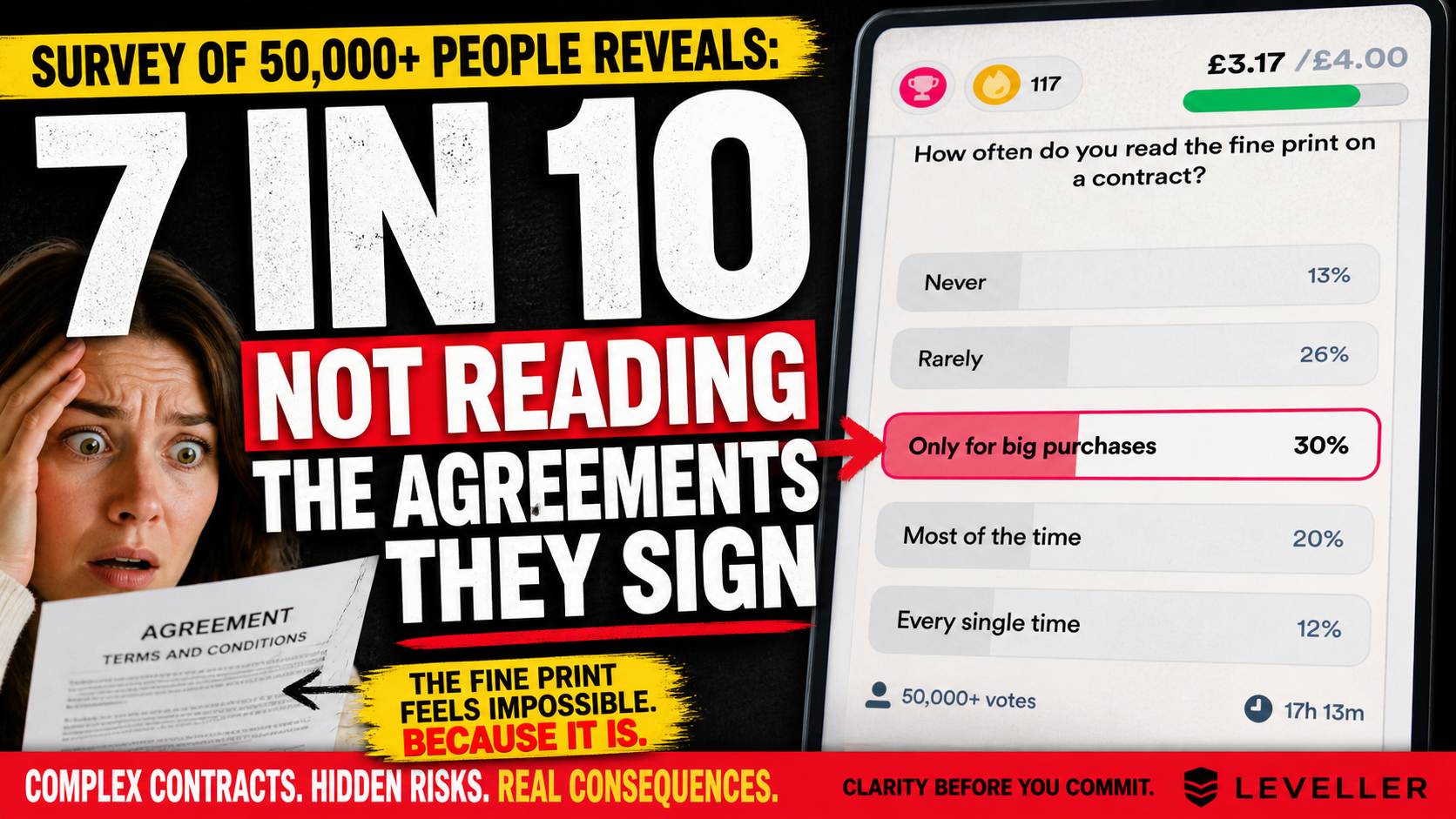
A recent consumer survey of over 50,000 people by Survey Pop asked a simple question:
How often do you read the fine print on a contract?
The answers should give all of us pause.
- 13% said never
- 26% said rarely
- 30% said only for big purchases
That means nearly 7 out of 10 people do not consistently read the contracts they sign.
Only:
- 20% read them most of the time
- 12% read them every time
At first glance, this might be framed as a behavioural issue.
A lack of diligence. A failure to take responsibility.
But that interpretation misses something fundamental.
This Is Not About Carelessness. It’s About Capacity.
Modern contracts are not written for human comprehension.
They are:
- Long
- Dense
- Technical
- Structurally biased toward the issuer
Even highly educated professionals struggle to interpret them properly.
So people adapt.
They skim.
They trust.
They assume fairness.
They sign.
Not because they are reckless — but because the cognitive load exceeds practical capacity.
This is not a failure of the individual.
It is a failure of design.
The Moment That Matters Most Is the Moment Least Understood
In financial planning, we often focus on outcomes:
- Investment performance
- Retirement income
- Portfolio construction
But the single most consequential moment in many financial journeys happens earlier:
The moment someone agrees to terms they do not fully understand.
This is where:
- hidden costs are embedded
- rights are limited
- obligations are locked in
- future options are quietly constrained
And in most cases, it happens without true informed consent.
The System Relies on You Not Reading It
There is an uncomfortable truth at the heart of this:
Many agreements are not designed to be read.
They are designed to be accepted.
Not maliciously in every case — but structurally.
Legal complexity, regulatory layering, and commercial incentives have combined to create documents that:
- transfer risk efficiently
- protect institutions thoroughly
- but remain opaque to the end user
This creates a profound imbalance.
One side understands the contract in full.
The other signs it in good faith.
Telling People to “Read the Fine Print” Is No Longer a Serious Solution
For decades, consumer protection has leaned on a simple principle:
Disclosure equals protection.
But disclosure only works if:
- it is accessible
- it is understandable
- it is actionable
In reality, most disclosures fail on all three counts.
So repeating the advice:
“You should read the contract before signing”
is no longer meaningful guidance.
It is a theoretical safeguard in a system that is practically inaccessible.
A Different Approach: Restore Understanding Before Commitment
If the problem is structural, the solution must be structural.
At the Academy of Life Planning, we take an asset-based view:
All planning begins with what is already present.
Before money is invested, before strategies are implemented, before risks are taken —
there is almost always a contract.
And that contract shapes everything that follows.
So the question becomes:
What if understanding that contract was simple, fast, and reliable?
Introducing the Leveller: A Pre-Decision Clarity Layer
The Leveller was built to address this exact gap.
Not as legal advice.
Not as interpretation in the traditional sense.
But as a clarity tool.
A way to:
- scan the small print before you sign
- surface the key risks, obligations, and asymmetries
- translate complexity into plain, usable insight
In seconds, not hours.
Because in a world where most people do not — and realistically cannot — read every contract in detail, the solution is not to demand more effort.
It is to change the interface between people and the agreements they enter into.
From Blind Commitment to Informed Agency
This is not just about convenience.
It is about restoring something more fundamental:
Agency.
The ability to:
- understand what you are agreeing to
- see where the risks lie
- make decisions with clarity, not assumption
Within the Academy’s wider framework, this sits in the “before harm” layer:
- Before the mistake
- Before the dispute
- Before the loss
Because once a contract is signed, options narrow quickly.
A Shift That Is Already Underway
The Survey Pop data does not just highlight a problem.
It signals a transition.
We are moving from a world where:
- information was scarce
- institutions were trusted
- and complexity could be delegated
to one where:
- information is abundant
- trust must be earned structurally
- and individuals need tools to navigate complexity themselves
In that world, capability becomes the new form of protection.
The Real Question
So the question is no longer:
“Why aren’t people reading contracts?”
It is:
“Why are contracts still being presented in a way that makes understanding them so difficult?”
And more importantly:
“What tools are we giving people to close that gap?”
Closing Thought
If nearly 70% of people are not reading the agreements they sign,
we are not looking at a fringe issue.
We are looking at a system-wide exposure point.
And in a structurally untrustworthy environment,
clarity is not optional.
It is protection.
The Leveller is part of the Academy of Life Planning’s operating system for restoring human agency — before, during, and after financial harm.
If you are about to sign something that matters,
start with what is already present.
Then make your decision — with your eyes open.


One thought on “Most People Don’t Read the Contracts They Sign.”