
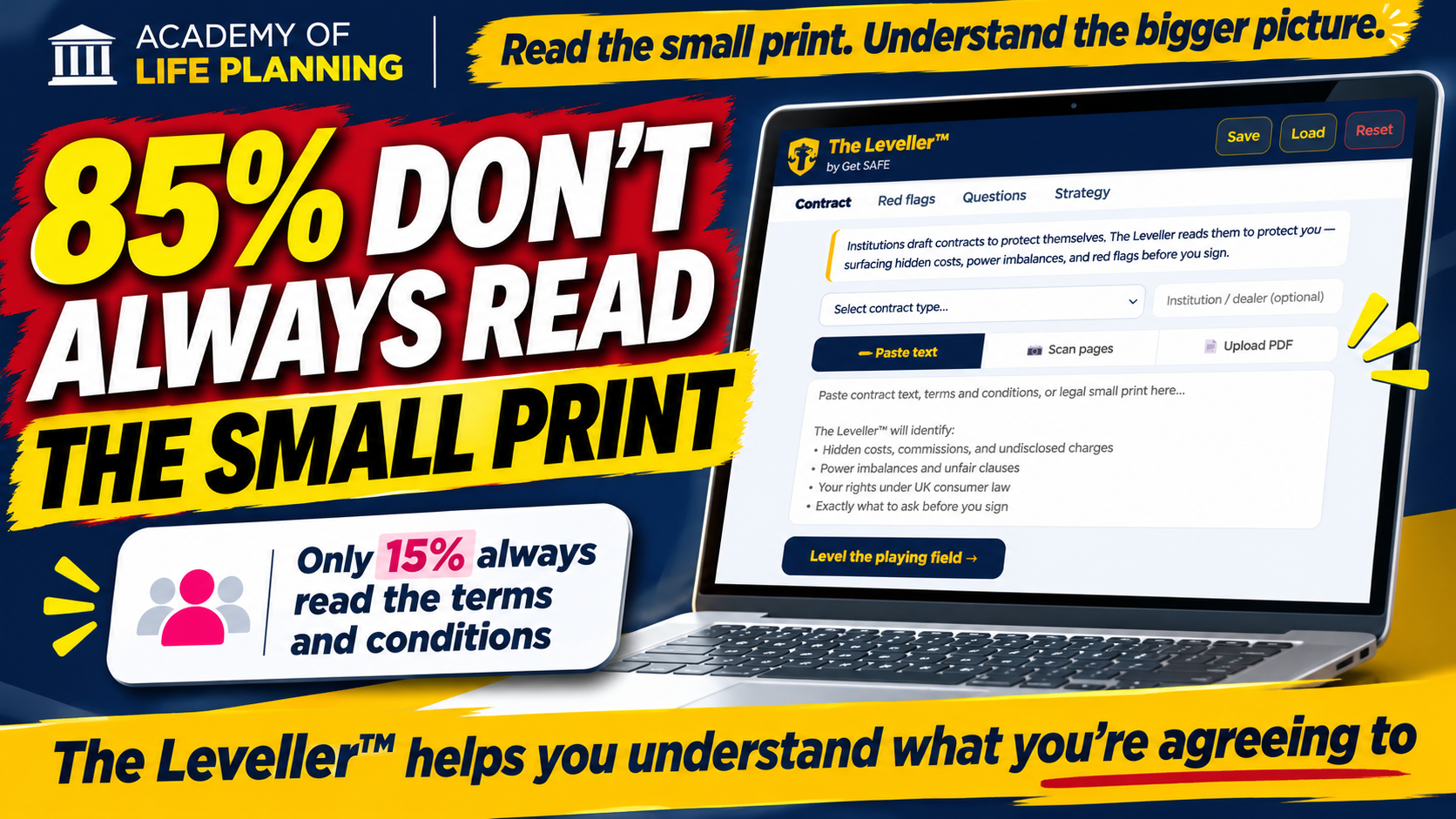
Introducing The Leveller™ — read the small print, understand the bigger picture.
By Steve Conley, Founder of the Academy of Life Planning
We have all done it.
Scrolled to the bottom of a document. Ticked a box. Clicked “I agree”. Signed on the dotted line.
But what exactly did we agree to?
A poll captured on 23 November 2026, with more than 100,000 votes recorded at the time, asked a deceptively simple question:
How often do you actually read the terms and conditions?
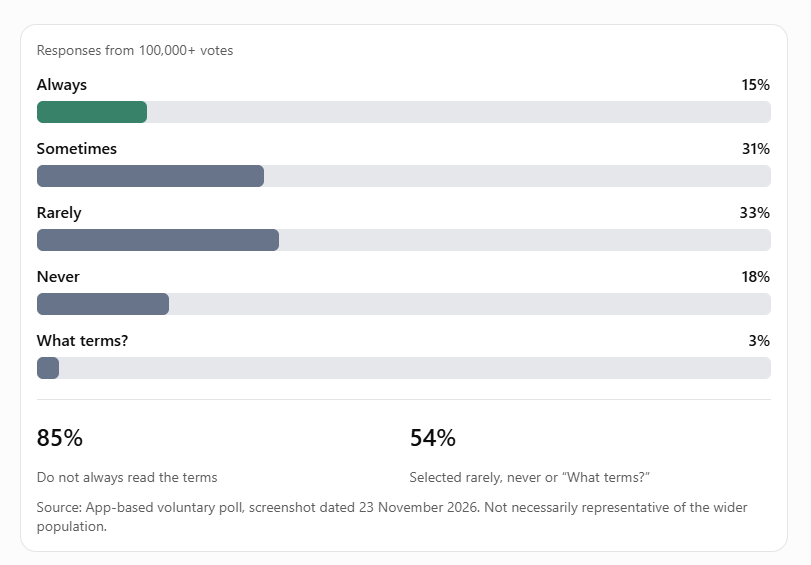
Whilst this is not a representative national survey, it raises an important question about the way our economy operates.
We have built a commercial system that relies on consumers giving informed consent, whilst making the process of becoming informed extraordinarily difficult.
Perhaps the problem is not that people fail to read the small print.
Perhaps the problem is the small print itself.
Agreement is not the same as understanding
Imagine two parties entering into a contract.
One has a legal department, compliance specialists, commercial strategists and decades of experience drafting agreements.
The other has a lunch break.
One understands the implications of every clause.
The other is trying to work out whether they can afford the monthly payments.
Yet both are expected to enter into the agreement with an understanding of their respective rights and obligations.
That is a structural power imbalance.
The organisation writes the terms. The individual is expected to understand them. The organisation may enter into thousands of similar agreements. The individual may encounter one only once in their lifetime.
A signature demonstrates agreement. It does not necessarily demonstrate understanding.
And the consequences can last for decades.
When the small print becomes the big problem
Through our work at the Academy of Life Planning and Get SAFE, we encounter situations where people discover the practical implications of agreements long after they have committed to them.
Consider the following examples:
- A trainee financial adviser discovers that what appeared to be a salary was actually a recoverable advance.
- An employee accepts training without understanding the potential repayment obligations if they leave.
- An investor discovers that exiting an investment is considerably more expensive or difficult than entering it.
- A business owner signs a personal guarantee without fully appreciating the consequences for their family.
- A consumer discovers that a recurring charge continues unless they follow a particular cancellation procedure.
- A person accepting a settlement discovers that they have agreed to waive rights they did not realise they possessed.
In each case, the important question is not simply whether the terms were disclosed.
It is whether the person understood their practical consequences before agreeing to them.
There is an enormous difference between making information available and making information accessible.
The economics of complexity
Complexity is not always necessary.
Sometimes it reflects genuine legal or technical requirements. Sometimes it arises from decades of accumulated regulation. Sometimes it protects both parties.
But complexity can also serve a commercial purpose.
When consumers find it difficult to understand, compare, challenge or exit agreements, the organisation may enjoy a commercial advantage.
Economists call this information asymmetry.
One party knows considerably more than the other.
Historically, reducing that asymmetry has required individuals to purchase professional expertise. For many everyday agreements, the cost of obtaining that expertise is disproportionate to the value of the transaction.
So people take their chances.
Artificial intelligence offers an opportunity to change that equation.
Not by removing the need for professional expertise, but by making understanding more accessible before professional expertise is needed.
Introducing The Leveller™
Read the small print. Understand the bigger picture.
The Leveller™ is an AI-powered tool designed to help individuals understand contracts, agreements, financial products and important documents before they commit.
It puts a powerful analytical capability on the individual’s side of the negotiating table.
Rather than simply summarising a document, The Leveller™ helps you explore what it could mean for you in practice.
It helps you:
- Translate complex contractual and legal language into plain English.
- Identify potentially hidden risks, clauses and obligations.
- Recognise potentially unfair terms and structural power imbalances.
- Understand the practical consequences of entering or exiting an agreement.
- Identify missing information and areas of uncertainty.
- Generate better questions before signing.
- Recognise when specialist professional assistance may be appropriate.
The objective is not to tell you whether to sign.
The objective is to put you in a better position to decide for yourself.
Seven questions before you sign
Imagine being able to interrogate an agreement before committing to it.
With The Leveller™, you can explore questions such as:
- What exactly am I agreeing to?
- What could this cost me beyond the advertised price?
- What happens if my circumstances change?
- How do I get out of this agreement?
- What rights am I giving up?
- Does the agreement disproportionately protect the other party?
- What should I ask before signing?
These are not necessarily questions the organisation presenting the agreement will volunteer answers to.
But they are questions you have every reason to ask.
Not just for financial products
The Leveller™ is designed for the legally and financially significant agreements we encounter throughout our lives.
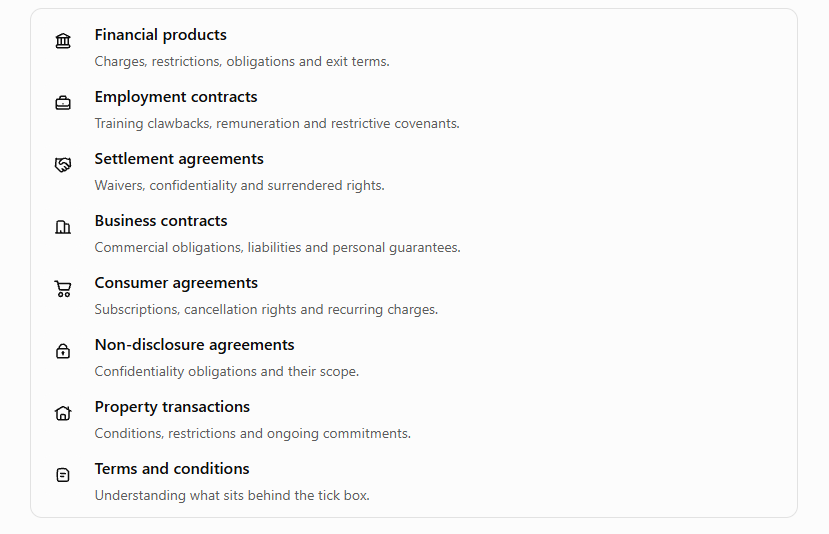
The Leveller™ does not provide legal advice, determine the enforceability of contractual terms or replace a qualified professional. AI can make mistakes, and important findings should be checked against the original document. Sensitive personal information should be removed where appropriate before submitting documents.
Its role is to help you become a more informed participant in the decisions that affect your life.
From disclosure to understanding
For decades, consumer protection has relied heavily on disclosure.
Provide the document.
Publish the terms.
Obtain the signature.
Record the consent.
But what if we measured success differently?
What if the test of effective disclosure was not whether the organisation had provided the information, but whether the individual could understand and act upon it?
| Disclosure-led model | Agency-led model |
|---|---|
| Information provided | Information understood |
| Terms accepted | Consequences explored |
| Risks disclosed | Risks comprehended |
| Consent recorded | Informed decisions supported |
| Responsibility transferred | Capability strengthened |
The Leveller™ represents a practical step towards that alternative.
At the Academy of Life Planning, we believe that technology should strengthen human agency rather than replace it.
The purpose of AI should not simply be to help organisations process more agreements, sell more products or onboard more customers.
It should also help individuals understand what they are being asked to agree to.
Institutional AI helps organisations write and process the contract. Sovereign AI helps individuals understand and interrogate it.
That is what levelling the playing field looks like.
Try The Leveller™ before you commit
The Leveller™
Read the small print. Understand the bigger picture.
Your AI-powered document understanding and decision-support tool.Launch The Leveller™
Apple iOS | Google Play | Learn more about The Leveller™ at Get SAFE
The next time someone asks you to sign a document, accept an agreement or tick a box, remember that you have another option.
You can interrogate it.
You can question it.
You can understand it.
You can decide whether it serves your interests.
The ability to do those things should not be reserved for people who can afford a legal department.
That is why we created The Leveller™.
The organisation has had the advantage of understanding the small print for centuries. Now it is your turn.
Academy of Life Planning — restoring human agency in the age of AI.
Suggested blog category: Consumer Protection & Justice.
Suggested SEO description: A poll of over 100,000 votes reveals that 85% do not always read terms and conditions. Discover how The Leveller™ uses AI to help you understand contracts, identify risks and make informed decisions before signing.

