
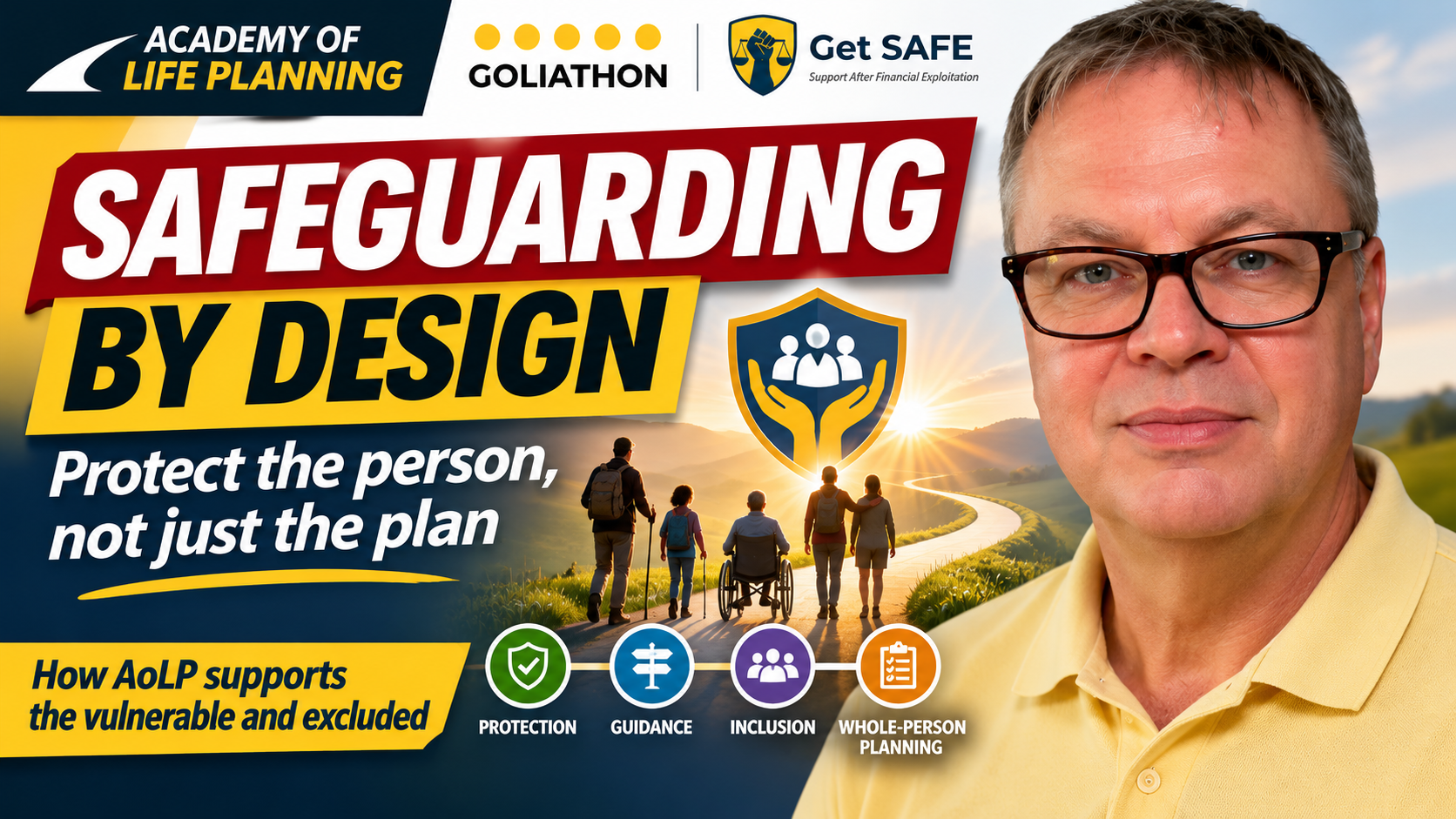
Don’t simply safeguard the delivery of an incomplete financial plan. Safeguard the person through a more complete planning methodology.
By Steve Conley, Founder, Academy of Life Planning | 25 November 2026
What happens when a financial planner tells someone approaching retirement that they do not have enough money and that there is little they can do about it?
The individual may experience fear, shame, anxiety, despair or a profound loss of hope.
The conventional response might be to ask whether the practitioner has sufficient safeguarding training to deliver that difficult news.
At the Academy of Life Planning, we ask an additional question.
Was the financial planning methodology itself a source of avoidable harm?
Was the assessment complete? Did it consider all the individual’s resources and capabilities? Did it explore alternative futures? Or did it simply project the depletion of accumulated financial capital and present the result as a verdict on someone’s life?
These are not merely questions about how we communicate financial planning outcomes.
They are questions about how we design financial planning itself.
The people who need us most
The Academy of Life Planning was established to make financial planning accessible to ordinary people, not simply those with extraordinary wealth.
We consciously seek to support people who have historically been underserved or excluded by the financial services industry.
These include:
- People with inadequate pension provision.
- People approaching later life without significant accumulated assets.
- People experiencing redundancy, divorce, bereavement or financial hardship.
- People with limited financial knowledge or confidence.
- People rebuilding their lives following financial exploitation.
- People experiencing trauma, distress and loss of hope.
- People who cannot afford conventional professional financial advice.
Through Get SAFE and our wider public-interest work, we also support individuals experiencing suicidal ideation following devastating financial losses.
These are not people we reluctantly encounter in the course of our work.
They are among the people we exist to serve.
We recognise that supporting them requires appropriate competence, professional boundaries, accessible technology, safeguarding procedures and specialist referral pathways.
That recognition has informed the development of our methodology, policies, technology and community programmes.
The danger of presenting half a financial plan
Imagine a 60-year-old approaching retirement with insufficient pension savings.
A conventional financial capital projection might establish that their accumulated assets will not sustain their anticipated retirement lifestyle.
The conclusion might be that they have left it too late.
Indeed, some contemporary retirement research uses the expression “No Way Out” to describe people without adequate pensions, property, savings or expected inheritance.
The Academy rejects this as a description of a person’s future.
Why?
Because financial capital is only one component of wealth.
Our Total Wealth framework recognises:
Total Wealth = Financial Capital + Human Capital − Liabilities
Human capital encompasses knowledge, skills, talents, experience, capabilities and productive potential. Our wider planning methodology also considers relationships, community, health, purpose and the different dimensions of well-being.
A person may have exhausted their financial capital without having exhausted their human potential.
Financial products generally concern the management, preservation, investment or distribution of existing financial resources. Their provision frequently involves fees and charges.
Human capital solutions seek to create new resources, including through productive activity, education, retraining, entrepreneurship and alternative working arrangements.
Put simply:
Financial intermediation takes fees out of people’s pockets. Human capital development can help put money into them.
Both financial and human capital matter. But an industry overwhelmingly focused on the former risks overlooking the opportunities presented by the latter.
Presenting someone with a financial capital-only projection and declaring that they have no way out is not complete financial planning.
It risks confusing the limitations of the financial model with the limitations of the human being.
We believe that presenting an incomplete assessment as a definitive verdict is a potentially harmful professional practice that should stop.
A financial shortfall is not a human shortfall
Consider two different conversations.
The first:
“Your pension will not sustain your retirement. Under these assumptions, your money will run out at age 77.”
The second:
“Under your current assumptions, there appears to be a financial shortfall. Let’s explore what you have going for you, what matters most to you, what resources remain available and what alternative futures might be possible.”
Both conversations acknowledge financial reality.
But only the second begins to explore the person’s wider possibilities.
This does not mean promising that every financial shortfall can be resolved. Health, disability, caring responsibilities, employment opportunities and other circumstances may impose significant limitations.
Nor does it mean telling everyone to work longer.
It means refusing to declare that all possibilities have been exhausted before those possibilities have even been explored.
Sometimes the way forward involves earning additional income. Sometimes it involves securing benefits, accessing community resources, adapting expenditure, exploring housing alternatives or redefining what constitutes enough.
Sometimes it involves helping someone reconnect with purpose and belonging, even where their financial circumstances cannot immediately be improved.
We do not manufacture false hope. We refuse to manufacture unnecessary hopelessness.
The Academy Safeguarding by Design Framework
Our approach operates across four complementary layers.
| Safeguarding layer | Purpose |
|---|---|
| Methodological safeguarding | Reduce avoidable harm arising from incomplete, deterministic or excessively narrow financial assessments. |
| Technological safeguarding | Adapt AI-supported planning to the individual’s circumstances, emotional readiness and support needs. |
| Operational safeguarding | Establish professional boundaries, vulnerability policies, proportionate responses and specialist escalation procedures. |
| Community safeguarding | Provide accessible, collaborative and victim-led support, particularly for people experiencing financial exploitation and loss. |
Together, these layers establish our approach to Safeguarding by Design.
Safeguarding is not simply something we introduce after a person becomes distressed.
It is something we seek to embed throughout the design of the service.
Layer 1: Methodological safeguarding
Plan the person before the money
The Academy’s GAME Plan methodology considers the individual’s Goals, Actions, Means and Execution.
We explore the life the individual wishes to create before determining how that life might be supported financially.
Our planning principles include:
- Recognising human capital alongside financial capital.
- Exploring alternative life and financial scenarios.
- Prioritising materially significant decisions.
- Distinguishing assumptions from facts.
- Avoiding deterministic language about future outcomes.
- Recognising that well-being extends beyond accumulated financial wealth.
- Preserving the individual’s authority over decisions.
Our financial projections are conditional illustrations, not predictions or verdicts.
We explore what might happen under different assumptions and help individuals understand the choices available to them.
This is fundamental to safeguarding.
A better planning methodology can reduce avoidable distress before additional safeguarding intervention becomes necessary.
Layer 2: Technological safeguarding
Adapt the planning process to the person
The Academy’s AI-supported planning tools are designed with trauma-informed principles.
An example is our Total Wealth Plan v6.0 specification, which documents the Adaptive Human Agency System.
The system distinguishes between seven situational states:
| State | Indicative planning horizon | Planning focus |
|---|---|---|
| Survival | This week | Immediate needs and stabilisation |
| Stabilisation | Three months | Financial triage and a bridge plan |
| Recovery | Six to twelve months | Resilience and rebuilding |
| Rebuild | One to three years | Direction and practical progress |
| Growth | Lifetime | Financial sustainability and execution |
| Expansion | Ten to thirty years | Contribution and impact |
| Legacy | Remaining lifetime | Meaning, succession and life integration |
These states describe circumstances, not identities.
People are not permanently classified by their wealth, vulnerability or past experiences. They can move between states as their circumstances and readiness change.
The individual participates in determining the appropriate planning approach.
One of our central technological design principles is:
Stabilise first. Plan when ready.
A person struggling to meet this week’s essential bills does not need to be confronted with a 50-year financial forecast.
They need an achievable next step, appropriate support and the opportunity to regain stability.
Our technology specification includes requirements for:
- Recognising indicators of overwhelm, shame, fear, grief, panic and exhaustion.
- Adjusting the pace, depth and timeframe of planning conversations.
- Offering opportunities to pause, skip questions or use a lighter planning mode.
- Separating personal identity from adverse financial outcomes.
- Recognising indications of severe distress and suicide risk.
- Interrupting routine planning when crisis signals arise.
- Providing appropriate crisis support information.
- Encouraging reflection before irreversible financial decisions.
- Protecting sensitive personal information.
- Maintaining a human capital inventory throughout the planning journey.
- Testing safeguarding responses when technology changes.
These are documented design requirements, with implementation and testing subject to our continuing development and quality assurance processes.
The objective is not to turn AI into a therapist or a crisis intervention service.
It is to ensure that AI-supported financial planning recognises the person behind the numbers.
Layer 3: Operational safeguarding
Protect people without removing their agency
The Academy has an established Safeguarding & Vulnerability Policy, Version 1.0, effective from 26 August 2026.
Its governing principle is that safeguarding should protect people’s well-being, wishes and control without becoming unnecessarily paternalistic.
The policy addresses:
- Recognition of vulnerability.
- Adult safeguarding.
- Financial abuse, exploitation and coercion.
- Mental capacity and decision-making.
- Proportionate adjustments to service delivery.
- Severe distress, self-harm and suicide risk.
- Specialist support and referrals.
- Confidentiality and lawful information sharing.
- Reporting and recording safeguarding concerns.
- Professional responsibilities and training.
- Concerns about people in positions of trust.
- Continuing policy review.
The Academy also has a designated safeguarding lead.
Our existing escalation framework distinguishes between three levels of response.
Level 1 — Additional support
Adapt communication, slow down, check understanding and provide appropriate assistance.
Level 2 — Material concern
Pause high-consequence decisions where appropriate, consult the safeguarding lead, obtain specialist input and consider external referral.
Level 3 — Immediate or serious risk
Contact emergency services or other appropriate authorities without waiting for internal procedures.
We recognise that financial planners are not necessarily qualified to provide mental health treatment, clinical assessments, specialist debt advice, legal services or other specialist interventions.
Our role is to recognise the limits of our competence and facilitate appropriate support.
Professional boundaries matter.
But professional boundaries should not become barriers to inclusion.
Layer 4: Community safeguarding
Helping people rebuild after financial devastation
Through Get SAFE, we work with people who have experienced financial exploitation and devastating financial losses.
For some, the loss extends far beyond money.
It can involve the destruction of confidence, identity, relationships, trust and belief in the future.
Our initiatives include:
Get SAFE
Public-interest support for people affected by financial exploitation, helping them understand their circumstances, organise evidence, identify options and restore agency.
Goliathon
AI-supported capability for people facing complex problems and powerful institutions, helping them understand information and pursue informed courses of action.
Rebuild & Thrive
Victim-led group support drawing upon our whole-person planning methodology to help people explore their remaining capabilities, reconnect with purpose and rebuild their lives.
Consumer Financial Protection Charity
Our wider charitable initiative dedicated to supporting people affected by financial harm and exploitation.
We also participate in wider support networks, including One Voice One Hope, recognising that effective support frequently requires collaboration across disciplines and organisations.
These activities complement, rather than replace, specialist mental health and crisis services.
We do not automatically exclude someone from financial and life-planning support because they are experiencing suicidal thoughts. We respond proportionately, prioritise immediate safety where necessary and recognise the importance of appropriate specialist involvement.
We believe that people experiencing severe financial distress should have access to support that helps them rebuild their lives.
Not simply be told where they can go elsewhere.
Accessibility is itself a safeguarding consideration
A service that is theoretically available but financially inaccessible does little for those who cannot afford it.
The traditional financial services industry has struggled to serve people without substantial investable assets.
Its commercial structures frequently depend upon the existence of financial capital from which remuneration can be derived.
The Academy has developed a different architecture.
Our approach combines open educational resources, accessible AI-supported applications, proportionate human expertise and charitable support.
The applications themselves are not individually priced, and AI usage costs are kept low. Through Get SAFE, we frequently cover relevant costs for people experiencing financial hardship.
Our intention is to ensure that the absence of substantial financial resources does not automatically prevent someone from developing financial understanding and planning capability.
We should not simply ask whether financially vulnerable households constitute a viable market for conventional financial advice.
We should ask whether we can design a better service model that makes their exclusion unnecessary.
Technology allows us to reconsider the economics of inclusion.
What we expect of Academy members
Membership of the Academy is an invitation to participate in a professional community committed to restoring human agency.
We expect members to familiarise themselves with our foundational principles, planning methodology, existing safeguarding arrangements and available support resources.
We expect practitioners to understand:
- The importance of human capital in financial planning.
- The potential harm of incomplete financial assessments.
- The need for accessible and compassionate communication.
- The distinction between vulnerability and incapacity.
- The importance of appropriate professional boundaries.
- The need for safeguarding awareness proportionate to their activities.
- When specialist support, referral or escalation may be necessary.
- The individual’s right to retain authority over their own decisions.
Not every Academy member is expected to specialise in complex vulnerability, trauma or financial exploitation.
Independent practitioners remain responsible for their own professional competence, safeguarding obligations and service arrangements.
However, we expect members to understand the collective purpose of the Academy and the resources available through its wider ecosystem.
We also welcome constructive challenge and evidence-based proposals for improvement.
Such proposals should begin with an understanding of the existing framework, rather than an assumption that appropriate arrangements are absent.
Our eighth foundational principle: Inclusion before avoidance
On 24 November 2026, the Academy updated its Foundational Proposition Specification to articulate an eighth foundational principle:
Inclusion before avoidance.
Financial vulnerability is not, in itself, a reason to exclude someone from financial planning.
We recognise the risks of both intervention and non-intervention, communicate difficult realities with compassion, support informed action within professional competence, and establish appropriate safeguarding and specialist referral pathways.
This principle builds upon the Academy’s established practices and makes our commitment to inclusion more explicit.
It does not mean that every practitioner must accept every engagement.
It means that the collective response of our profession to vulnerability should be to develop appropriate capabilities and pathways of support, rather than leave people without access to help.
Safeguarding should be the architecture of inclusion, not the justification for exclusion.
Safeguarding as a continuing commitment
We do not claim that any safeguarding framework eliminates every risk.
No policy, practitioner, technology platform or professional methodology can guarantee that harm will never occur.
Our responsibility is to anticipate foreseeable risks, design out avoidable harm where possible, respond appropriately when concerns arise and continue learning from experience.
That includes evaluating our technology, reviewing our policies, developing our professional capabilities and listening to the people we serve.
It also includes challenging established financial planning practices where their underlying assumptions may contribute to avoidable harm.
We believe the profession should look upstream.
Not simply at how difficult financial news is delivered.
But at whether the financial assessment is sufficiently complete, balanced and human-centred in the first place.
Conclusion: Protect the person, not merely the process
A financial model may conclude that someone’s accumulated assets are insufficient to support their anticipated retirement.
That is important information.
But it is not the whole story.
Human beings possess capabilities, relationships, experiences, aspirations and possibilities that cannot be adequately represented by a pension balance or investment portfolio.
Our responsibility is to recognise those possibilities without denying financial reality.
To communicate uncertainty without manufacturing despair.
To recognise vulnerability without removing agency.
To establish professional boundaries without abandoning people.
And to make financial planning accessible to those who have historically been excluded from it.
The Academy of Life Planning exists to restore human agency.
That mission becomes particularly important when someone has lost their financial wealth, confidence or hope.
A financial shortfall is not a human shortfall.
There may be no way out within the confines of a financial capital-only model.
That does not mean there is no way forward in life.
Don’t simply safeguard the delivery of an incomplete financial plan. Safeguard the person through a more complete planning methodology.
Learn more
Supporting Academy documentation
- Safeguarding & Vulnerability Policy, Version 1.0, effective 26 August 2026.
- Foundational Proposition Specification, Version 1.1, dated 24 November 2026.
- Total Wealth Plan App Specification v6.0, dated 25 November 2026.
Join the conversation
Are you a financial planner who believes that professional safeguarding should extend beyond the delivery of financial information to the design of the planning methodology itself?
We welcome constructive dialogue with practitioners, researchers, charities, technology developers and other professionals interested in developing more inclusive, agency-led financial planning.
Our minds remain open to evidence, challenge and improvement.
Our commitment to the people we serve remains firm.
Steve Conley BSc FCII APFS
Founder, Academy of Life Planning
Chartered Financial Planner | Chartered Insurer
Restoring Human Agency in the Age of AI.


One thought on “The Academy Safeguarding by Design Framework”