
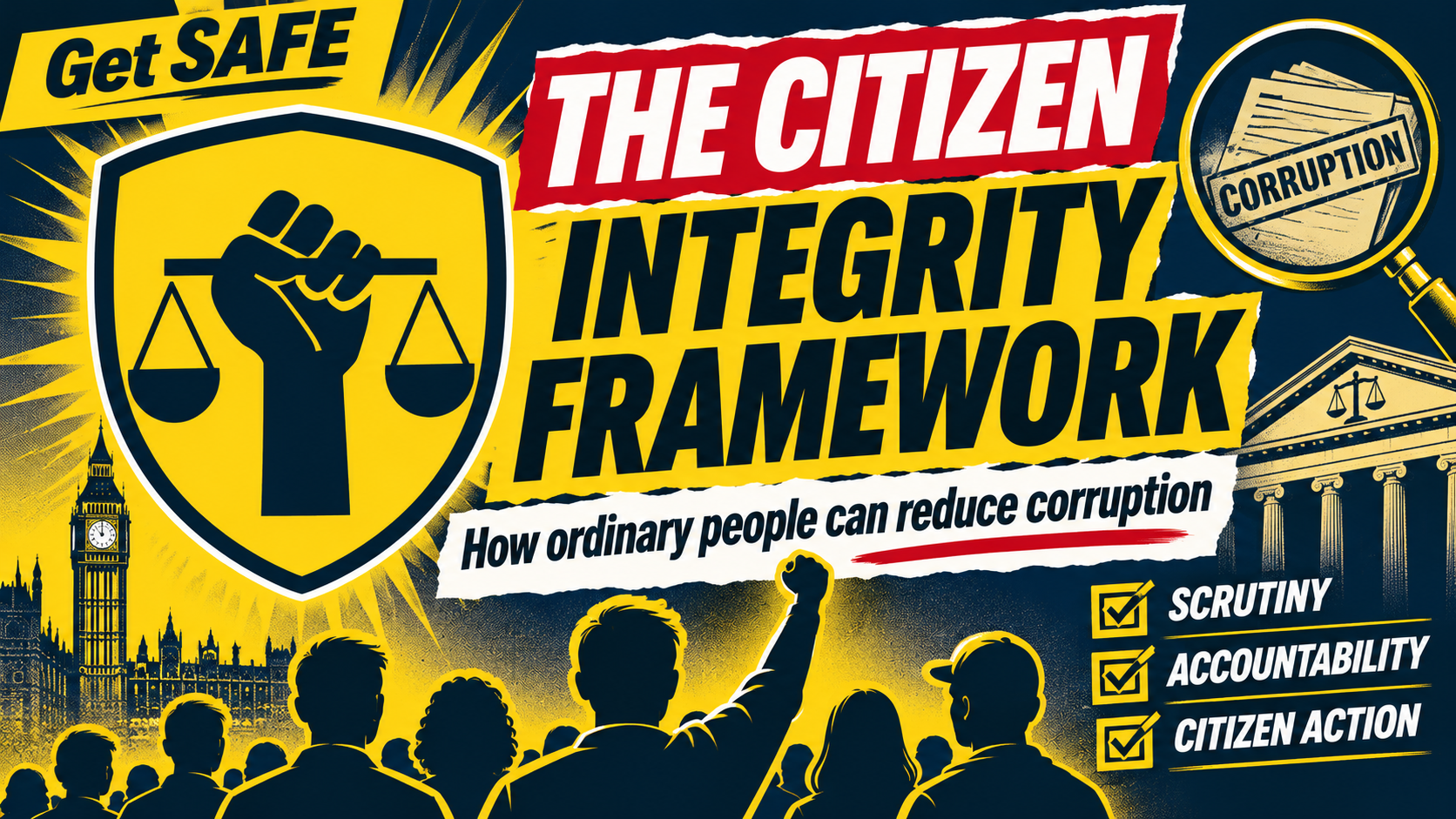
Five steps ordinary people can take to reduce corruption, challenge economic wrongdoing and restore accountability
What can ordinary people do about corruption?
It is a question many of us ask when we read about financial exploitation, organised crime, institutional failures and abuses of power.
We become frustrated. We express our outrage. We question why the authorities are not doing more.
And then, all too often, we conclude that there is nothing we can do.
But what if that sense of powerlessness is itself part of the problem?
Corruption flourishes where scrutiny is weak, accountability is fragmented, information is inaccessible and ordinary people feel unable to challenge authority.
An empowered public can help change those conditions.
We do not need to become police officers, lawyers or professional investigators. We need to become more capable citizens.
Corruption is not someone else’s problem
In July 2026, the All-Party Parliamentary Group on Anti-Corruption and Responsible Tax published its report, Cleaning Up the High Streets.
The report cites National Crime Agency estimates that at least £1 billion in criminal proceeds is laundered through British high street businesses every year.
It describes how economic crime can undermine legitimate businesses, exploit workers, deprive public services of tax revenues and weaken confidence in public institutions.
It also identifies a significant gap in public awareness and communication.
This matters because economic wrongdoing does not occur in isolation. It operates within the same communities, markets and institutions that we interact with every day.
We are customers, employees, investors, taxpayers, pension savers and voters.
Our decisions matter.
But our ability to make informed decisions depends upon our access to information, our understanding of the systems around us and our confidence to challenge what does not appear right.
Introducing the Citizen Integrity Framework
At Get SAFE, we propose a simple five-stage framework for citizen-led economic integrity.
Recognise → Verify → Document → Act → Reform
Its purpose is not to encourage vigilantism.
It is to help ordinary people exercise informed, responsible and lawful human agency in the face of suspected wrongdoing.
Stage 1: Recognise
Learn to see what might otherwise go unnoticed.
Economic wrongdoing is not always obvious.
It may be concealed behind respectable brands, professional qualifications, complex corporate structures, impressive offices or institutional authority.
We need to understand how exploitation can arise from:
- Conflicts of interest.
- Information asymmetry.
- Misaligned financial incentives.
- Opaque ownership structures.
- Misleading commercial practices.
- Abuses of positions of trust.
- Weak oversight and accountability.
- Exploitation of vulnerable people.
This is not about assuming that everyone is dishonest.
It is about recognising that trust should be supported by transparency and evidence.
A useful starting question is:
Who benefits from my not understanding what is happening?
Stage 2: Verify
Replace assumptions with evidence.
Something that looks suspicious is not necessarily unlawful.
An unusual business model, a cash-only shop, a complex company structure or an expensive financial service does not, by itself, establish wrongdoing.
We must distinguish between what we know, what we suspect and what we can demonstrate.
Ordinary citizens now have access to an extraordinary range of public information:
- Companies House records.
- Regulatory registers.
- Published company accounts.
- Public procurement records.
- Parliamentary records.
- Freedom of Information disclosures.
- Published court judgments.
- Official enforcement notices.
- Independent investigative journalism.
Artificial intelligence can help us navigate these resources, understand complex documents and formulate better questions.
However, AI can also make mistakes. Its findings must be checked against original evidence.
The purpose of verification is not to confirm our suspicions. It is to discover whether our suspicions are justified.
Be prepared to discover that you were wrong.
That is what separates responsible scrutiny from prejudice.
Stage 3: Document
Turn concerns into credible, usable information.
A suspicion expressed on social media may achieve very little.
A carefully documented account supported by original evidence may be considerably more useful.
Where it is safe and lawful to do so:
- Retain relevant correspondence.
- Preserve contracts, receipts and statements.
- Record dates and events.
- Keep copies of relevant public records.
- Identify inconsistencies between statements and evidence.
- Maintain a clear chronology.
- Separate facts from interpretations.
- Record previous attempts to resolve concerns.
Protect confidential information and respect the privacy of others.
Do not trespass, impersonate people, conduct intrusive surveillance or place yourself in danger.
You are not required to prove that a crime has occurred before reporting a genuine concern.
Your responsibility is to present what you know accurately.
Leave the verdict to the court.
Stage 4: Act
Use the legitimate mechanisms available to you.
Awareness without action rarely changes anything.
There are many ways citizens can respond responsibly to suspected economic wrongdoing.
As consumers, we can support businesses that operate transparently, request receipts, decline knowingly illicit transactions and make informed purchasing decisions.
As employees, we can seek independent guidance about whistleblowing and workplace concerns.
As investors and pension savers, we can question charges, investigate conflicts of interest and challenge misleading representations.
As citizens, we can report suspected wrongdoing, contact elected representatives, submit Freedom of Information requests and participate in public consultations.
Useful UK reporting and support channels include:
| Concern | Reporting or support channel |
|---|---|
| Suspected tax evasion | HMRC |
| Suspected organised crime | Crimestoppers |
| Unfair or illegal trading | Trading Standards via Citizens Advice |
| Corporate misconduct | Companies House and the Insolvency Service |
| Workplace whistleblowing | Protect |
| Public-sector transparency | WhatDoTheyKnow |
Where there is immediate danger, contact the emergency services.
Never confront suspected criminals or attempt to enforce the law yourself.
Where appropriate, retain reporting reference numbers, request updates and use established escalation procedures.
Reporting a concern is an exercise of citizenship, not an accusation of guilt.
Stage 5: Reform
Challenge the systems that allow wrongdoing to flourish.
Catching individual wrongdoers is important.
But what happens when the structures that enabled their behaviour remain unchanged?
Another operator may take their place.
Another consumer may be exploited.
Another business may disappear, leaving its liabilities behind.
Another institution may repeat the same failures.
We need to look beyond individual misconduct and examine the underlying enabling conditions.
Ask:
- What made this wrongdoing possible?
- What financial incentives encouraged it?
- Who was responsible for preventing it?
- Why did existing safeguards fail?
- Were there consequences for those responsible?
- What would prevent the same thing happening again?
When citizens share responsibly gathered evidence, recurring patterns can become visible.
What initially appeared to be an isolated experience may warrant investigation as a wider systemic problem.
Citizens can support independent journalism, anti-corruption organisations, public-interest research and evidence-led institutional reform.
We should measure success not simply by how many wrongdoers are caught, but by how many future victims are prevented.
The best anti-corruption system is one in which corruption becomes increasingly difficult and unprofitable.
The Citizen Integrity Framework at a glance
| Stage | Citizen capability | Intended outcome |
|---|---|---|
| Recognise | Awareness | Identify potential wrongdoing |
| Verify | Critical thinking | Separate evidence from suspicion |
| Document | Evidence literacy | Create credible records |
| Act | Civic agency | Exercise rights and raise concerns |
| Reform | Systems thinking | Reduce opportunities for future harm |
Together, these five stages provide a pathway from passive concern to responsible civic participation.
AI changes the balance of power
Historically, institutions have enjoyed a considerable information advantage over ordinary citizens.
They have had access to specialist knowledge, professional advisers, legal departments, compliance teams and sophisticated information systems.
The individual has often been left trying to understand complex documents, unfamiliar terminology and procedures that were never designed around their needs.
Artificial intelligence is beginning to change that balance.
Used responsibly, AI can help ordinary people:
- Understand the small print before signing.
- Examine corporate records and institutional statements.
- Identify questions about potential conflicts of interest.
- Organise evidence and construct chronologies.
- Draft clear, factual correspondence.
- Navigate complaint and escalation processes.
- Understand their consumer rights.
- Recognise patterns across multiple experiences.
These capabilities were once expensive and difficult to access.
They are becoming available to a much wider public.
AI cannot replace professional investigators, courts or enforcement agencies.
But it can help citizens engage with those institutions from a position of greater understanding.
The democratisation of intelligence creates an opportunity for the democratisation of accountability.
Introducing the Get SAFE citizen toolkit
Through the Academy of Life Planning’s Total Wealth Plans ecosystem, we are developing tools that can support this transition.
The Leveller™
Understand contracts, agreements and financial documents before committing. Identify potential risks, unfair terms and structural power imbalances.
The Investigator™
Support structured, evidence-led examination of financial concerns, corporate information and institutional conduct.
Goliathon™
Help individuals organise their thinking and communicate more effectively when challenging powerful organisations.
These tools are designed to strengthen human capability, not replace human judgement.
They support a wider ambition for Get SAFE: helping people protect themselves upstream of harm, as well as supporting those who have already experienced financial exploitation.
An ethical code for citizen integrity
Greater capability must be accompanied by greater responsibility.
Anyone using the Citizen Integrity Framework should commit to five principles:
- Truth before confirmation. Follow the evidence, even when it challenges your beliefs.
- Evidence before accusation. Distinguish facts, suspicions and opinions.
- Safety before confrontation. Never place yourself or others in unnecessary danger.
- Accountability before retaliation. Seek lawful remedies, not personal revenge.
- Prevention before punishment. Look for changes that reduce future harm.
Nobody should be presumed guilty because of their nationality, ethnicity, occupation, business sector or personal circumstances.
Nor should anyone be presumed trustworthy simply because of their wealth, status, professional credentials or institutional affiliation.
Apply the same standards of evidence and fairness to everyone.
From individual protection to collective resilience
Imagine a society in which more citizens understood their rights.
Where consumers routinely questioned unclear contracts.
Where employees felt supported in raising legitimate concerns.
Where institutional authority was accompanied by meaningful accountability.
Where victims of financial exploitation could recognise shared experiences without feeling isolated or ashamed.
Where public-interest organisations could help turn fragmented evidence into informed proposals for reform.
Such a society would not eliminate corruption.
But it could become more resistant to it.
Responsibility for investigating crime and enforcing the law must remain with properly resourced, accountable institutions.
Nevertheless, citizens have an important role in strengthening the environment in which those institutions operate.
What can you do today?
You do not have to investigate a major scandal or launch a national campaign.
Start with something small.
Read an agreement before signing it.
Check a company’s credentials.
Ask for a transparent explanation of charges.
Support a responsible local business.
Help someone understand their rights.
Report a genuine concern through the appropriate channel.
Share verified information rather than rumours.
Every act of informed citizenship contributes to a culture in which integrity matters.
We are also its stewards
For too long, ordinary people have been encouraged to believe that accountability is somebody else’s responsibility.
That we should leave everything to the experts, the regulators, the authorities and the institutions.
But institutional accountability and citizen agency should reinforce one another.
Get SAFE stands for a future in which people are better equipped to understand, recognise, prevent and challenge financial exploitation.
The Citizen Integrity Framework is an invitation to participate in that future.
Recognise. Verify. Document. Act. Reform.
Five steps towards a more informed, empowered and resilient society.
We cannot outsource the integrity of our society entirely to its institutions. We are also its stewards.
Join the conversation
What practical steps could ordinary citizens take to make economic wrongdoing harder to conceal and less profitable?
What tools, education and safeguards would help people exercise their rights with greater confidence?
The Citizen Integrity Framework is an evolving proposition. We welcome constructive challenge, alternative perspectives and contributions from citizens, professionals, researchers and public-interest organisations.
Together, we can build capability upstream of harm.
Get SAFE — restoring human agency in the face of financial exploitation.
Source: All-Party Parliamentary Group on Anti-Corruption & Responsible Tax, Cleaning Up the High Streets, July 2026.
The Citizen Integrity Framework is a Get SAFE proposal inspired by the wider challenges of economic crime, financial exploitation and institutional accountability. It is not an official government framework and does not constitute legal advice.

