
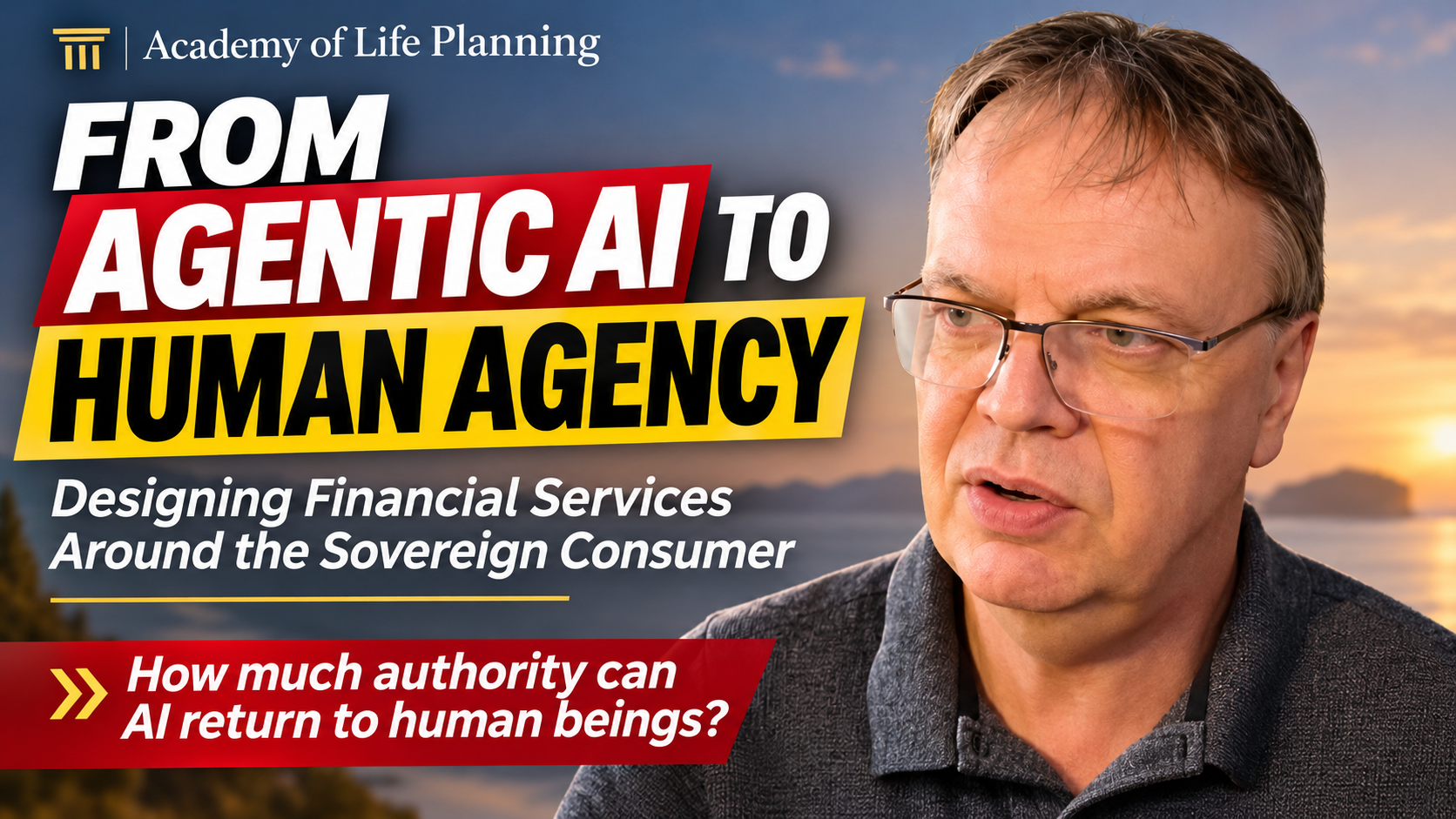
The Academy of Life Planning launches a new policy initiative to put human sovereignty at the heart of AI-enabled financial services.
The financial services industry is asking an increasingly important question:
How much authority can we safely delegate to artificial intelligence?
At the Academy of Life Planning, we are asking a different question:
How much authority can artificial intelligence help us return to human beings?
The distinction may define the future of financial services.
Today, 24 November 2026, the Financial Conduct Authority (FCA) published an update on its approach to agentic AI, announcing plans for a dedicated Agentic Policy Sprint to bring together financial services firms, policymakers and technology providers.
We welcome this initiative and are seeking to contribute to the conversation.
We have also developed a public policy discussion paper:
From Agentic AI to Human Agency: Designing Financial Services Around the Sovereign Consumer
Our aim is to ensure that the restoration of human agency becomes an explicit objective in the development of AI-enabled financial services.
Not merely an accidental consequence of technological progress.
Agentic AI is not the same as human agency
The two terms sound similar. They describe fundamentally different things.
Agentic AI concerns the ability of machines to pursue objectives, make decisions and perform tasks with varying degrees of autonomy.
Human agency concerns the ability of people to understand their circumstances, establish their own objectives, make informed choices and act upon them.
An increase in machine agency does not necessarily result in an increase in human agency.
Indeed, it could produce the opposite.
Imagine an AI system that selects your investments, manages your pension, switches your financial products and automatically moves your money.
It might be remarkably efficient.
But are you more financially capable as a result?
Do you understand your decisions any better? Can you challenge the assumptions? Can you identify conflicts of interest? Can you take back control?
Or have you simply exchanged one form of dependency for another?
The autonomy of the machine should be subordinate to the autonomy of the person.
The consumer now has AI too
For decades, financial institutions have enjoyed a considerable advantage over consumers.
They have had access to specialist knowledge, analytical tools, professional expertise and sophisticated information systems.
Consumers have often depended on intermediaries to navigate that complexity.
Artificial intelligence has the potential to change this relationship.
A consumer can increasingly use their own AI to:
- Understand complex financial documents.
- Examine the costs and assumptions behind professional recommendations.
- Explore alternative financial and life planning scenarios.
- Identify potential conflicts of interest.
- Understand contractual rights and obligations.
- Prepare questions for financial institutions.
- Recognise warning signs of potential financial exploitation.
- Maintain an independent record of their financial affairs.
The consumer no longer necessarily depends on the institution to explain the institution’s own proposition.
That is a potentially profound redistribution of capability.
And it raises an important question for every financial services business.
How will your proposition stand up to interrogation by your customer’s AI?
Three possible futures
We see three broad futures emerging for AI-enabled financial services.
| Future | Who holds the power? |
|---|---|
| Institutional dependency | Financial institutions use AI to reinforce their control over the customer relationship. |
| Algorithmic dependency | Technology platforms become the new intermediaries, controlling information, access and decisions. |
| Human sovereignty | Individuals retain meaningful authority, drawing on AI and professional expertise as required. |
All three futures could involve sophisticated technology.
All three could generate substantial commercial opportunities.
But they are not equivalent from the perspective of the consumer.
Replacing a financial intermediary with an algorithmic intermediary does not necessarily restore human agency.
It may simply digitise dependency.
We believe the third future deserves a much more prominent place in the policy conversation.
Introducing Human Agency by Design
Privacy by Design established the importance of incorporating privacy considerations into technology from the outset.
We propose a complementary principle for financial services innovation:
Human Agency by Design.
Instead of treating consumer empowerment as an incidental benefit, we should make it an explicit design objective.
When developing a financial service or AI application, we should ask whether it enables the individual to understand more, exercise greater control, explore meaningful alternatives, challenge information, access appropriate support and retain authority over consequential decisions.
We should also examine whether its commercial incentives reward the development of consumer capability or the continuation of consumer dependency.
The test of an empowering service is not how indispensable the provider becomes.
It is how capable the person becomes.
The AI Financial Agency Spectrum
Not every application of artificial intelligence in financial services performs the same function.
Our discussion paper proposes a six-level functional framework.
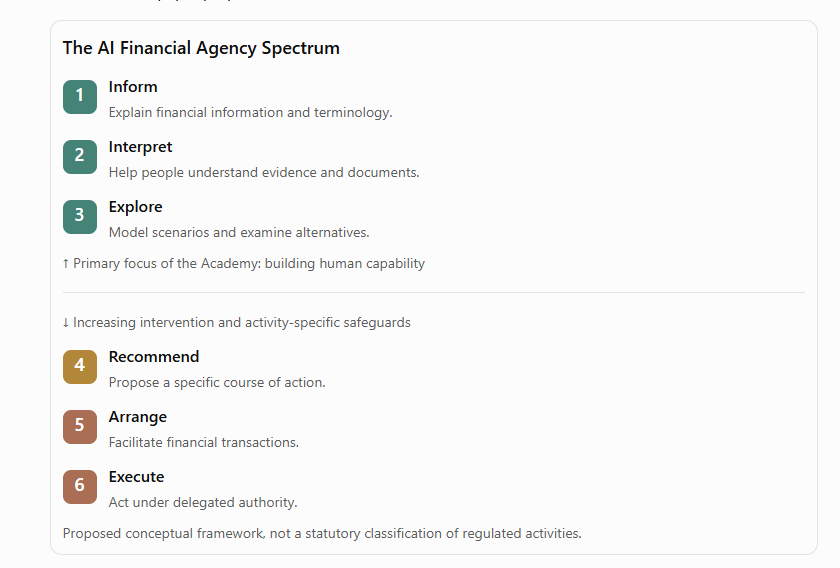
At the Academy, our primary focus is on the first three functions.
We help people understand, interpret and explore.
Where specific specialist recommendations or implementation services are required, individuals can engage the appropriate professionals.
This is not a temporary limitation while we wait for technology to become more capable.
It is a deliberate design choice.
Just because artificial intelligence can make a decision for someone does not necessarily mean that it should.
Measuring what really matters
Financial services businesses already measure assets under management, revenue, customer retention, satisfaction and transaction volumes.
But how often do they measure whether their customers have become more capable?
Our policy paper proposes a Human Agency Test, drawing on the Academy’s five capability outcomes.
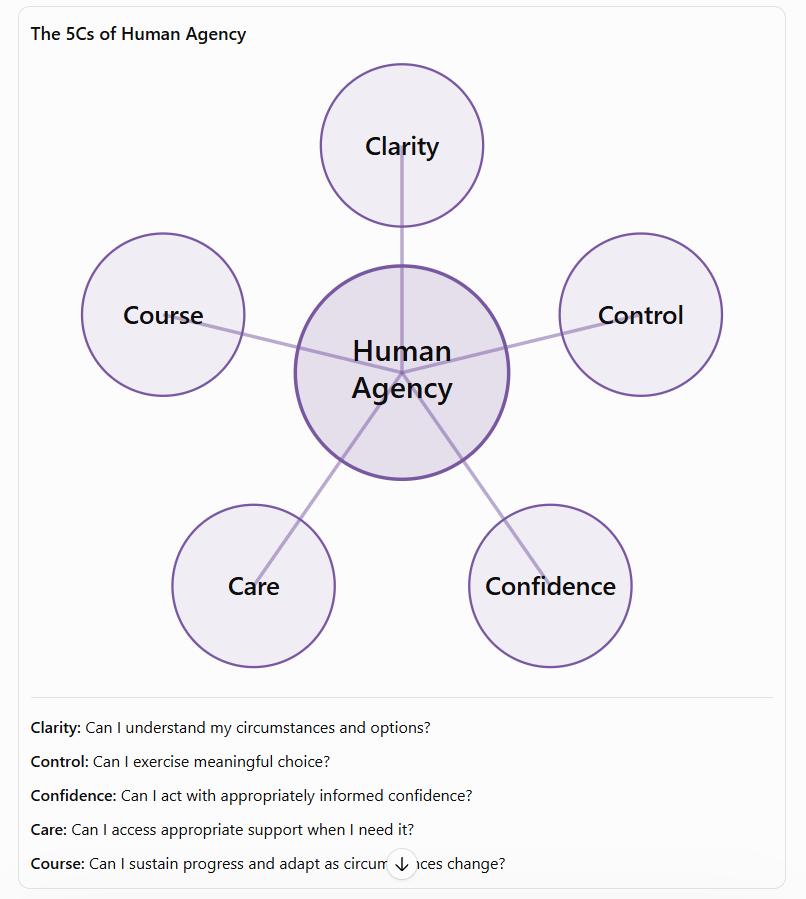
We propose developing and validating these measures through consumer research.
The question underpinning the framework is one that any financial services provider could ask today:
What can my customer understand, decide or do after receiving my service that they could not understand, decide or do before?
That is a different way of thinking about consumer outcomes.
A Sovereign Consumer Charter
Our discussion paper also proposes ten consumer entitlements for the age of artificial intelligence.
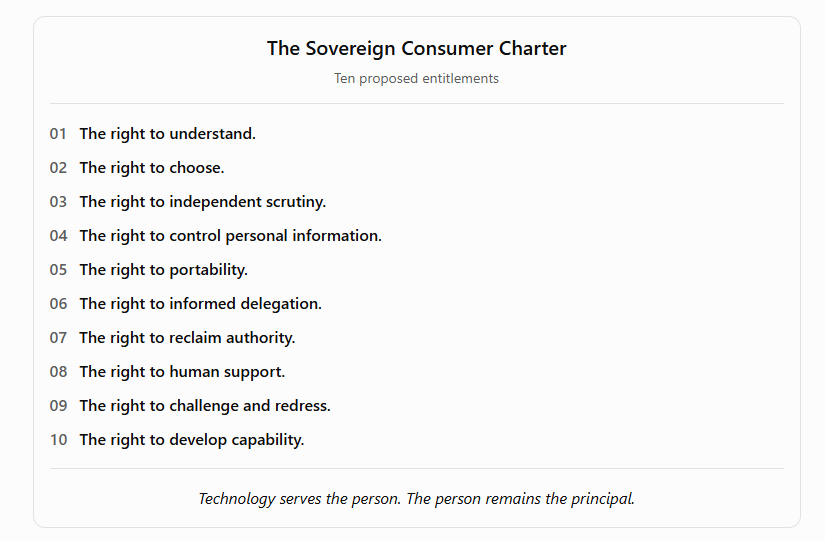
These are proposals for consultation, not a statement of existing statutory rights.
They are intended to stimulate debate across financial regulation, consumer protection, technology governance, competition policy and professional ethics.
Human sovereignty does not mean doing everything yourself
There is an important distinction between independence and isolation.
We are not suggesting that everyone should become their own investment specialist, accountant, solicitor or pension expert.
Nor are we suggesting that people should never delegate tasks to technology.
The freedom to delegate is itself an expression of human agency, provided that the delegation is informed, appropriately safeguarded and capable of being withdrawn where practicable.
Some people will require substantial ongoing support. Others will require specialist intervention only occasionally.
People recovering from financial exploitation may first need help restoring their safety, confidence and access to information before they can begin exercising greater independence.
Human agency must accommodate these differences.
Our preferred architecture is one of continuous agency with episodic expertise.
Self-directed by default. Supported when it matters.
We are building the alternative
At the Academy of Life Planning, this is not simply a theoretical policy discussion.
It is the organising principle behind the ecosystem we are developing.
The educational and public-interest movement supporting the restoration of human agency.
AI-enabled tools designed to help individuals understand their circumstances, explore alternatives and make informed decisions.
The human support layer, providing independent financial planning and access to professional expertise when required.
A lifelong record designed to help individuals retain continuity and control of their personal and financial information.
Supporting the prevention of financial exploitation and the restoration of human agency following harm.
The intention is not to create another closed ecosystem to which consumers become attached.
It is to develop a practical example of how financial planning, technology and human expertise can be organised around the individual.
We recognise that our own services must also be held accountable against the principles we are proposing.
The Academy should not ask of others what it is unwilling to demonstrate itself.
Contributing to the FCA’s Agentic Policy Sprint
We are seeking to participate in the FCA’s forthcoming Agentic Policy Sprint.
Our proposed contribution focuses on consumer capability, sovereignty and decision authority.
We would welcome a cross-industry conversation about how consumer-controlled AI can interact securely with financial institutions, how delegated permissions can be controlled, how accountability and redress can be maintained, and how consumer capability can become an observable outcome of financial services innovation.
We also believe that independent, non-intermediating financial planning models deserve consideration alongside traditional financial services business models.
The future of finance should not be designed exclusively around the business models of its existing participants.
It should also be designed around the needs, aspirations and capabilities of the people it exists to serve.
Our participation is not yet confirmed, and our proposals should not be interpreted as having received FCA endorsement.
An open invitation to challenge our thinking
We are publishing our discussion paper as a contribution to an emerging conversation.
We welcome constructive challenge from regulators, policymakers, financial planners, technology developers, academics, consumer representatives and members of the public.
Which principles would you challenge?
What have we overlooked?
How should we measure human agency?
Where might greater automation genuinely improve people’s lives?
Where might it undermine their independence?
And how do we ensure that people who need greater support are not excluded from the benefits of technological progress?
Our minds are not closed to alternative perspectives.
The frameworks we have proposed require research, testing, consultation and refinement.
We are not claiming to have all the answers.
We are inviting others to help design a better system.
The individual is the principal
The future of financial services will not be determined solely by the intelligence of its technology.
It will also be determined by the distribution of power between institutions, technology platforms and human beings.
We could build increasingly intelligent institutions.
We could build increasingly autonomous machines.
Or we could use these extraordinary advances to build increasingly capable human beings.
These outcomes need not be mutually exclusive. But the third should be an explicit objective of the first two.
The individual is not merely a customer, a risk profile, a portfolio, a source of data or a collection of transactions.
The individual is the principal.
Everything else should serve that principle.
As the financial services industry considers how much authority it can safely delegate to artificial intelligence, we invite it to consider a complementary question.
How much authority can artificial intelligence help us return to human beings?
That is the future we want to help build.
Read our policy discussion paper
From Agentic AI to Human Agency
Designing Financial Services Around the Sovereign Consumer
Steve Conley | Academy of Life Planning24 November 2026 | Version 1.0 | Draft for Consultation
Download the full policy discussion paper (PDF)
Further reading: FCA – Our approach to Agentic AI.
About the author
Steve Conley is the founder of the Academy of Life Planning, a Chartered Financial Planner, Chartered Insurer, former Head of Investments at HSBC UK and Ambassador for the Transparency Task Force.
His work focuses on restoring human agency through independent financial planning, consumer education, artificial intelligence and the prevention of financial exploitation.

