
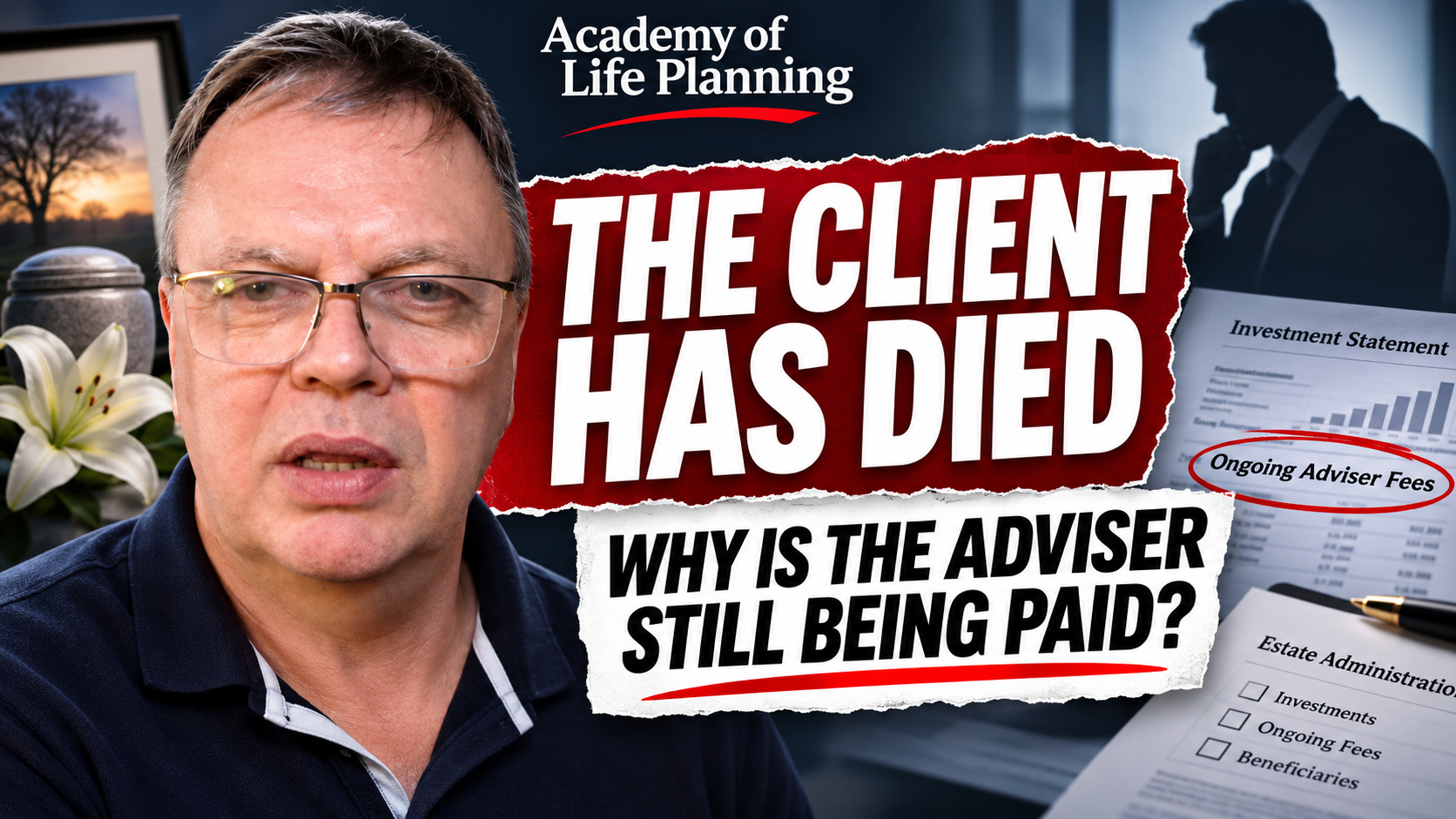
The FCA says ongoing advice fees must stop when the service ends. But its findings raise a bigger question: why should anyone have to die before we question whether recurring fees are justified?
By Steve Conley, Founder, Academy of Life Planning | 23 November 2026
A family loses someone. The fees continue.
Imagine losing your husband, wife, father or mother.
You are grieving. You are arranging a funeral. You are trying to understand their finances, locate documents, contact institutions and work out what happens next.
Among those institutions is a financial advice firm.
Your loved one had investments. They paid an adviser an ongoing fee, perhaps calculated as a percentage of the money invested.
The adviser provided a service to your loved one. But your loved one is no longer alive.
And yet the fees continue.
You might reasonably ask a simple question.
Who is receiving the advice now?
It turns out this is not merely a hypothetical concern.
On 23 November 2026, the Financial Conduct Authority (FCA) published findings from its review of how financial advisers, wealth managers and investment platforms support families following bereavement.
Among the problems it identified were cases where ongoing advice fees continued to be deducted until an original death certificate was provided.
The FCA’s position is unambiguous:
“Ongoing advice fees must stop when the related service is no longer being provided to the customer who has passed away.”
That sounds obvious.
So why did the regulator need to say it?
What the FCA discovered
The FCA examined bereavement procedures, firm records and 36 case summaries. It also considered information covering the period from 1 May 2025 to 30 April 2026.
Its findings were mixed.
Some financial advisers provided thoughtful, personal support. Others had arrangements that created unnecessary difficulties for grieving families.
The regulator identified problems including:
- Advice fees continuing after the service had ceased.
- Families being required to provide original death certificates before charges were stopped.
- Confusing or contradictory communications.
- Unnecessary paperwork and delays.
- Poor explanations of continuing charges.
- Firms relying on low complaint numbers as evidence that their bereavement services were working.
The regulator also found that the median processing time was 88 days among firms’ shortest bereavement cases and 1,178 days among their longest cases.
That latter figure is more than three years.
Of course, probate, complex investments and circumstances outside a firm’s control can cause substantial delays. The figures do not establish that every long case involved poor service.
But they do illustrate the difficulties some families face when trying to settle an estate.
And according to research cited by the FCA, only 47% of bereaved customers felt they had received the support they needed from financial firms.
The concern is not simply administrative inefficiency.
It is what happens when an institution’s processes become more important than the people those processes are supposed to serve.
Not all fees should stop after death
There is an important distinction here.
An investment platform may still hold assets belonging to the estate. An investment manager may still be managing investments. There may be legitimate administrative work to perform.
Charges for those continuing services may be justified.
The FCA is not saying that every charge must automatically cease when a customer dies.
It is saying that firms must explain which charges continue, why they continue, what services are being delivered and whether those charges represent fair value.
They must also establish an appropriate contractual or other legal basis for charges relating to work after death.
An investment remaining in place is not, by itself, evidence that personal financial advice is continuing.
That distinction matters.
Because it exposes something much more interesting about the financial advice industry’s business model.
When does a fee become detached from its service?
Consider two different ways of paying a professional.
You engage a solicitor to prepare a will. The solicitor completes the work and sends an invoice.
You engage an accountant to prepare your tax return. The accountant completes the work and charges for it.
You engage a financial planner to help you understand your future, explore your options and develop a financial plan.
The planner completes the work and charges for it.
In each case, the relationship between service and payment is reasonably clear.
Now consider an alternative arrangement.
The financial adviser charges 1% of your investments every year.
If you have £500,000 invested, that is £5,000 annually.
If your portfolio grows to £750,000, the fee becomes £7,500, assuming the same percentage continues to apply.
The adviser may provide valuable ongoing services. Some clients will appreciate the reassurance, monitoring and professional judgement available through that relationship.
But there is a fundamental difference between the two commercial arrangements.
In the first, payment is visibly connected to a particular piece of work.
In the second, payment is connected to the value of an asset.
The investment portfolio can change in value without any corresponding change in the amount of work required.
And the fee can continue to be deducted through an automated process.
The mechanism that collects the money does not necessarily know whether the service is still needed, wanted or delivered.
That is the structural question raised by the FCA’s findings.
The industry has become dependent on ongoing revenue
This is not a marginal feature of the financial advice market.
The FCA has previously reported that around 80% of financial advice firms’ revenue came from ongoing advice services in 2023, up from 60% in 2016.
Recurring revenue is central to the economics of many financial advice businesses.
It makes income more predictable. It supports staffing, investment and business continuity. It can also enable advisers to maintain long-term relationships with clients.
None of those benefits is inherently objectionable.
The issue is whether the business model creates incentives that are always aligned with the client’s interests.
A client may need intensive professional help during a major life transition.
They might then need very little support for several years.
Later, a bereavement, divorce, redundancy, inheritance or retirement decision might create another need for specialist assistance.
Their need for help is episodic.
But the industry’s preferred revenue model is often continuous.
The client’s need for advice may come and go. The firm’s need for revenue does not.
That is not proof of misconduct.
It is an incentive structure worth examining.
And when fees are calculated as a percentage of investments, the commercial relationship can become even more detached from the actual work performed.
The FCA’s bereavement review provides a particularly stark illustration of what can happen when the charging arrangement outlives the service it was intended to fund.
What about the living client?
This is where I think the conversation needs to go further.
The FCA has established an important expectation concerning deceased clients.
But consider the person who is still alive.
They have received their initial advice.
Their investments are in place.
Their circumstances have not materially changed.
They are perfectly capable of understanding their financial position, reviewing their plan and recognising when they need additional help.
Do they need to continue paying for an ongoing advice relationship?
Perhaps.
Perhaps not.
That should be a decision they can make with a clear understanding of the services, costs, benefits and alternatives.
In February 2025, the FCA reported that suitability reviews had been delivered in approximately 83% of cases examined in its review of ongoing advice services. In another 15%, firms reported that customers had declined or not responded to offers of a review. In fewer than 2%, firms reported making no attempt to deliver the review.
Those findings showed that most firms in the review were attempting to deliver the contracted service.
But they did not answer a different question.
Did every client need to purchase that ongoing service in the first place?
Delivering a contracted service is one measure of professional performance.
Helping a person understand whether they need the service at all is another.
And that distinction takes us to the heart of independent financial planning.
Planning should build capability, not dependence
At the Academy of Life Planning, we believe financial planning should help people understand their lives, clarify their choices and make decisions for themselves.
We call this restoring human agency.
The starting point is the person, not their investment portfolio.
Their values. Their family. Their work. Their talents. Their health. Their relationships. Their financial resources. Their hopes for the future.
We help people explore possibilities, understand risks and uncertainties, model financial scenarios and make informed choices.
We do not select regulated investments for clients, arrange investment transactions or take responsibility for their investment suitability decisions.
Where specialist services are needed, people remain free to engage the appropriate professionals.
Our commercial model is designed around a simple principle:
Self-directed by default. Supported when it matters.
There is no requirement for a client to place investments under our management.
There is no percentage of assets we need to collect.
And no continuing investment relationship that must be maintained to justify the existence of the financial plan.
That does not mean ongoing support is never valuable.
It means ongoing support should be a choice, rather than an assumed condition of receiving professional help.
People should be able to buy a financial plan, understand it, own it and walk away.
They should also be able to return when their circumstances change.
The professional’s role is to strengthen the person’s capability, not make the person permanently dependent on the professional.
What families should ask when someone dies
The FCA’s findings also have immediate practical implications.
If you are administering an estate and the deceased person had investments or a financial adviser, it is worth establishing exactly what was being charged and why.
Ask the firms involved:
- What ongoing advice charges were in place before death?
- When were those charges stopped?
- Were any deducted after the advice service had ceased?
- What services, if any, were provided in return?
- Which investment management, platform or product charges continue, and why?
- What is the contractual or other legal basis for any additional estate administration charges?
- Are any adjustments or refunds due?
Request an itemised explanation rather than relying on a general statement that the account remains active.
The date of death, the date the firm was notified, the contractual arrangements and the services actually delivered may all be relevant when assessing disputed charges.
The FCA has not prescribed a universal refund period beginning automatically on the date of death.
But its position is clear: families should not continue paying ongoing advice fees for services that are no longer being provided.
If a firm cannot satisfactorily explain its charges, an eligible complainant may be able to pursue the matter through the firm’s complaints procedure and subsequently the Financial Ombudsman Service.
The point is not to assume wrongdoing.
It is to establish the facts and ensure the estate pays only charges that can properly be justified.
The real test of a professional relationship
There is another aspect of this story that deserves attention.
The FCA reported that firms received only two complaints for every 100 bereavement cases examined during the review period.
A business might be tempted to regard that as evidence of satisfied customers.
The FCA explicitly cautioned against doing so.
Grieving people may not have the time, energy, knowledge or confidence to complain.
Silence is not necessarily satisfaction.
And the absence of a complaint does not establish the presence of fair treatment.
That is particularly important in financial services, where firms often hold far more information than the people paying them.
A bereaved family may not know what services were promised, which fees were agreed, or whether those services continued after death.
They may simply assume that because the charges are being deducted, they must be legitimate.
But trust should not require blind faith.
A trustworthy professional relationship is one in which the client can understand what they are paying for, why they need it, and when they can stop.
That principle should apply throughout life, not merely after death.
The client has died. Why is the adviser still being paid?
The FCA’s intervention is welcome.
It reminds firms that the right to collect a fee depends on more than the existence of a charging agreement.
There must be a legitimate basis for the payment and, where it relates to an ongoing service, that service must actually be provided.
But I would like the industry to confront a more fundamental question.
Why should a client have to die before the continuing justification for their ongoing advice fees comes under scrutiny?
A living client might no longer need regular advice.
They might have developed the knowledge and confidence to manage their own financial affairs.
They might prefer to pay for professional help when a significant decision arises.
They might simply have reached a point where their financial arrangements are sufficiently straightforward that continuing advice offers little additional value.
These should be legitimate outcomes of successful financial planning.
Indeed, helping a person become more capable and independent should be recognised as a professional achievement.
Yet a business model built around retaining assets and collecting recurring fees may have little commercial incentive to encourage that independence.
That is the deeper problem.
We have built an industry in which financial independence is frequently presented as the client’s objective, while financial dependence on the adviser can remain central to the firm’s business model.
Perhaps it is time to reconsider what successful financial planning actually looks like.
Not the amount of money an adviser retains under management.
Not the recurring revenue a client generates.
Not how long a commercial relationship can be maintained.
But what the person can understand, decide and do because of the help they received.
The ultimate test of financial planning is not whether the client keeps paying the planner.
It is whether the client becomes more capable of living without one.
About the Academy of Life Planning
The Academy of Life Planning helps people understand their financial and life choices, build confidence and take control of their futures.
Our independent, whole-person planning approach focuses on financial and human capital, personal values, life goals and informed decision-making.
We provide education, financial modelling, balanced information and decision support without requiring clients to purchase investment products or place assets under management.
Self-directed by default. Supported when it matters.
If you have a financial decision to make and would value an independent conversation, book a 50-minute Strategy Meeting on Zoom for £50.
Bring us the problem, not the portfolio.
Sources
- Financial Conduct Authority, 23 November 2026: Bereaved families need support, not a battle with paperwork.
- Financial Conduct Authority, 23 November 2026: Support for bereavement: what consumer investment firms do well and need to improve.
- Financial Conduct Authority, February 2025: Review of ongoing advice services.

